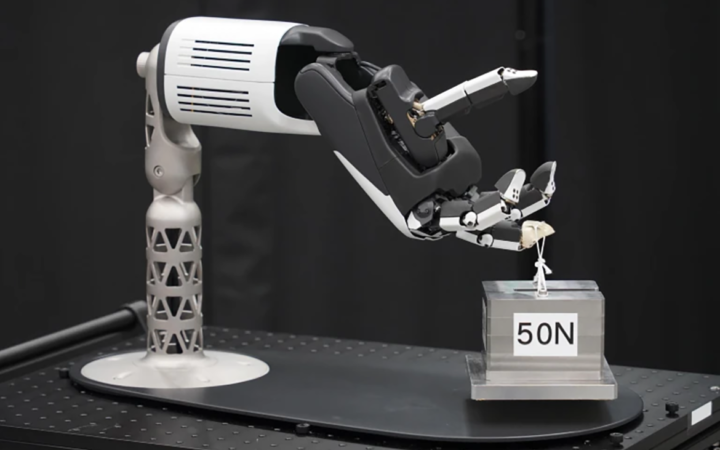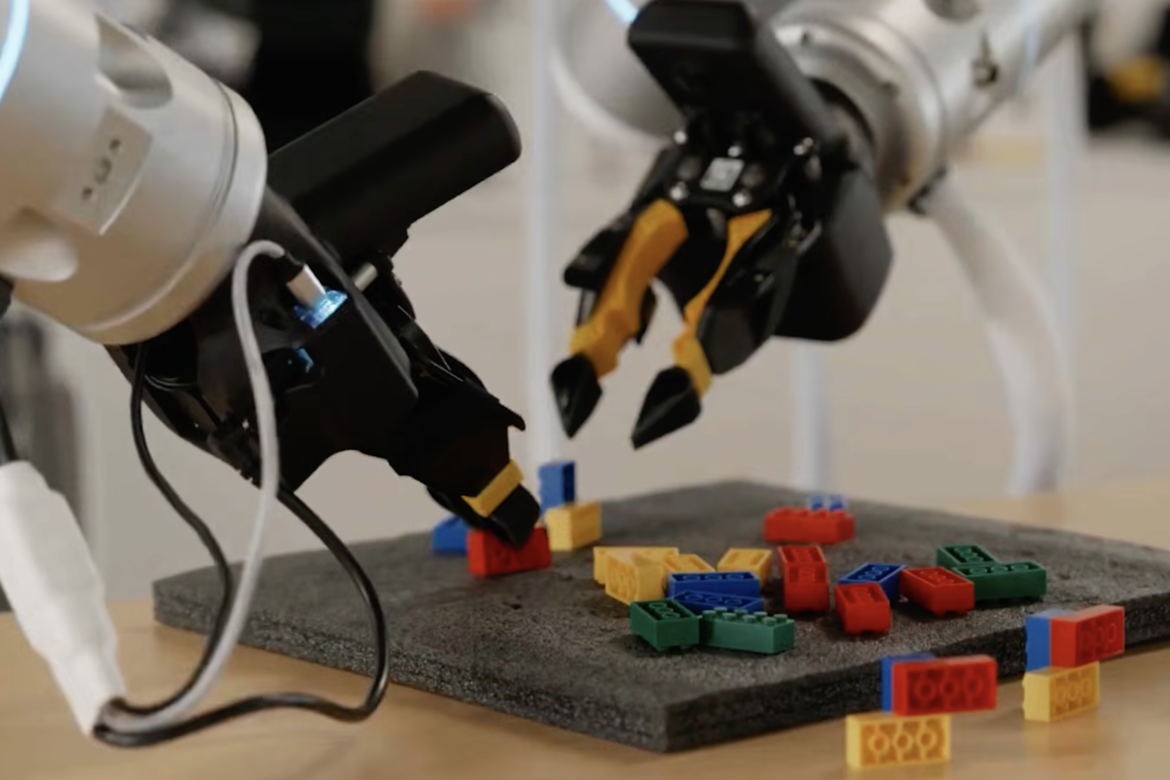
Generalist AI has released GEN-1.5, a robot foundation model that can learn new physical tasks from a single demonstration inserted into its context window – no gradient updates, no fine-tuning, no additional training of any kind. The model achieves 59% average success on new tasks from a single 3-to-12-second demonstration across 10 diverse tasks including handling zippers, opening jars, and extracting items from wallets. With 10 gradient steps on 5 minutes of data per task, performance rises to 83%.
The company describes these as the first broad one-shot and few-shot physical skill learning capabilities to emerge at scale in a robot foundation model – an analogue to what GPT-3 achieved for language in-context learning in 2020.
What GEN-1.5 Can Do
The model processes 30 seconds of rolling video memory alongside sensor, language, and proprioceptive inputs, and produces 100 Hz action trajectories. When a physical demonstration is inserted into its context window – what the team calls a physical prompt – the model performs the task immediately.
Several capabilities emerge from this architecture that were not explicitly trained in. Compositional generalization allows the model to chain two independently demonstrated tasks into a single continuous behavior, bridging the transition with intermediate repositioning and error recovery motions that appear in neither demonstration. Zero-shot sim-to-real transfer allows simulation rollouts to serve as physical prompts for real-world tasks, despite the model’s pretraining containing no simulation data. Human-to-robot imitation allows a person to demonstrate a task with their own hands in view of the robot’s cameras, with the robot reproducing it immediately using its own end-effectors.
For fine-tuning, GEN-1.5 adapts to new tasks in 1 to 10 gradient steps on 1 to 5 minutes of data. Ten fine-tuning steps change the model weights by less than 0.15%, suggesting the process reconfigures knowledge already present rather than building new representations. The team describes this as closer to test-time training than conventional fine-tuning.
Why This Is Technically Significant
The pursuit of one-shot physical skill learning traces back to the 1954 Unimate teach-by-guiding patent and MIT’s 1970 Copy Demo. Decades of prior work demonstrated various forms of in-context learning but limited to restricted task types, specific objects, or particular sensing modalities. Broad, general, closed-loop physical skill learning from a single demonstration across diverse tasks has been considered out of reach.
Generalist AI did not engineer in-context learning into GEN-1.5 through architectural choices, meta-learning loops, or auxiliary objectives. The capability emerged from pretraining on large volumes of physical interaction data collected in homes, warehouses, and factories. The company’s hypothesis is that physical work exhibits the kind of repetitive, Zipfian structure that has been linked to in-context learning in language models – allowing the model to detect and extend physical patterns in context the way language models generalize sequences.
The model has been training continuously for more than eight months, following scaling laws the company first observed leading up to GEN-0 nine months ago. Each successive generation has made new task adaptation more data-efficient, more compute-efficient, and more general.
The Practical Implication
Conventional industrial robot programming takes months and requires specialist expertise. If a robot can be taught a new task by showing it a 3-second demonstration, two things change: the time to useful deployment shrinks from months to seconds, and the prerequisite expertise disappears entirely. Anyone can show the robot what to do.
GEN-1.5’s current success rates are modest and tasks are short-horizon. But the emergence of broad physical in-context learning at this scale, without explicit engineering for it, is what the company describes as the technically significant milestone – not the performance numbers themselves. The question the team says it cannot yet answer is where the improvement curve asymptotes as pretraining continues to scale.
Disclaimer: RobotsBeat is an independent media brand owned and operated by NuvexMedia LLC, publishing news, research, and insights on artificial intelligence, emerging technologies, automation, and related industries. NuvexMedia LLC invests in and collaborates with companies across the AI, Robotics, technology, software, and digital innovation sectors. These relationships do not influence RobotsBeat's editorial coverage, and the publication maintains full editorial independence to provide accurate, timely, and objective information. © 2026 NuvexMedia LLC. All rights reserved. This content is for informational purposes only and should not be considered legal, tax, investment, financial, or other professional advice.