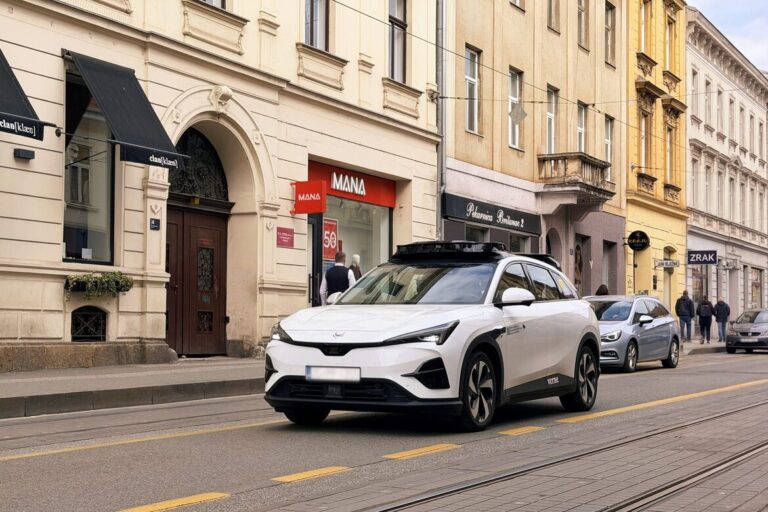

Pony.ai and Uber have announced an expansion of their strategic partnership to deploy more than 2,000 Pony.ai robotaxis across Europe, adding four cities to the existing commercial service in Zagreb and including plans to expand into the Middle East. The announcement builds on a collaboration that began in May 2025 and produced Europe’s first commercial robotaxi service in Zagreb earlier this year, where Croatian mobility company Verne operates the local fleet.
Additional European cities and deployment details will be announced in phases. The expanded partnership follows Pony.ai’s achievement of city-wide breakeven unit economics in multiple Chinese markets, where it operates paid, fully driverless robotaxi services across four tier-one cities.
We’re expanding our partnership with @Uber , with plans to deploy more than 2,000 https://t.co/xQ9peem45P Robotaxis across Europe.
Building on the commercial service in Zagreb, the partnership targets four additional European cities—taking our joint-deployment model toward… pic.twitter.com/db1X428TDs
— Pony.ai (@PonyAI_tech) August 14, 2026
The Three-Party Deployment Model
The partnership operates through a structured division of roles across three functions. Pony.ai provides its Level 4 autonomous driving technology, along with rider-experience and operational expertise developed through large-scale deployments. Uber provides customer access through its global mobility platform, covering booking, payment, and customer service, alongside its existing driver network. Day-to-day fleet operations are handled by established local fleet partners selected for each market.
The model is designed to be scalable: individual partners can take on more than one role depending on the market, and vehicle funding and ownership can sit with different parties. In Zagreb, Verne holds the fleet operator role. For the four additional European cities, local partner arrangements have not yet been disclosed.
“By combining Pony.ai’s proven autonomous driving technology and operational know-how with Uber’s global mobility platform and extensive market reach, we aim to build sustained commercial operations at scale across Europe and beyond,” said Dr. James Peng, Founder and CEO of Pony.ai.
Why This Deployment Scale Matters
More than 2,000 vehicles represents a meaningful commercial fleet rather than a pilot program. Pony.ai’s Chinese operations have validated that its unit economics can reach breakeven at city scale – a commercial milestone that most autonomous vehicle programs have not demonstrated. Applying that model to European cities through Uber’s existing customer base removes the demand-side uncertainty that has historically constrained autonomous vehicle commercial expansion.
Uber’s parallel autonomous mobility strategy includes its agreement with Waymo in the United States and partnerships with WeRide in multiple markets. The Pony.ai expansion extends that approach into European cities where Waymo does not currently operate, diversifying Uber’s autonomous vehicle partner portfolio geographically.
“The next chapter for autonomous mobility is about moving from individual launches to repeatable commercial scale,” said Sarfraz Maredia, Global Head of Autonomous Mobility and Delivery at Uber. “Together with Pony.ai, we’re building a model that can quickly and reliably expand across cities.”
Disclaimer: RobotsBeat is an independent media brand owned and operated by NuvexMedia LLC, publishing news, research, and insights on artificial intelligence, emerging technologies, automation, and related industries. NuvexMedia LLC invests in and collaborates with companies across the AI, Robotics, technology, software, and digital innovation sectors. These relationships do not influence RobotsBeat's editorial coverage, and the publication maintains full editorial independence to provide accurate, timely, and objective information. © 2026 NuvexMedia LLC. All rights reserved. This content is for informational purposes only and should not be considered legal, tax, investment, financial, or other professional advice.