
As robotics companies race to bring artificial intelligence into physical workplaces, one of the biggest challenges remains translating laboratory breakthroughs into machines capable of surviving real factory conditions.
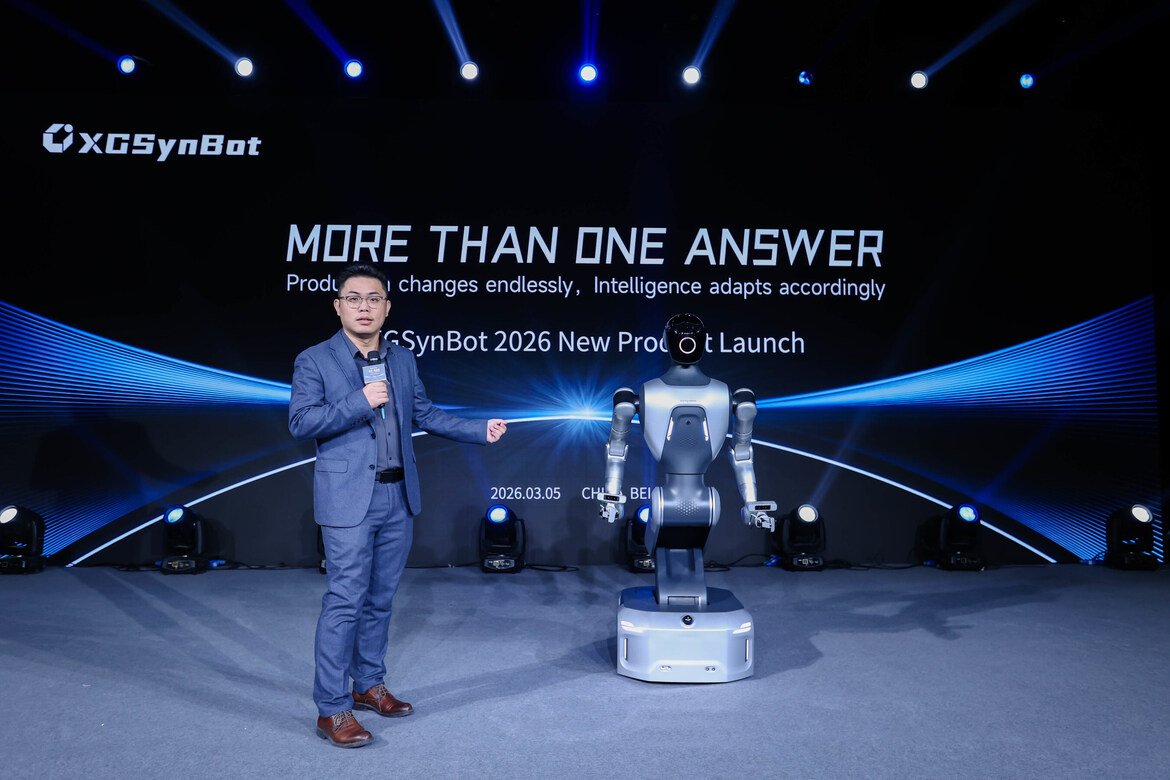
XGSynBot, a robotics company focused on embodied AI systems, has introduced a new industrial robot designed specifically to address that gap. The company unveiled its Z1 wheeled humanoid robot during a dual-city launch event held in Silicon Valley and Beijing, positioning the platform as a system built for continuous operation in manufacturing environments rather than controlled demonstrations.
The launch comes at a time when manufacturers are experimenting with more flexible automation technologies, including humanoid robots, but many of those systems remain limited to pilot programs or research settings.
Designing Robots for Real Factories
According to XGSynBot, the Z1 robot was designed around the practical constraints of industrial environments, where automation systems must operate continuously while maintaining high levels of precision.
Unlike traditional industrial robots, which are typically configured for a single task, the Z1 is designed to switch between different types of work through a modular tool interface.
The robot features a quick-change system that allows end-effectors such as grippers, welding tools, or suction devices to be swapped in under six seconds. The approach is intended to allow a single robot to move between multiple workstations rather than being dedicated to a single repetitive operation.
The company also introduced a proprietary joint module architecture that integrates motors, sensors, and mechanical components into a single unit. By consolidating these elements, the system aims to reduce latency and signal interference while improving mechanical stability.
These design choices reflect a broader shift in industrial robotics toward more adaptable machines capable of operating in varied environments rather than highly specialized automation systems.
A Dual-System Architecture for Embodied AI
At the software level, the Z1 platform incorporates a dual-system architecture inspired by cognitive science models of human decision-making.
One system focuses on high-level reasoning, allowing the robot to interpret instructions and plan tasks using AI models. A second system operates at high frequency to manage real-time motor control and tactile feedback, ensuring stable movement and precise manipulation.
The combination allows the robot to interpret complex commands while maintaining the millisecond-level responsiveness required for industrial operations.
Such architectures are becoming increasingly common in embodied AI research, where systems must integrate perception, reasoning, and physical control simultaneously.
Building an Ecosystem Around Embodied AI
Alongside the robot launch, XGSynBot announced a broader ecosystem initiative called Project STARFIRE aimed at accelerating industrial adoption of embodied AI.
The initiative focuses on three areas: collaborative development with industrial partners, open hardware interfaces that allow third-party tools to connect with the robot platform, and gradual open-sourcing of datasets and software tools.
By encouraging external developers and manufacturers to build applications on the platform, the company hopes to create a plug-and-play ecosystem for industrial robotics.
Early interest from industry partners and investors has reportedly generated potential orders worth tens of millions of dollars following the launch event.
The Manufacturing Automation Challenge
Despite rapid progress in robotics and artificial intelligence, the manufacturing sector continues to face what some researchers describe as an “automation paradox”.
Advanced robotics systems have become increasingly capable, yet many remain difficult to deploy in environments where conditions include oil, dust, vibration, and constant operation.
This gap between prototype systems and durable production robots has become one of the central challenges in embodied AI.
XGSynBot’s strategy appears to focus less on building experimental humanoids and more on designing systems capable of surviving industrial use from the outset.
What This Signals for Embodied AI
The Z1 launch highlights an emerging shift in the robotics industry from highly specialized industrial robots toward adaptable machines capable of operating across multiple tasks.
For manufacturers facing labor shortages and increasingly complex production lines, such flexibility could become increasingly valuable.
But achieving reliable performance in industrial environments remains a significant technical hurdle.
If companies like XGSynBot can deliver robots that combine AI-driven flexibility with the durability required for factory operations, embodied AI may begin to move from experimental demonstrations to everyday industrial infrastructure.