
Amazon is expanding its robotics-driven logistics network with plans to build a new AU$750 million automated fulfillment center in Brisbane, Australia, a project that highlights the growing role of robotics in large-scale e-commerce operations.
The facility, scheduled for completion in 2028, will span approximately 150,000 square meters across four levels, making it one of the largest warehouses ever constructed in Queensland. Once fully operational, the center is expected to process more than 125 million packages annually.
The investment reflects Amazon’s continued push to integrate robotics and artificial intelligence into warehouse operations as global e-commerce demand continues to grow.
A New Generation of Robotics Warehouses
Amazon’s newest Australian facility will rely heavily on robotic systems designed to assist human workers in sorting, moving, and preparing products for shipment.
Inside the warehouse, autonomous robots will transport shelving units filled with products across the floor to ergonomic workstations where employees pick items for customer orders.
One of the core systems used in Amazon’s robotics fulfillment centers is a robot known as Hercules. These mobile robots move storage pods weighing up to 500 kilograms, eliminating the need for employees to walk long distances across warehouse floors or manually lift heavy shelves.
The robots navigate the warehouse using onboard sensors and cameras while coordinating with warehouse management systems to route inventory efficiently.
To improve safety, employees working near robotic equipment wear wireless transmitters known as Tech Vests. These devices allow robots to detect nearby workers and adjust their movement accordingly.
AI and Robotics in Order Processing
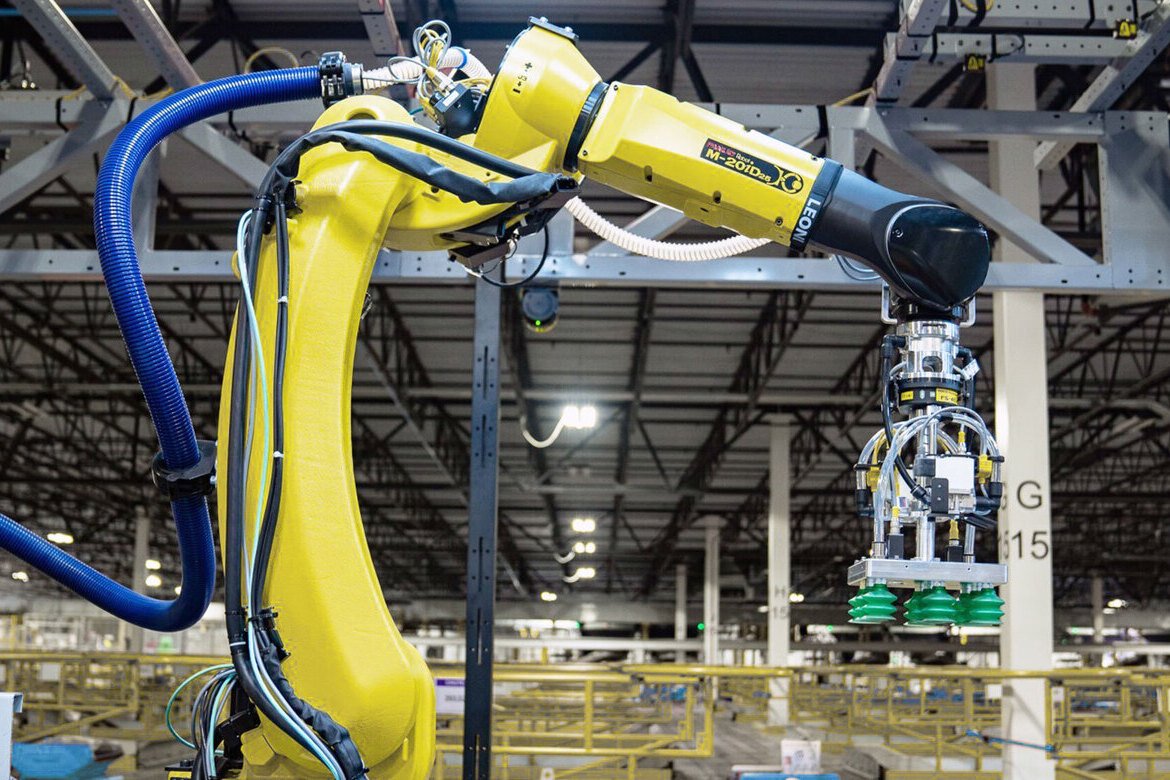
In addition to mobile robots, Amazon uses robotic arms to assist with item sorting.
A system called Sparrow uses computer vision and artificial intelligence to identify products and place them into containers that move along the fulfillment line.
The robot analyzes visual information to determine the correct item to pick and place, helping workers group items together for customer orders before they are packaged for delivery.
Such systems illustrate how robotics and AI are increasingly integrated into warehouse workflows rather than operating as standalone machines.
Human workers still perform tasks requiring judgment, quality control, and exception handling, while robots handle repetitive physical operations.
Scaling Logistics for E-Commerce
The Brisbane facility will have the capacity to store as many as 15 million small items ranging from electronics and beauty products to household goods and toys.
In addition to Amazon’s own retail operations, the warehouse will also process products sold by small and medium-sized Australian businesses using the company’s online marketplace.
When operating at full capacity, the facility’s throughput of more than 125 million packages per year would make it one of the largest logistics hubs in the region.
Amazon said the project will create more than 1,000 permanent jobs once the facility opens, while the construction phase is expected to generate roughly 2,000 additional roles.
Robotics as Infrastructure
The project highlights how warehouse robotics has become a core part of Amazon’s logistics infrastructure rather than a limited automation experiment.
Over the past decade, the company has deployed hundreds of thousands of robots across its fulfillment network worldwide. These machines support a variety of tasks including inventory transport, picking, packing, and sorting.
By combining automation with human labor, companies aim to increase warehouse efficiency while reducing physically demanding work for employees.
Amazon’s Australian expansion reflects the broader trend of e-commerce companies investing heavily in automated logistics systems to manage growing volumes of online orders.
What This Signals for Industrial Robotics
Large-scale fulfillment centers are emerging as one of the most significant real-world deployments of robotics and AI technologies.
Unlike research prototypes or pilot projects, warehouse robots operate continuously in commercial environments that require reliability, safety, and integration with complex supply chains.
As companies continue building automated logistics hubs around the world, the technologies developed for warehouse robotics are likely to influence other industries where large-scale automation is needed.
For robotics developers, the fulfillment center has become one of the most important proving grounds for real-world automation.