
XGSynBot Launches Z1 Robot Targeting Industrial Embodied AI

XGSynBot has introduced the Z1 wheeled humanoid robot designed for industrial environments, positioning the system as a flexible platform aimed at closing the gap between AI prototypes and real factory automation.

By Laura Bennett | Edited by Kseniia Klichova Published:
XGSynBot Launches Z1 Robot Targeting Industrial Embodied AI
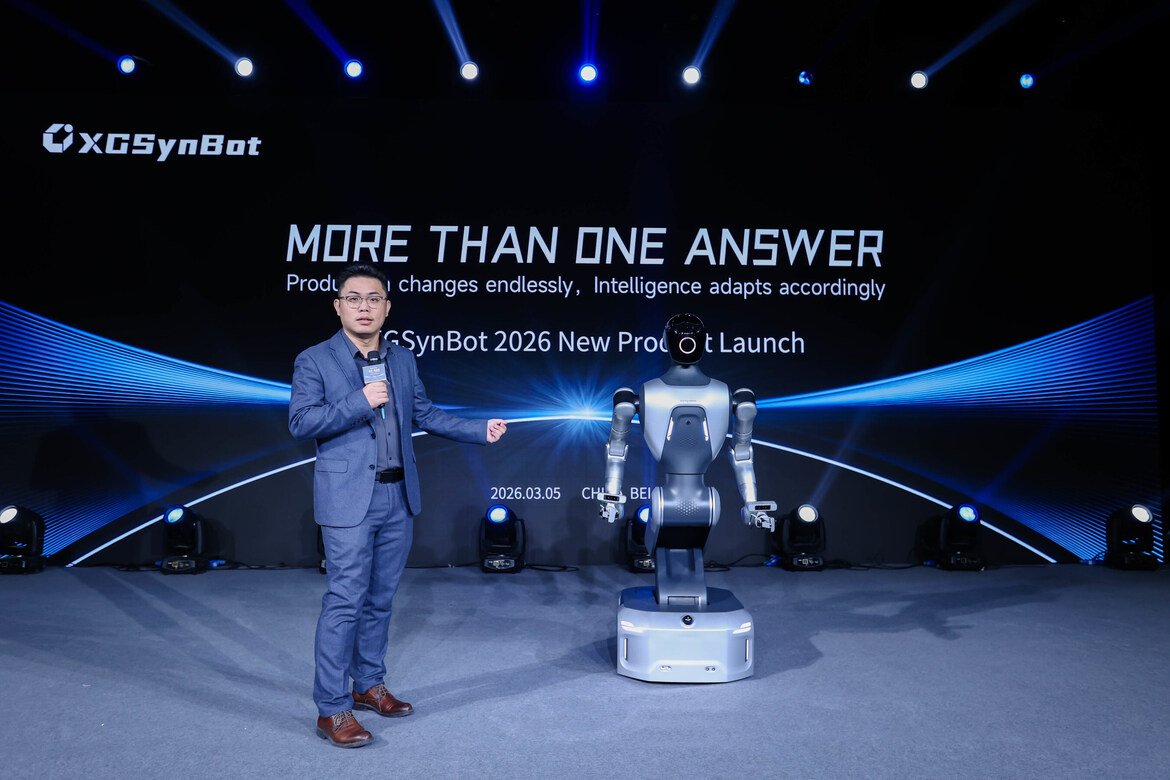
XGSynBot’s Z1 wheeled humanoid robot is designed to operate in demanding factory environments, supporting multiple industrial tasks through modular tools and embodied AI control systems. Photo: XGSynBot

As robotics companies race to bring artificial intelligence into physical workplaces, one of the biggest challenges remains translating laboratory breakthroughs into machines capable of surviving real factory conditions.

XGSynBot, a robotics company focused on embodied AI systems, has introduced a new industrial robot designed specifically to address that gap. The company unveiled its Z1 wheeled humanoid robot during a dual-city launch event held in Silicon Valley and Beijing, positioning the platform as a system built for continuous operation in manufacturing environments rather than controlled demonstrations.

The launch comes at a time when manufacturers are experimenting with more flexible automation technologies, including humanoid robots, but many of those systems remain limited to pilot programs or research settings.

Designing Robots for Real Factories

According to XGSynBot, the Z1 robot was designed around the practical constraints of industrial environments, where automation systems must operate continuously while maintaining high levels of precision.

Unlike traditional industrial robots, which are typically configured for a single task, the Z1 is designed to switch between different types of work through a modular tool interface.

The robot features a quick-change system that allows end-effectors such as grippers, welding tools, or suction devices to be swapped in under six seconds. The approach is intended to allow a single robot to move between multiple workstations rather than being dedicated to a single repetitive operation.

The company also introduced a proprietary joint module architecture that integrates motors, sensors, and mechanical components into a single unit. By consolidating these elements, the system aims to reduce latency and signal interference while improving mechanical stability.

These design choices reflect a broader shift in industrial robotics toward more adaptable machines capable of operating in varied environments rather than highly specialized automation systems.

A Dual-System Architecture for Embodied AI

At the software level, the Z1 platform incorporates a dual-system architecture inspired by cognitive science models of human decision-making.

One system focuses on high-level reasoning, allowing the robot to interpret instructions and plan tasks using AI models. A second system operates at high frequency to manage real-time motor control and tactile feedback, ensuring stable movement and precise manipulation.

The combination allows the robot to interpret complex commands while maintaining the millisecond-level responsiveness required for industrial operations.

Such architectures are becoming increasingly common in embodied AI research, where systems must integrate perception, reasoning, and physical control simultaneously.

Building an Ecosystem Around Embodied AI

Alongside the robot launch, XGSynBot announced a broader ecosystem initiative called Project STARFIRE aimed at accelerating industrial adoption of embodied AI.

The initiative focuses on three areas: collaborative development with industrial partners, open hardware interfaces that allow third-party tools to connect with the robot platform, and gradual open-sourcing of datasets and software tools.

By encouraging external developers and manufacturers to build applications on the platform, the company hopes to create a plug-and-play ecosystem for industrial robotics.

Early interest from industry partners and investors has reportedly generated potential orders worth tens of millions of dollars following the launch event.

The Manufacturing Automation Challenge

Despite rapid progress in robotics and artificial intelligence, the manufacturing sector continues to face what some researchers describe as an “automation paradox”.

Advanced robotics systems have become increasingly capable, yet many remain difficult to deploy in environments where conditions include oil, dust, vibration, and constant operation.

This gap between prototype systems and durable production robots has become one of the central challenges in embodied AI.

XGSynBot’s strategy appears to focus less on building experimental humanoids and more on designing systems capable of surviving industrial use from the outset.

What This Signals for Embodied AI

The Z1 launch highlights an emerging shift in the robotics industry from highly specialized industrial robots toward adaptable machines capable of operating across multiple tasks.

For manufacturers facing labor shortages and increasingly complex production lines, such flexibility could become increasingly valuable.

But achieving reliable performance in industrial environments remains a significant technical hurdle.

If companies like XGSynBot can deliver robots that combine AI-driven flexibility with the durability required for factory operations, embodied AI may begin to move from experimental demonstrations to everyday industrial infrastructure.

News, Robots & Robotics, Science & Tech

Beeple Installs Robot Dogs with Musk and Zuckerberg Heads at Berlin’s Neue Nationalgalerie

American digital artist Beeple has installed a group of robot dogs fitted with hyper-realistic silicone heads modeled after Elon Musk, Mark Zuckerberg, Jeff Bezos, Andy Warhol, and Pablo Picasso at Berlin’s Neue Nationalgalerie, where they roam freely and print AI-transformed images of their surroundings.

By Laura Bennett | Edited by Kseniia Klichova Published: Updated:

American digital artist Beeple, whose legal name is Mike Winkelmann, has opened an interactive installation at Berlin’s Neue Nationalgalerie featuring robot dogs fitted with hyper-realistic silicone heads modeled after some of the most recognizable figures in technology and cultural history. The dogs roam freely through the museum, carrying the likenesses of Elon Musk, Mark Zuckerberg, Jeff Bezos, Andy Warhol, and Pablo Picasso – as well as a head modeled after Beeple himself.

The work, entitled “Regular Animals”, was first shown at Art Basel Miami Beach in 2025 and is now on extended display in Berlin.

How the Installation Works

Each robot dog is equipped with integrated cameras that continuously capture images of its surroundings as it moves through the gallery. Those images are processed by AI and periodically printed – with the output filtered through the personality or aesthetic worldview of the figure each dog represents. The Picasso dog produces images in Cubist style. The Warhol dog outputs in pop art. The technology billionaire dogs reinterpret their surroundings through AI models conditioned on each figure’s public identity and worldview.

The printing mechanism is deliberately unglamorous: the dogs occasionally stop and produce the images in a manner the artist and press have described as defecating. The choice of delivery method is part of the work’s visual language.

The Commentary Behind the Hardware

Beeple has been direct about the installation’s intent. “In the past, our view of the world was shaped in part by how artists saw the world,” he told the Associated Press. “How Picasso painted changed how we saw the world, how Warhol talked about consumerism, pop culture, that changed how he saw those things.”

The figures who shape perception now, he argues, are not artists but technology executives controlling algorithmic platforms that determine what billions of people see and do not see. “That’s an immense amount of power that I don’t think we’ve fully understood, especially because when they want to make a change, they don’t need to lobby the U.N. They don’t need to get something through Congress or the EU – they just wake up and change these algorithms.”

By placing those figures’ faces on quadruped robots – hardware associated with surveillance, industrial automation, and military research – the installation draws a connection between algorithmic power and physical AI systems that is rarely made this explicitly in a public cultural setting.

Lisa Botti, the exhibition’s curator, said artificial intelligence is among the phenomena most significantly affecting daily life and that museums are the appropriate spaces for society to examine such shifts. Beeple, according to Christie’s, is the third most expensive living artist to sell at auction, after David Hockney and Jeff Koons.

Artificial Intelligence (AI), News, Robots & Robotics

LG Electronics and Nvidia in Talks on Robotics, AI Data Centers, and Mobility

LG Electronics has confirmed it is in discussions with Nvidia on potential cooperation spanning robotics, AI data center infrastructure, and mobility technologies, as both companies deepen their positions in physical AI.

By Daniel Krauss | Edited by Kseniia Klichova Published:
LG Electronics and Nvidia in Talks on Robotics, AI Data Centers, and Mobility
At CES 2026, LG introduced AI-powered living spaces spanning from homes to vehicles. Photo: LG Electronics

LG Electronics has confirmed it is in discussions with Nvidia on potential cooperation across three areas: robotics development, AI data center infrastructure, and future mobility applications. No formal agreement has been announced. The talks follow a visit by Madison Huang, a senior Nvidia executive focused on physical AI platforms, to LG Electronics and other major South Korean companies.

The confirmation positions LG as an active participant in the physical AI ecosystem at a moment when global hardware manufacturers are moving to align with leading AI platform providers across industrial, data infrastructure, and autonomous systems markets.

What Is Being Discussed

The three areas under discussion reflect distinct but converging priorities. In robotics, LG has been building out a service and commercial robotics business through its subsidiary LG Electronics Business Solutions, with cleaning, delivery, and guide robots already deployed in hotels, hospitals, and commercial buildings. A partnership with Nvidia’s physical AI stack – which includes Isaac simulation, Jetson edge compute modules, and Omniverse digital twin infrastructure – would give LG access to the training and deployment tools that are becoming standard across the humanoid and service robotics sector.

On data centers, Nvidia’s accelerated computing infrastructure is the dominant platform for AI model training and inference at scale. LG’s interest in AI data center cooperation reflects a broader shift among large electronics manufacturers toward providing AI-optimized infrastructure solutions to enterprise customers, rather than competing purely on consumer devices.

The mobility component aligns with LG’s existing investments in vehicle components and smart home-to-vehicle connectivity systems, areas where Nvidia’s DRIVE platform for autonomous vehicle computing has established significant market presence.

Strategic Context

The discussions gained public attention through the reported visit of Madison Huang to South Korean companies, a trip that signals Nvidia’s active effort to deepen physical AI partnerships in a country with significant electronics manufacturing capability and a growing robotics industry. South Korea’s government has identified robotics and AI as national strategic priorities, and companies including Samsung, Hyundai, and LG are all expanding their positions in the sector.

LG and Nvidia have not disclosed a timeline for reaching a formal agreement, the financial terms under discussion, or which specific product or platform areas any agreement would initially cover. The talks remain at an exploratory stage, though the combination of LG’s manufacturing scale and Nvidia’s AI infrastructure position would, if formalized, add a significant hardware partner to Nvidia’s physical AI ecosystem.

Kinetix AI Unveils KAI Humanoid with 115 Degrees of Freedom and 18,000-Sensor Tactile Skin

Shenzhen-based Kinetix AI has unveiled KAI, a full-sized humanoid robot with 115 degrees of freedom, a 36-DoF dexterous hand, and a full-body tactile skin system with 18,000 sensors, targeting service and home assistance applications at a sub-$40,000 price point.

By Rachel Whitman | Edited by Kseniia Klichova Published:

Shenzhen-based startup Kinetix AI held its GIFTED press conference on April 26 to unveil KAI, a full-sized humanoid robot designed for service and home assistance applications. The company, also operating as Kai Robotics, was founded by veterans of the original R&D team behind the XPENG Iron humanoid. KAI is targeting a sub-$40,000 price point and mass production in late 2026.

The platform’s specifications are ambitious across hardware, sensing, and AI architecture – though the gap between laboratory demonstration and reliable real-world deployment remains the central challenge the company will need to close before commercial scale is achievable.

115 Degrees of Freedom

The most distinctive technical claim is KAI’s 115 degrees of freedom across the full body – a figure substantially higher than the 20 to 45 DoF typical of most contemporary humanoid platforms. The articulation range includes shoulder movement, torso flexion to 75 degrees, and neck rotation across a 65-degree range, giving the robot a range of motion intended to closely approximate human flexibility.

The hands are the most mechanically complex element. Each features 36 DoF – 22 active and 14 passive joints. The passive joints act as mechanical buffers, allowing the hand to conform to objects and absorb impact forces without requiring immediate computational response. The company describes this as a safety feature for domestic use, where contact with objects and people is frequent and unpredictable.

Tactile Sensing and Battery Safety

KAI is covered in a synthetic tactile skin containing 18,000 sensing points capable of detecting forces as light as 0.1 newtons. The system enables what Kinetix AI calls haptic-aware manipulation – the ability to modulate grip force and contact behavior based on real-time pressure feedback across the robot’s surface.

Power is supplied by a 1.7 kWh semi-solid-state battery, a chemistry choice that reduces thermal runaway risk compared to conventional lithium-ion packs. The selection mirrors a broader trend among Chinese humanoid manufacturers, including XPENG Robotics, toward safer battery architectures for robots operating in proximity to people.

Data Strategy and AI Architecture

KAI’s intelligence layer is built around what Kinetix AI calls the KAI World Model, a closed-loop architecture comprising Base, Action, and Evaluation modules. The system is designed to predict environmental changes and assess the safety of candidate movement trajectories before executing them – a simulation-before-action approach that parallels techniques used across physical AI development more broadly.

To address the data scarcity problem that constrains most humanoid AI training, Kinetix AI developed the KAI Halo, a lightweight head-mounted device worn by human operators during normal daily routines. The device captures first-person video, body pose, and environmental point cloud data, generating training data from natural human behavior rather than structured motion-capture sessions. The company argues that this approach produces a more diverse and naturalistic dataset than traditional capture methods.

Market Positioning and the Reliability Question

KAI is positioned as a general-purpose helper for retail, concierge, and home assistance roles rather than heavy industrial applications. The sub-$40,000 target price is designed to be competitive within a segment where most platforms remain either significantly more expensive or more narrowly capable.

The architecture’s complexity – 115 DoF, 18,000 sensors, semi-solid-state batteries – introduces significant engineering challenges in maintaining system reliability outside laboratory conditions. XPENG’s own robotics leadership has publicly identified hardware reliability, including signal disconnection and mechanical failure rates, as a primary bottleneck for the industry. Whether KAI’s high-DoF design can sustain stable performance in the unstructured environments it targets will determine whether the platform reaches commercial deployment on its stated timeline.

News, Robots & Robotics, Startups & Venture

Humanoid Robots Close In on Human 100-Metre Sprint Record as Locomotion Advances Accelerate

Unitree’s H1 robot has recorded a peak sprint speed of 10 meters per second on an athletics track, approaching Usain Bolt’s average race speed of 10.44 meters per second, as Chinese manufacturers push bipedal locomotion toward the limits of human athletic performance.

By Daniel Krauss | Edited by Kseniia Klichova Published:
Humanoid Robots Close In on Human 100-Metre Sprint Record as Locomotion Advances Accelerate
A bipedal humanoid robot sprinting on an athletics track during a speed test, with a velocity measurement device recording peak speed. Photo: Unitree

Humanoid robots are converging rapidly on the limits of human athletic performance in sprinting. Unitree Robotics recently released footage of its H1 robot reaching a peak speed of 10.1 meters per second on an athletics track – a figure that approaches the average race speed of 10.44 meters per second Usain Bolt maintained during his 9.58-second 100-metre world record. Unitree’s CEO Wang Xingxing has publicly predicted that Chinese humanoid robots will break the 10-second barrier in the 100-metre dash by mid-2026.

The sprint developments follow the Beijing half-marathon in April, where Honor’s humanoid robot Lightning completed the 13-mile course in 50 minutes and 26 seconds – below the standing human world record by nearly seven minutes. Taken together, the results mark a rapid compression of the performance gap between human and robotic bipedal locomotion across both endurance and speed dimensions.

What the Speed Numbers Represent

Unitree’s 10.1 m/s figure was recorded as the H1 passed a speed-measuring device during a track test, with the company noting possible measurement error in the video. The robot weighs approximately 62 kilograms with a combined leg length of 80 centimeters – proportions comparable to an average adult human. MirrorMe Tech, a startup linked to Zhejiang University, has separately demonstrated a humanoid named Bolt reaching 10 meters per second on a treadmill, with an explicit design goal of approaching or exceeding the biological limits of human motion.

At 10 seconds flat for a 100-metre sprint, a humanoid robot would place within range of elite Olympic competition. The current humanoid robot 100-metre record, set at the 2025 World Humanoid Robot Games, stands at 21.50 seconds – a figure that illustrates how quickly the performance envelope is shifting.

Engineering Progress, Not Scientific Breakthrough

Researchers with deep experience in bipedal robotics caution against overstating what the speed records demonstrate. Alan Fern, a computer science professor at Oregon State University who helped develop the Cassie bipedal robot, said the basic principles of robot locomotion are not new. What changed in the past year, he argued, was engineering quality and investment volume – faster machines that hold together longer, rather than a fundamental advance in how robots learn to move.

“What changed this year was good old-fashioned engineering and investment,” Fern said. “Last year’s robots were slower, and many broke. This year’s machines were fast and held together. That is not nothing, but it is not a breakthrough either.” Yanran Ding, a robotics professor at the University of Michigan, identified heat management as the more significant engineering achievement behind sustained high-speed operation.

Jonathan Hurst, whose company Agility Robotics builds the Digit warehouse humanoid, drew a sharp distinction between track performance and operational readiness. The gap between a robot that can run a premapped course and one that can navigate safely among people in a warehouse is the gap the industry is still working to close. “It’s like looking at the first cars and being like, ‘It doesn’t fly,'” Hurst said. “It’s a pretty high bar.”

Why Speed Benchmarks Still Matter

The investment in locomotion speed serves purposes beyond athletic competition. High-speed bipedal movement requires tight integration across perception, actuation, and learned control policies – the same control stack that governs how a robot navigates dynamic environments, responds to unexpected disturbances, and maintains stability under load. Progress at the performance extremes tends to transfer into improved reliability at the operational middle.

For Chinese manufacturers, publicly demonstrated speed records also carry strategic value in a sector where national competition is explicit. With more than 150 humanoid robot companies active in China and government support tied to performance milestones, speed benchmarks function as both technical validation and competitive positioning.

News, Robots & Robotics

AtkinsRéalis and Oxford Robotics Institute Partner to Deploy Autonomous Robots in Nuclear Sites

AtkinsRéalis and the University of Oxford’s Oxford Robotics Institute have formed a partnership to commercialize autonomous inspection and manipulation robots for nuclear decommissioning and energy sector applications, building on deployments already active at Sellafield.

By Laura Bennett | Edited by Kseniia Klichova Published:
AtkinsRéalis and Oxford Robotics Institute Partner to Deploy Autonomous Robots in Nuclear Sites
An autonomous mobile robot conducting inspection and radiation mapping in a hazardous industrial facility, operating without direct human presence in the environment. Photo: AtkinsRéalis

AtkinsRéalis, the engineering and project management firm, has formed a partnership with the University of Oxford’s Oxford Robotics Institute to accelerate the deployment of autonomous robots in nuclear and wider energy sector environments. The collaboration formalizes and scales a body of work already active in the UK, where ORI-developed systems have been integrated into AtkinsRéalis platforms for autonomous navigation, mapping, and radiation hotspot detection at nuclear sites including Sellafield.

The partnership’s initial focus is on converting those proven UK deployments into commercial products available to international customers. Systems currently operating as mobile inspection vehicles and manipulation platforms will be refined in ORI’s laboratory infrastructure before transitioning into field-ready applications through AtkinsRéalis’ nuclear engineering capabilities.

Why Nuclear Is a Demanding Test Environment

Nuclear decommissioning and inspection represent one of the most constrained deployment contexts in industrial robotics. Human access is limited by radiation exposure limits, physical endurance, and safety protocols that restrict time on-site. Autonomous robots that can navigate, map, and detect radiation anomalies without continuous human presence directly address those constraints, extending operational capability into areas and durations that human crews cannot sustain.

Reducing personnel exposure to hazardous conditions is the core operational driver. Beyond safety, autonomous systems can potentially accelerate decommissioning work that would otherwise be paced by human radiation limits – a meaningful economic consideration given the multi-decade timescales and substantial costs associated with nuclear site closure programs.

The partners described the work as part of the emerging field of physical AI – the coupling of simulation, AI-enabled perception, decision-making, and real-world validation to enable reliable autonomous operation in safety-critical environments.

AtkinsRéalis’ Broader Robotics Ecosystem

The ORI partnership extends an ecosystem AtkinsRéalis has been assembling across robotics and AI over the past year. The company has a proposed trial of remote robot operation with Sellafield Ltd, an extended partnership with Canadian robotics manufacturer Kinova, and an active collaboration with NVIDIA on simulation and autonomy tools. Together, these alliances position AtkinsRéalis as an integrator across the physical AI stack for nuclear applications – from simulation and perception to manipulation hardware and regulatory compliance.

The deal gives AtkinsRéalis deeper access to ORI’s academic research and specialist testing infrastructure in perception, navigation, manipulation, and digital twin development. First public demonstrations of related technology in the UK are expected in the coming months as trials with nuclear site operators progress.

“This partnership allows us to rapidly move autonomous robotics from research to operational deployment on nuclear power plants around the world,” said Sam Stephens, head of digital for AtkinsRéalis’ nuclear division.

The longer-term objective is a validated suite of autonomous inspection and manipulation platforms deployable across decommissioning, operations, and monitoring tasks at nuclear sites internationally – a market where regulatory requirements, site-specific complexity, and safety standards create high barriers to entry but also durable demand for proven systems.

Business & Markets, News, Robots & Robotics, Science & Tech