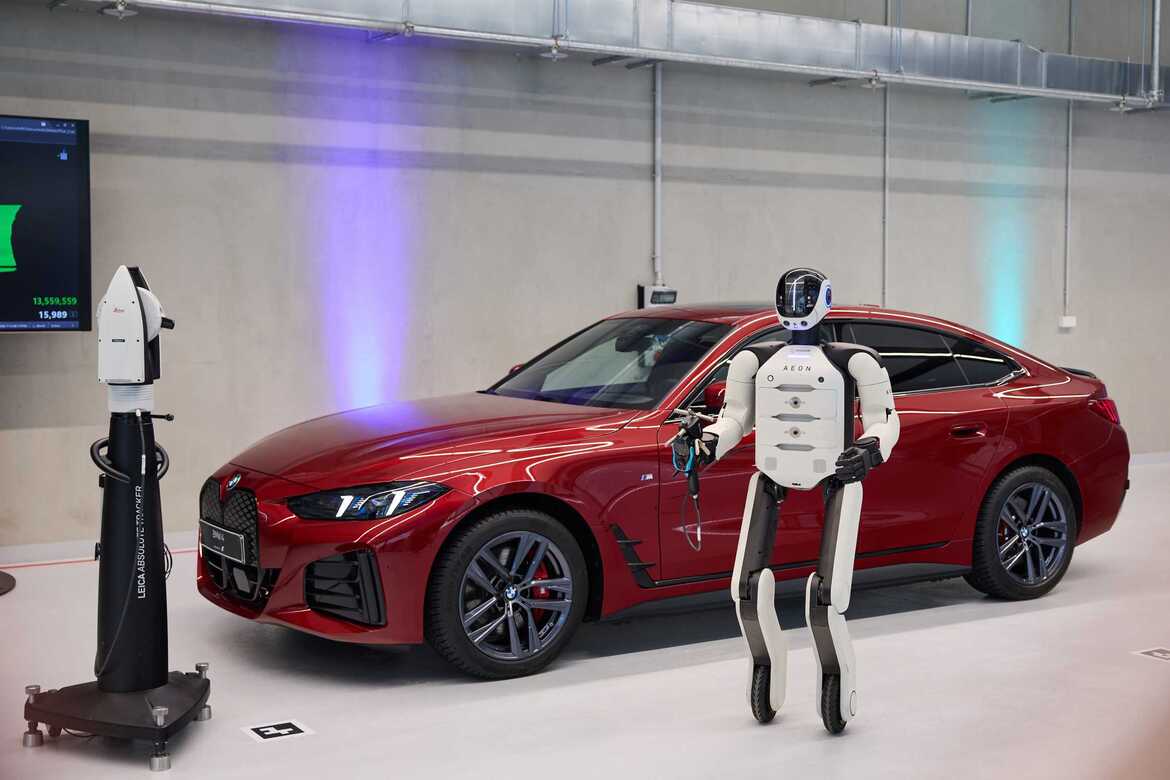
BMW Group has begun testing humanoid robots in its Leipzig manufacturing plant, marking a new phase in the company’s effort to integrate artificial intelligence and robotics into automotive production. The pilot program introduces the AEON humanoid robot, developed with Hexagon’s robotics division, to assist with complex assembly tasks in battery manufacturing.
The deployment represents the first European test of BMW’s broader “physical AI” strategy, which combines advanced artificial intelligence with real-world robotics systems capable of operating on factory floors.
The company is evaluating whether humanoid robots can automate physically demanding and repetitive production processes as electric vehicle manufacturing becomes increasingly complex.
Humanoid Robots Enter Battery Production
The AEON robot is being tested for tasks related to high-voltage battery assembly and component manufacturing. In these roles, the system uses modular gripping tools, scanning sensors, and mobile locomotion to handle materials and support assembly workflows.
Battery production involves heavy components and precise placement operations, making it a potential candidate for robotic assistance. BMW is particularly interested in determining whether humanoid robots can operate across multiple production stages rather than performing a single specialized task.
According to BMW production executives, the goal of the Leipzig pilot is to evaluate the robot’s ability to perform multifunctional tasks across various parts of the manufacturing process, including energy module assembly and exterior component production.
The project follows earlier experiments at BMW’s Spartanburg facility in the United States, where humanoid robots were tested in live factory environments.
Simulation and AI Accelerate Robot Training
The AEON system was developed using a simulation-first approach. Much of the robot’s training occurred in virtual environments before deployment in the real world.
Using NVIDIA’s robotics simulation platforms, engineers trained the robot to perform navigation, locomotion, and manipulation tasks within digital factory models. This approach significantly reduces the time required to develop new robotic capabilities.
Once trained in simulation, the robot’s learned behaviors can be transferred to physical hardware. This process allows engineers to refine motion control and task planning before exposing the robot to real manufacturing conditions.
The system runs on NVIDIA Jetson edge computing hardware, which processes sensor data and supports real-time decision-making on the production floor.
Multimodal Sensors Enable Industrial Awareness
AEON integrates a combination of cameras, scanners, and spatial sensing systems that allow it to understand its environment and interact with industrial equipment.
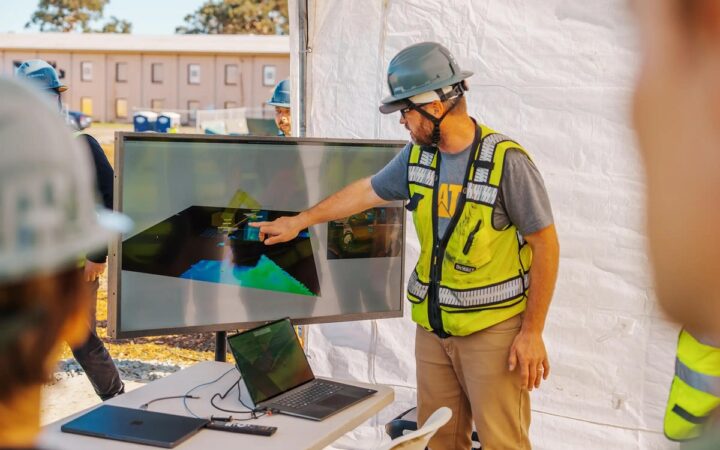
These sensors capture high-resolution data from the factory floor and upload it to cloud-based digital twin platforms. Engineers can then analyze the data using 3D models that replicate the physical production environment.
By connecting the robot to digital twin infrastructure, BMW and Hexagon can monitor operations remotely and adjust robot behavior through software updates.
The system also uses machine learning models that learn from human demonstrations and synthetic training data, enabling the robot to acquire new skills more quickly than traditional industrial robots.
Automakers Explore the Future of Physical AI
BMW’s humanoid robot pilot reflects a broader trend across the automotive industry. Car manufacturers are increasingly exploring humanoid robotics as a way to automate labor-intensive production tasks.
Humanoid robots offer potential advantages over traditional industrial robots because they can operate in environments designed for human workers, using existing tools and workstations without major infrastructure changes.
At the same time, the technology remains in an early stage of deployment. Automakers are testing whether humanoid systems can meet the reliability, safety, and productivity standards required for large-scale manufacturing.
BMW has also established a new Center of Competence for Physical AI in Production to coordinate research and development across its global manufacturing network.
If the Leipzig pilot proves successful, humanoid robots could eventually become a regular presence on automotive production lines as manufacturers continue to integrate AI-driven automation into modern factories.
Disclaimer: RobotsBeat is an independent media brand owned and operated by NuvexMedia LLC, publishing news, research, and insights on artificial intelligence, emerging technologies, automation, and related industries. NuvexMedia LLC invests in and collaborates with companies across the AI, Robotics, technology, software, and digital innovation sectors. These relationships do not influence RobotsBeat's editorial coverage, and the publication maintains full editorial independence to provide accurate, timely, and objective information. © 2026 NuvexMedia LLC. All rights reserved. This content is for informational purposes only and should not be considered legal, tax, investment, financial, or other professional advice.