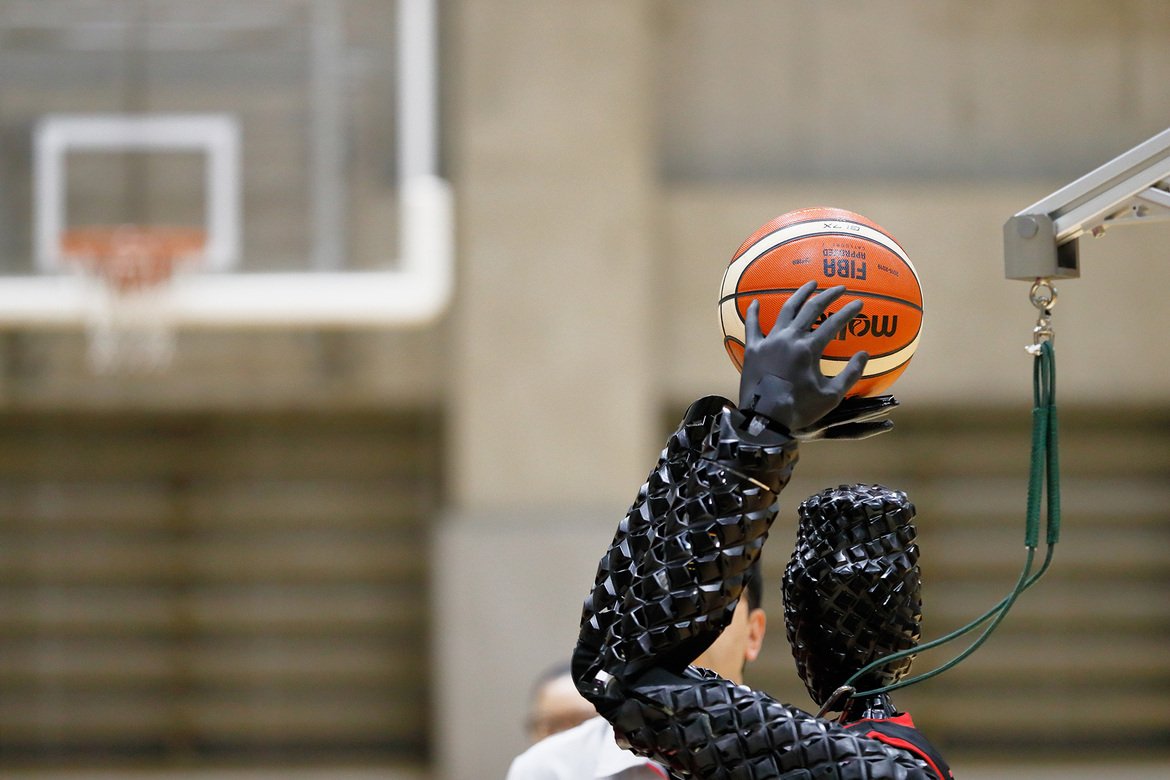
Toyota has unveiled CUE7, the seventh generation of its basketball-shooting robot platform, on April 12. The system marks the most significant technical upgrade in the CUE series to date, with reductions in weight, a new mobility architecture, and a hybrid AI control system that combines reinforcement learning with model predictive control.
The robot was developed by Toyota’s Frontier Research Center and signals the company’s continued investment in embodied AI research outside its traditional automotive domain.
What Changed in CUE7
The most immediate change is physical. CUE7 weighs 74 kg, down from 120 kg in its predecessor – a reduction of nearly 40%. The wheeled base has been redesigned around an inverted two-wheel structure, replacing the earlier fixed-platform approach and giving the robot greater dynamic stability during motion.
The control architecture is also new. Rather than relying on a single AI method, CUE7 uses a hybrid system that combines reinforcement learning – where the robot improves through repeated trial and feedback – with model predictive control, which uses forward simulation to plan and execute precise movements in real time. The result is a platform capable of more dynamic, fluid motion than earlier versions of the robot.
CUE7 uses vision systems to identify the basket, estimate distance, and calculate shot trajectory. Its upper body makes deliberate postural adjustments to align the release angle before executing the shot with calibrated force.
A Platform Built Over Years
The CUE project began as an internal employee initiative before becoming a dedicated research program. CUE3 set a Guinness World Record in 2019 by completing 2,020 consecutive free throws. CUE6 extended the platform’s range, completing a 24.55-meter shot during a record attempt.
Each iteration has expanded the robot’s operational scope. Early versions were stationary shooters. Later models introduced mobility, ball retrieval, and dribbling. CUE7 advances the underlying control and sensing systems rather than adding new physical tasks, consolidating the platform’s technical foundation.
The Broader Purpose
Toyota uses the CUE series as a testbed for capabilities with direct relevance to general robotics: vision-based target acquisition, real-time trajectory planning, precise force control, and repeatable physical execution under variable conditions. Basketball provides a structured environment in which each of these capabilities can be isolated, measured, and improved.
The platform reflects a wider industry pattern in which automakers are applying their manufacturing and systems engineering expertise to humanoid and semi-humanoid robotics. Toyota has not announced commercial applications for CUE7, and the robot remains a research demonstration. The hybrid control architecture, however, represents a technical approach with potential applicability beyond sport – particularly in industrial and service environments where consistent, adaptive physical performance is required.
Disclaimer: RobotsBeat is an independent media brand owned and operated by NuvexMedia LLC, publishing news, research, and insights on artificial intelligence, emerging technologies, automation, and related industries. NuvexMedia LLC invests in and collaborates with companies across the AI, Robotics, technology, software, and digital innovation sectors. These relationships do not influence RobotsBeat's editorial coverage, and the publication maintains full editorial independence to provide accurate, timely, and objective information. © 2026 NuvexMedia LLC. All rights reserved. This content is for informational purposes only and should not be considered legal, tax, investment, financial, or other professional advice.