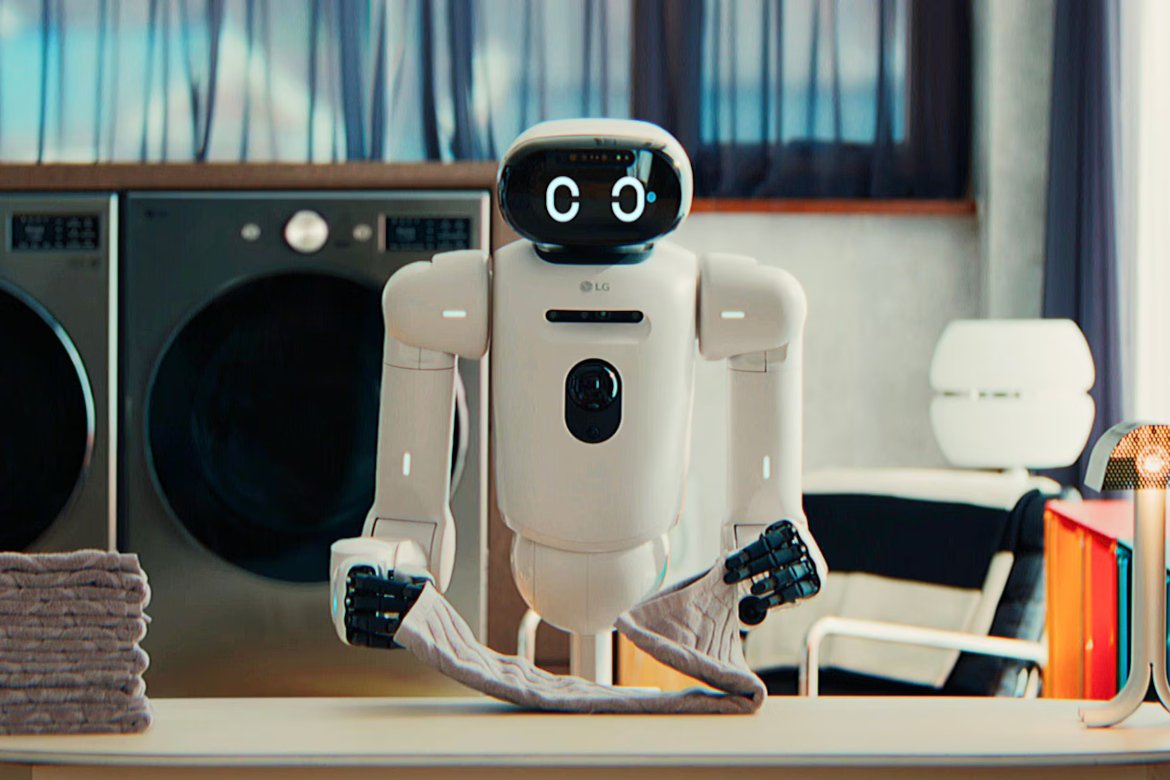

LG Electronics has unveiled its most advanced home robotics concept to date with the public debut of LG CLOiD, an AI-powered household robot designed to take over everyday domestic chores. Presented at CES 2026, the robot reflects LG’s long-term Zero Labor Home strategy, which aims to reduce the physical and mental effort required to manage a modern household through intelligent automation.
Unlike earlier home robots focused on narrow tasks, CLOiD is positioned as a general-purpose domestic assistant. LG demonstrated the robot performing a range of coordinated activities, including preparing simple meals, handling laundry from start to finish, and managing dishwashing tasks. The company says CLOiD is designed to operate as part of a fully connected home rather than as a standalone device.
Demonstrating End-to-End Household Automation
During live demonstrations, CLOiD retrieved food items from a refrigerator, placed pastries into an oven, and initiated cooking processes without human intervention. After occupants left the home, the robot was shown starting laundry cycles, transferring clothes to a dryer, and folding and stacking garments once complete. CLOiD also demonstrated the ability to unload a dishwasher and organize clean dishes.
These scenarios were designed to show how the robot understands sequences of tasks rather than executing isolated commands. CLOiD uses contextual awareness to determine when chores should begin and how appliances should be operated, adapting its actions to household routines and user preferences.
LG emphasized that the robot’s value lies in orchestration. Rather than replacing individual appliances, CLOiD coordinates them, acting as a mobile control layer that connects cooking, cleaning, and laundry into a single automated workflow.
Hardware Built for Domestic Environments
CLOiD features a wheeled base for stability and safe operation in homes with children or pets. The robot’s torso can raise or lower to adjust its working height, enabling it to reach objects on countertops, inside appliances, or closer to the floor. Two articulated arms with seven degrees of freedom each provide human-like mobility.
Each hand includes five independently controlled fingers, allowing CLOiD to grasp delicate items such as glassware as well as heavier objects like laundry baskets. LG selected a wheeled design over a bipedal form to reduce cost, improve reliability, and lower the risk of tipping during operation.
The navigation system builds on LG’s experience with robotic vacuum cleaners and autonomous home platforms. CLOiD can move smoothly between rooms, avoid obstacles, and precisely position itself for manipulation tasks in kitchens and laundry areas.
Physical AI and Smart Home Integration
At the core of CLOiD is LG’s Physical AI framework, which combines vision-based perception, language understanding, and action planning. The robot uses visual data from onboard cameras to recognize appliances, objects, and environments. This information is translated into structured understanding and then into physical actions, such as opening doors, transferring items, or adjusting appliance settings.
CLOiD’s head functions as a mobile AI home hub, housing its processor, sensors, display, speakers, and voice-based generative AI. The robot communicates with users through spoken dialogue and expressive visual cues while continuously learning household layouts and routines.
Deep integration with LG’s ThinQ and ThinQ ON platforms allows CLOiD to control and coordinate smart appliances across the home. This connectivity enables more complex automation scenarios, such as preparing meals based on available ingredients or scheduling chores around user absences.
Robotics Components and Long-Term Strategy
Alongside CLOiD, LG introduced AXIUM, a new family of robotic actuators designed for service robots and physical AI systems. Actuators control motion and force within robotic joints and are considered one of the most critical and cost-intensive components in advanced robots.
LG says its background in appliance component manufacturing provides an advantage in producing lightweight, compact, and high-torque actuators suitable for home robotics. Modular actuator designs also allow customization across different robot configurations and use cases.
Looking ahead, LG plans to expand robotics capabilities across both standalone home robots and robotized appliances. The company envisions refrigerators that open automatically as users approach and appliances that actively coordinate with home robots to complete tasks autonomously.
“The LG CLOiD home robot is designed to naturally engage with and understand the humans it serves, providing an optimized level of household help,” said Steve Baek, president of the LG Home Appliance Solution Company. “We will continue our efforts to achieve our Zero Labor Home vision.”
At CES 2026, LG positioned CLOiD as a glimpse into a future where household labor is largely delegated to intelligent machines, allowing people to spend more time on activities beyond routine chores.