
A robotics startup spun out of electric vehicle manufacturer Rivian has raised $500 million to build a new generation of industrial robots powered by artificial intelligence.
The company, called Mind Robotics, announced the Series A round this week, bringing its total funding to approximately $615 million only months after its launch. The investment values the company at around $2 billion and was co-led by venture firms Accel and Andreessen Horowitz.
Mind Robotics was created in late 2025 by Rivian founder and CEO RJ Scaringe, who now serves as chairman of the robotics startup.
The company’s goal is to address one of the biggest limitations in modern factory automation: the difficulty robots have performing tasks that require dexterity, adaptability, and real-world reasoning.
A Different Approach to Industrial Robotics
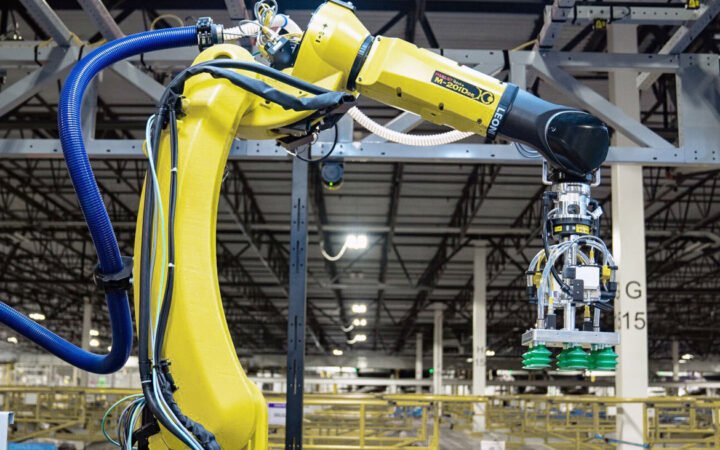
Industrial robots have been used in manufacturing for decades, but most systems remain limited to highly structured tasks such as welding, assembly, or material handling.
These machines perform best when working with predictable objects and fixed production lines.
Mind Robotics is attempting to develop robots capable of operating in more dynamic manufacturing environments where parts vary, conditions change, and tasks require human-like manipulation.
The startup plans to build AI systems that allow robots to interpret their surroundings and adapt their movements in real time.
Unlike many robotics startups that are focusing on humanoid machines, Mind Robotics is taking a more traditional approach to hardware design.
Scaringe has suggested that the company’s focus is on practical factory automation rather than building robots designed to resemble humans.
Training Robots with Factory Data
One advantage the startup brings to the robotics industry is access to manufacturing data from Rivian’s electric vehicle factories.
These facilities provide a real-world environment where robotic systems can be trained and tested on production tasks.
The company aims to use this data to develop AI models that help robots understand physical interactions and perform tasks requiring precision and adaptability.
According to Mind Robotics, much of the value generated inside factories today still depends on human workers performing tasks that traditional automation cannot easily replicate.
By combining robotics hardware with AI models capable of learning from real-world data, the company hopes to automate a broader range of manufacturing activities.
A Growing Investment Wave in Physical AI
The large funding round reflects growing investor interest in robotics companies building AI-driven physical systems.
Over the past year, venture capital firms have increasingly backed startups focused on what many researchers call physical AI – systems that combine machine learning with robots operating in the real world.
Mind Robotics is part of a broader shift toward integrating artificial intelligence directly into industrial automation.
Scaringe has said the company expects to deploy significant numbers of its robots within factories before the end of the year, suggesting an aggressive timeline for moving from research to deployment.
Ties to Rivian’s Technology Ecosystem
Although Mind Robotics operates as an independent company, its relationship with Rivian could extend beyond manufacturing data.
Rivian has recently developed custom semiconductor chips designed to run autonomous driving software inside its vehicles.
Those processors could potentially be used to power robotics systems as well, creating a shared technology foundation between the two companies.
The spinout is also part of a broader pattern emerging at Rivian, which has begun launching new technology ventures alongside its core automotive business.
In 2025 the company also created another startup focused on electric mobility platforms for small cargo vehicles and e-bikes.
Together, these efforts suggest that Rivian is positioning itself not only as a vehicle manufacturer but as a broader developer of robotics and AI technologies.
For Mind Robotics, the next challenge will be proving that AI-powered robots can deliver tangible productivity gains on real factory floors.