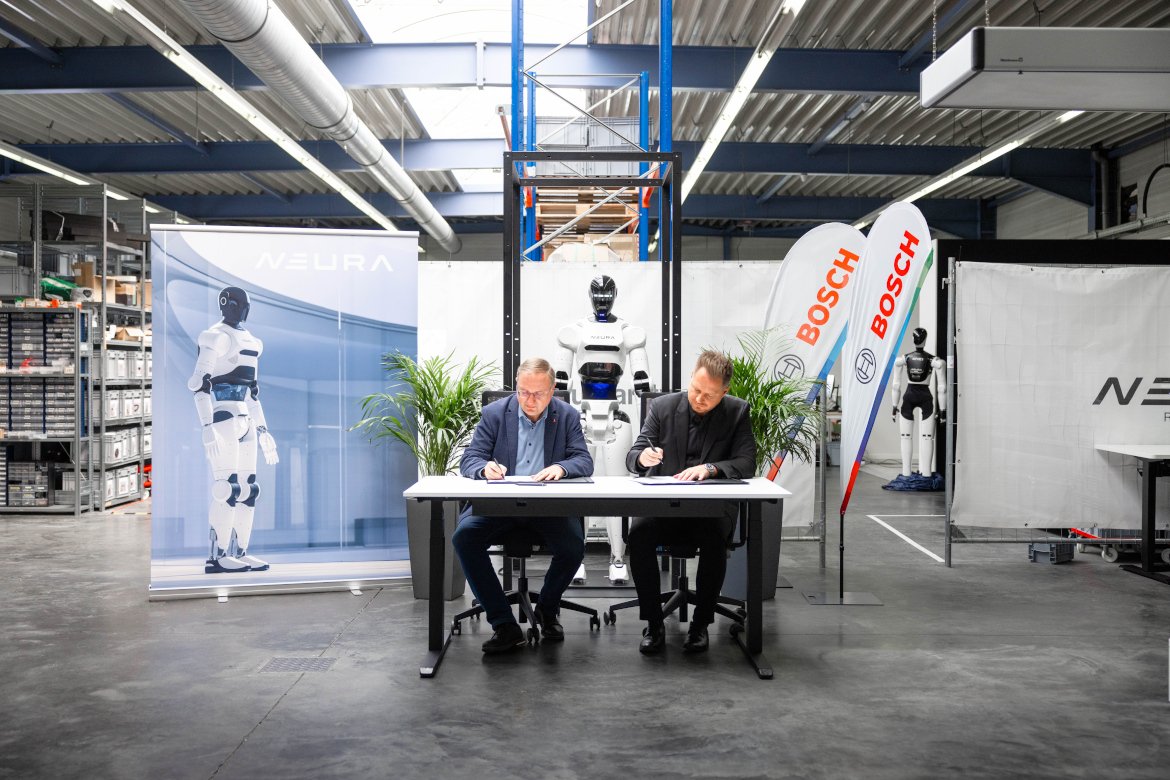

NEURA Robotics and Bosch have announced a strategic partnership aimed at accelerating the industrial deployment of humanoid robots and physical AI technologies developed in Germany. The collaboration brings together NEURA’s fast-moving robotics platform and Bosch’s manufacturing scale, signaling a coordinated European push into one of the most competitive emerging technology markets.
“NEURA aims to position Europe as the global leader in one of the most significant future markets, humanoid robotics,” said David Reger, founder and CEO of NEURA Robotics. “Our mission is to set the global benchmark for physical AI and humanoid robotics, establishing a European alternative to the major platform players in the U.S. and China. The partnership with Bosch is a powerful signal that Germany and Europe are investing in next-generation technologies developed independently.”
Reger said access to real-world physical training data remains the largest constraint in robotics development. “Physical training data is the biggest challenge in robotics; no one has it,” he said. “At NEURA, we have turned this challenge into our competitive advantage, and now, with Bosch, we have the opportunity to capture, structure, and leverage real-world data.”
The partnership is positioned around a shared objective: moving humanoid robots from experimental systems into reliable, scalable tools for real-world work environments. Both companies describe humanoid robotics as a technological shift comparable in impact to the rise of the personal computer or smartphone.
Building the Data Foundation for Humanoid Robots
A central pillar of the collaboration is the joint collection of real-world physical data inside Bosch facilities. Using advanced sensor suits, the partners will capture human motion, task execution, and environmental interaction data during everyday industrial work. This type of physical training data is scarce but critical for teaching humanoid robots how to move, manipulate objects, and operate safely alongside people.
By grounding robot learning in real workplace conditions rather than purely simulated environments, NEURA and Bosch aim to accelerate deployment timelines and improve reliability. The data will feed directly into NEURA’s AI models, enabling faster learning cycles and more adaptable robotic behavior across diverse tasks.
In parallel, the companies will co-develop AI-based core software, functional robotics modules, and intuitive user interfaces designed for industrial use. This software collaboration is intended to bridge perception, reasoning, and physical action into a cohesive operating layer for humanoid robots.
From Scale-Up Innovation to Industrial Production
Bosch will play a key role in supporting NEURA’s transition from development to large-scale production. This includes optimizing manufacturing workflows, scaling embedded software, and potentially supplying robotic components such as motors and actuators. The partnership also leaves room for Bosch to support final assembly and motor production for future humanoid platforms.
NEURA enters the collaboration with a reported order book exceeding one billion euros and is actively expanding its production capacity. The company’s industrial scaling effort is led by executives with deep experience in Bosch’s own manufacturing systems, reinforcing the operational alignment between the two organizations.
The focus on industrialization reflects a broader industry shift. Customers are increasingly demanding robots that can deliver consistent performance, meet safety requirements, and integrate into existing facilities without extensive redesign.
An Open Ecosystem for Physical AI
At the software level, NEURA is advancing an open robotics ecosystem known as the Neuraverse. The concept centers on connected humanoid robots that share skills, data, and learned behaviors across a distributed network. Improvements made by one robot can propagate across the fleet through software updates, creating a continuous feedback loop between deployment and development.
Combined with Bosch’s manufacturing and systems expertise, this approach is designed to accelerate innovation while maintaining industrial reliability. Rather than closed, application-specific robots, the partners are betting on adaptable, general-purpose systems that improve over time.
The partnership underscores a broader ambition to establish a European alternative in humanoid robotics, at a time when major efforts are concentrated in the United States and China. By pairing real-world data acquisition with scalable production, NEURA and Bosch are positioning Germany as a central hub for the next phase of physical AI.