
The Seoul Welfare Foundation has announced a pilot program deploying AI monitoring systems, robotic exoskeletons, and smart care equipment across six nursing facilities in the city, targeting the physical demands that drive high staff turnover in South Korea’s elder care sector. The initiative, called the 2026 Care Service Digital Transformation Support, provides each selected facility with approximately 7 million won in project funding and specialized technical consulting.
The six facilities were chosen from a pool of 40 applicants and represent a range of care environments and technology approaches. The program focuses on what the foundation calls “care burden areas” – tasks that are both physically taxing for staff and high-risk for residents, including patient repositioning, fall prevention, and pressure ulcer monitoring.
What Each Facility Will Deploy
The deployments vary by institution and identified need. Gangbuk Haru Jeong and Balgeunssal nursing homes will introduce motorized repositioning beds that reduce the musculoskeletal strain on workers required to regularly turn bedridden patients – one of the most physically demanding and injury-prone tasks in residential care.
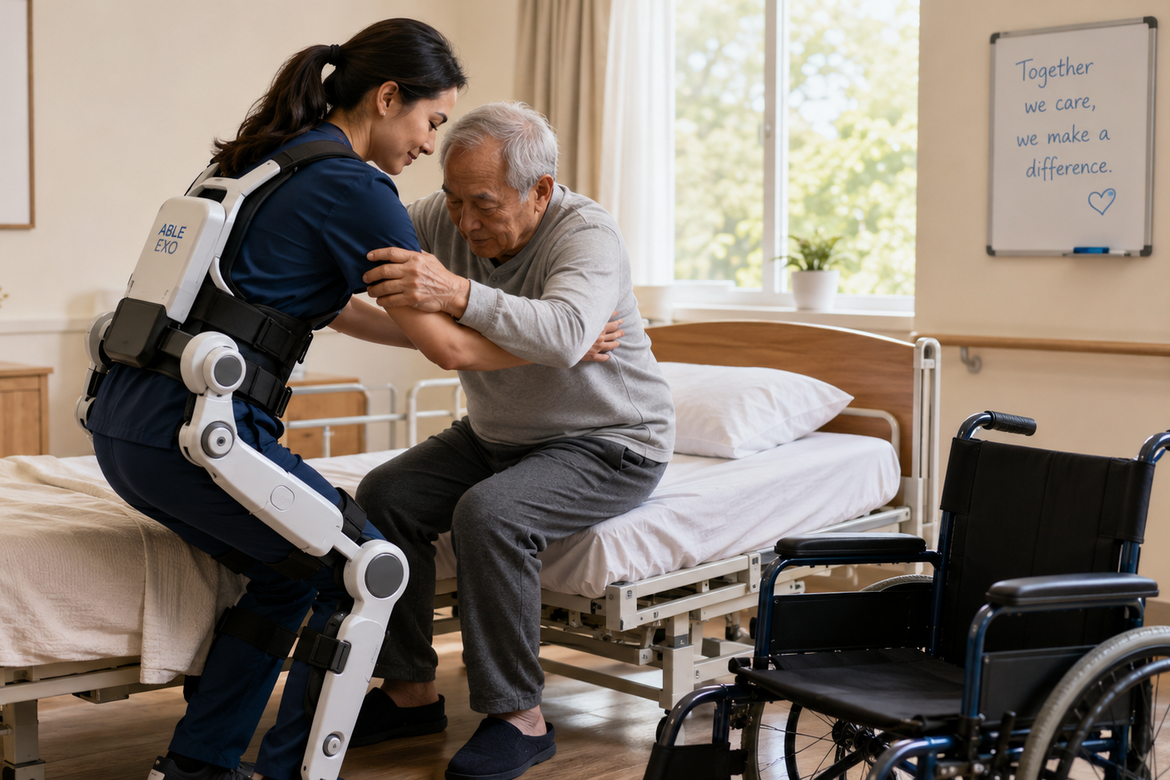
Yongsan Senior Nursing Home will install noncontact radar sensors to monitor resident movement patterns and detect pre-fall behavior, shifting the facility from reactive to predictive safety monitoring. Seoul Senior Town and the Yeomin Welfare Cooperative will use electric patient lifts and wearable robotic exoskeletons to assist with safe transfers. Songpa Senior Nursing Home will trial bowel sensors that alert staff only when intervention is needed, eliminating the repetitive manual checks that consume significant nursing time.
The Demographic Pressure Behind the Program
South Korea is among the fastest-aging societies in the world. The country is entering what officials describe as a super-aged society phase, in which more than 20% of the population is over 65 – a threshold that creates sustained structural demand for care services that the existing workforce cannot meet at current staffing levels. Elder care in Korea is characterized by high physical intensity, comparatively low wages, and turnover rates that compound the labor shortage over time.
The Seoul pilot is a direct response to that structural mismatch. By automating routine monitoring tasks and providing mechanical assistance for heavy physical work, the program aims to stabilize a workforce increasingly unable to keep pace with demand – without requiring a proportional increase in headcount.
“This project goes beyond the mere introduction of technology. It is a process of establishing an execution-oriented model for digital transformation that addresses the practical challenges of caregiving,” said Yoo Yeon-hee, head of the Social Service Support Center at the Seoul Welfare Foundation. “Our goal is to identify models with proven field effectiveness and expand their reach in the future.”
The foundation has framed the pilot explicitly as a precursor to broader rollout, with the six facilities intended to generate performance data that can support scaling decisions across Seoul’s wider network of senior care institutions.
Disclaimer: RobotsBeat is an independent media brand owned and operated by NuvexMedia LLC, publishing news, research, and insights on artificial intelligence, emerging technologies, automation, and related industries. NuvexMedia LLC invests in and collaborates with companies across the AI, Robotics, technology, software, and digital innovation sectors. These relationships do not influence RobotsBeat's editorial coverage, and the publication maintains full editorial independence to provide accurate, timely, and objective information. © 2026 NuvexMedia LLC. All rights reserved. This content is for informational purposes only and should not be considered legal, tax, investment, financial, or other professional advice.