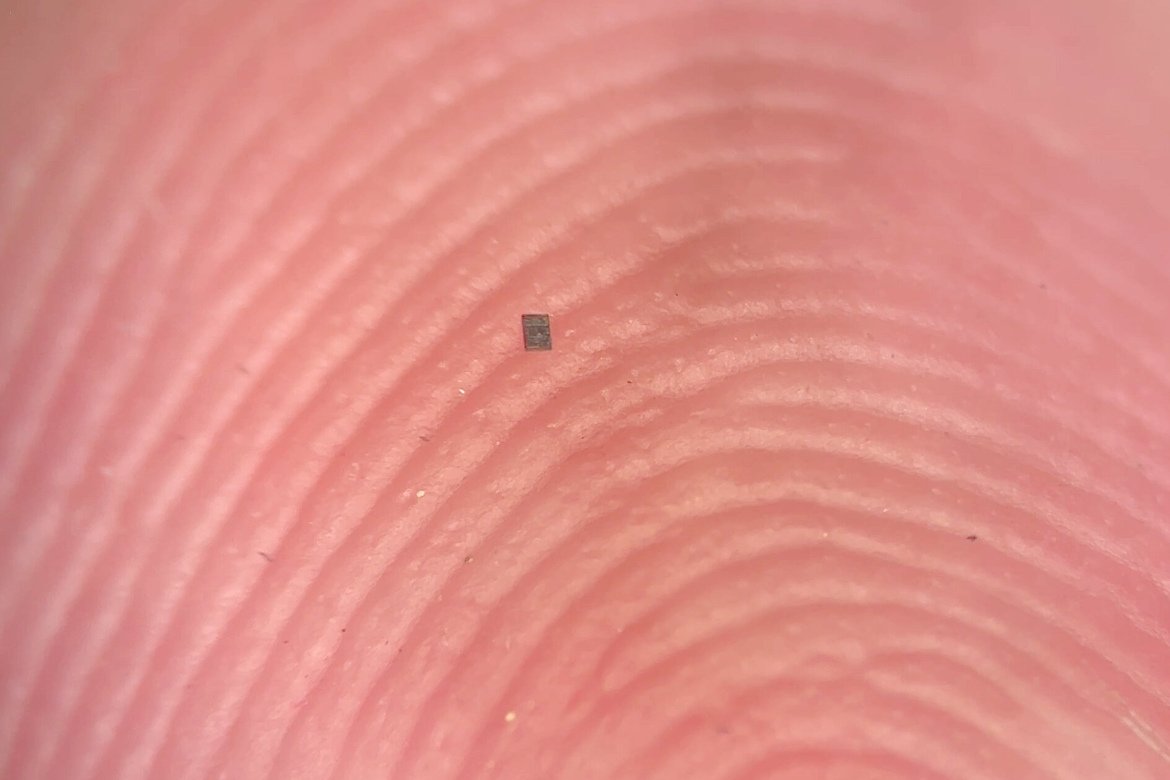

Researchers at the University of Pennsylvania and the University of Michigan have developed what they describe as the world’s smallest fully programmable autonomous robots, pushing robotics into a microscopic frontier. Each robot measures roughly 200 by 300 by 50 micrometers, smaller than a grain of salt, yet integrates computing, sensing, and propulsion into a single untethered system. The robots are designed to operate independently without external control, marking a significant step forward in microscale robotics.
Unlike earlier microrobots that relied on magnetic fields or external power sources, these robots are fully autonomous. They are powered by light, which activates onboard electronics and enables them to sense their surroundings and make basic decisions. In laboratory demonstrations, the robots were able to swim in liquid environments and adjust their motion without human intervention.
The robots can be produced using established semiconductor fabrication techniques, allowing them to be manufactured at scale. Researchers estimate the cost at roughly one cent per robot when produced in large quantities. Once activated, the devices can continue operating for months, making them suitable for long-duration experiments or deployments at microscopic scales.
Autonomous Microscale Motion and Control
Movement at microscopic scales presents unique challenges because fluid resistance dominates over inertia. To address this, the robots use an electrochemical propulsion method rather than mechanical parts. By generating electric fields, the robots interact with ions in the surrounding liquid, creating movement without the need for motors or moving limbs.
This approach allows the robots to swim at speeds of roughly one body length per second. The lack of moving components makes the robots mechanically robust and resistant to damage during handling. Researchers demonstrated that the devices could be transferred between samples using standard laboratory tools without losing functionality.
The propulsion method also enables precise directional control. By adjusting electrical signals, the robots can change direction, stop, or follow preprogrammed movement patterns. This capability is essential for future applications that require coordinated motion or navigation through confined environments.
Tiny Brains and Sensing Capabilities
A key breakthrough lies in the integration of a complete computing system at such a small scale. The robots include a processor, memory, and sensors embedded directly on the chip. Power is supplied by microscopic solar cells that generate approximately 75 nanowatts under LED illumination, an extremely small energy budget compared to consumer electronics.
Despite these constraints, the robots are capable of basic sensing and decision-making. They can detect temperature changes with high sensitivity and alter their behavior in response. Researchers also demonstrated simple communication by encoding information through movement patterns that can be observed under a microscope.
These capabilities allow the robots to respond dynamically rather than follow fixed paths. While the onboard intelligence is limited compared to larger robotic systems, it represents a major step toward autonomous behavior at microscopic dimensions.
Potential Applications and Next Steps
The researchers see strong potential for applications in biomedicine, where microscopic robots could one day monitor cellular environments or deliver targeted therapies. Their small size allows them to operate in spaces inaccessible to conventional devices, including narrow fluid channels and delicate biological systems.
In manufacturing and materials science, the robots could assist in assembling or inspecting microscale components. Because the platform is compatible with standard chip manufacturing processes, it could be adapted for large-scale production and customized for specific industrial tasks.
The current demonstrations were conducted in controlled laboratory conditions, and the researchers emphasize that further work is needed to expand functionality. Future efforts will focus on improving sensing, increasing computational complexity, and enabling operation in more complex environments. Even at this early stage, the work establishes a foundation for autonomous robotics at scales comparable to biological microorganisms.