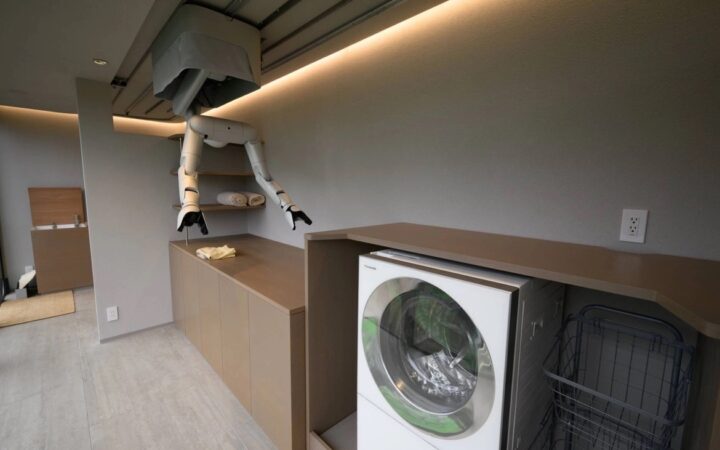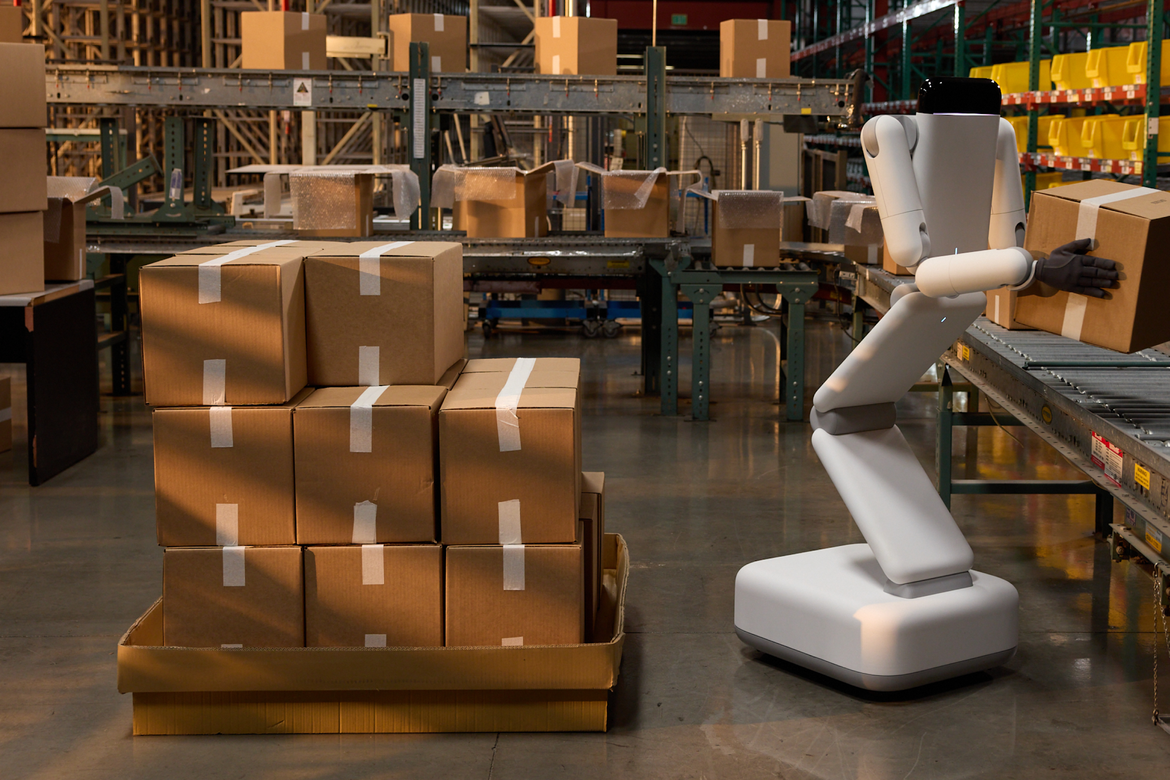
When Genesis AI unveiled Eno this week, it made a point of stating what the robot is not. “Humanoid robots don’t need to look human,” the company posted on X. Eno has no head, no legs, and no attempt at a human silhouette. It sits on a wheeled base, folds down for compact storage, and extends upward through an articulated tower when working. The only concession to human anatomy is its hands – designed, the company says, to exactly match human hand form and function.
Eno is not alone. Amazon’s next-generation Proteus robot has no humanoid pretensions. Agility Robotics’ Digit has legs but no face and a torso that reads more like industrial equipment than a person. Boston Dynamics’ production Atlas is bipedal but moves in ways that make its non-human nature immediately apparent. KUKA’s showroom installation uses industrial arms, not humanoid bodies. The question the industry is quietly splitting over is whether the bipedal, human-looking form factor is a genuine engineering requirement or an aesthetic choice that may not be optimal for the actual work.
The Case For Looking Human
The argument for humanoid form is architectural rather than aesthetic. The world was built for humans – the dimensions of doorways, the height of workbenches, the design of tools, the layout of staircases. A robot with human proportions can operate in those environments without requiring any modification to the infrastructure. This is the argument BMW made when deploying Hexagon’s Aeon at its Leipzig factory: rather than redesign assembly stations for specialized robots, deploy a robot that fits the stations already built for people.
Imitation learning – where robots learn by observing human movement – is also easier when teacher and student share the same physical form. Hexagon’s Arnaud Robert made this point directly: “The best translation from the human to the robot is when the teacher and the student have the same form factor.” Boston Dynamics trains Atlas using motion capture of human engineers performing the same tasks. Genesis AI, notably, does the same with Eno’s hands – the one part of the robot that mirrors human anatomy precisely.
The Case Against
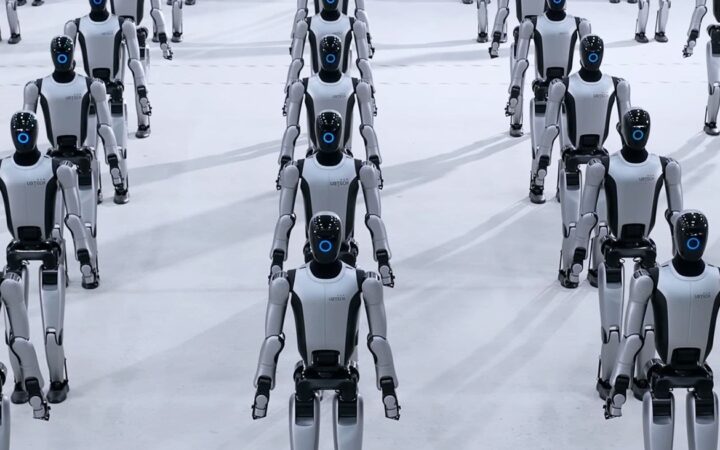
The counterargument is that humanoid form optimizes for the wrong variable. Bipedal locomotion is mechanically complex, energy-intensive, and failure-prone. A robot that falls over is a robot that breaks, damages its environment, or injures nearby workers. The viral footage of Unitree’s robot falling twice during a Michael Jackson moonwalk performance in Shenzhen is entertaining; in a hospital or factory, it would be neither.
Wheeled bases offer stability, reliability, and energy efficiency that bipedal systems cannot match at current engineering maturity. Eno’s height-adjustable tower provides the vertical reach of a humanoid without the instability of balancing on two feet. Amazon’s Proteus moves heavy carts reliably at scale across eight-hour shifts without the failure modes that accompany bipedal locomotion. Gartner analyst Bill Ray made the economics explicit: “When a robot costs 17 million, you’d reorganize your factory around the robot. But it doesn’t cost that anymore. So now you want to fit it into your existing way of working.” As robot costs fall, the calculus shifts – it may be cheaper to deploy a more capable wheeled platform than to redesign nothing but pay the reliability cost of bipedal locomotion.
Where the Industry Actually Is
The honest answer is that the debate is premature. Current humanoid robots – including the most capable commercial platforms – are not yet reliable enough in unstructured environments for the form factor question to be fully resolved by market evidence. Boston Dynamics’ Atlas is impressive in controlled demonstrations and promising in early factory pilots. Figure AI’s Figure 03 narrowly lost to a human intern in a parcel sorting contest. Agibot’s G2 achieves 99% task accuracy in a defined production station with controlled input conditions.
What the non-humanoid camp has demonstrated is commercial deployment at scale that the bipedal humanoid camp has not yet matched. Amazon’s warehouse robots handle millions of orders. Agility’s Digit is in Amazon fulfillment centers. Verity’s inventory drones, which won the IERA Award 2026, operate in 200 warehouses capturing 500,000 images per day. None of these look human. All of them work.
The form factor that wins will likely be determined not by philosophical preference but by which designs prove reliable enough, cheap enough, and capable enough to justify the procurement decision at scale. Genesis AI’s bet with Eno is that the hands matter more than the legs – and that everything else can be engineered for function rather than appearance. Whether enterprise customers agree will be answered on factory floors over the next two to three years, not in design studios.
Disclaimer: RobotsBeat is an independent media brand owned and operated by NuvexMedia LLC, publishing news, research, and insights on artificial intelligence, emerging technologies, automation, and related industries. NuvexMedia LLC invests in and collaborates with companies across the AI, Robotics, technology, software, and digital innovation sectors. These relationships do not influence RobotsBeat's editorial coverage, and the publication maintains full editorial independence to provide accurate, timely, and objective information. © 2026 NuvexMedia LLC. All rights reserved. This content is for informational purposes only and should not be considered legal, tax, investment, financial, or other professional advice.