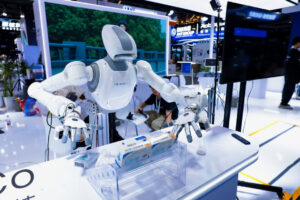
BrainCo Unveils Brain-to-Robot AI Platform for Thought-Controlled Robots
BrainCo has introduced a brain-to-robot AI platform that converts neural signals into commands for humanoids, robotic arms, and quadrupeds in under 200 milliseconds.
BrainCo has introduced a brain-to-robot AI platform that converts neural signals into commands for humanoids, robotic arms, and quadrupeds in under 200 milliseconds.
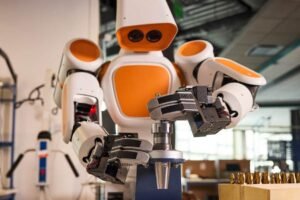
Walden Robotics has launched from stealth with $300 million at a $1.1 billion valuation, co-led by Toyota and Deviation Capital, with robots already performing real production work at a Toyota North American plant since February 2026, powered by Large Behavior Models developed at Toyota Research Institute.

Tesla has released time-lapse footage showing the decommissioning of its original Model S and Model X assembly line at Fremont in 46 days, with limited Optimus Gen 3 production expected to begin in late July or August 2026 on the converted space targeting one million units per year at full ramp.

Elon Musk has outlined a plan to send construction materials to the Moon and Mars starting in late 2026, with Tesla’s Optimus humanoid robots building infrastructure ahead of human settlement, targeting a self-sustaining Martian city between 2045 and 2055.
Mitsubishi Motors and University of Tokyo spinout Highlanders have signed an MOU to jointly develop humanoid robots for Mitsubishi’s manufacturing facilities and explore mass production at the Kyoto Plant, with production feasibility being examined for early 2027 – the first such collaboration between an automaker and a humanoid robot developer involving mass production.

UN Secretary-General António Guterres used the inaugural UN Global Dialogue on AI Governance in Geneva to call for binding international controls on autonomous weapons, mandatory AI safety testing before deployment, and renewable energy requirements for data centers by 2030.
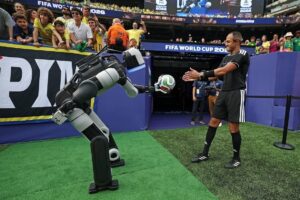
Boston Dynamics’ Atlas humanoid robot delivered the match ball to the referee at halftime of Brazil’s round-of-16 World Cup match against Norway at New York New Jersey Stadium, overcoming stadium RF interference and grass locomotion challenges in the largest public deployment of the production-ready platform to date.
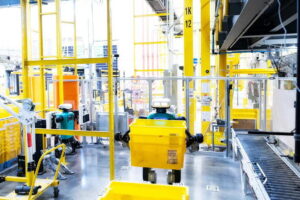
Agility Robotics has announced a merger with Churchill Capital Corp XI to go public at a $2.5 billion valuation, providing more than $620 million in proceeds to fund commercial expansion of its Digit humanoid robot, backed by over $300 million in existing orders for a new Digit version.
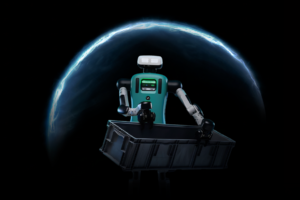
NVIDIA has announced Halos for Robotics, the industry’s first full-stack safety architecture for physical AI systems, drawing on 18,600 engineering years of autonomous vehicle safety development, with Agility Robotics integrating it into Digit as the first commercial humanoid deployment.
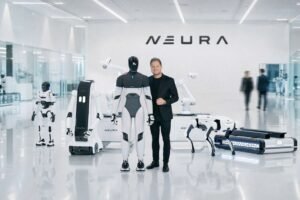
Neura Robotics has closed a Series C round of up to $1.4 billion led by Tether, the stablecoin issuer behind USDT, with Tether also planning to integrate its Wallet Development Kit directly into Neura’s robotic systems as the companies argue autonomous robots need financial tools.

Xpeng CEO He Xiaopeng has assumed direct leadership of the company’s robotics business, effective immediately, as the EV maker targets mass production of its IRON humanoid robot by the end of 2026 and commercial customer delivery from 2027.
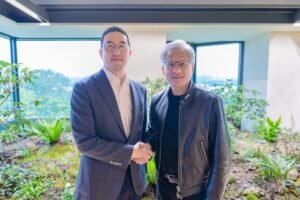
LG Group and NVIDIA have signed a broad strategic partnership covering physical AI and robotics, AI data center infrastructure, and autonomous vehicle systems, with Jensen Huang and LG Chairman Kwang Mo Koo meeting in Seoul to formalize the expanded cooperation.
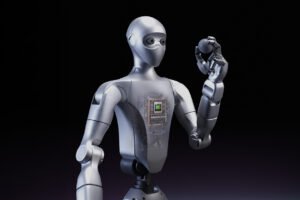
NVIDIA has announced the Isaac GR00T Reference Humanoid Robot, an open hardware and software platform combining a Unitree H2 Plus chassis, Sharpa dexterous hands, and Jetson Thor onboard compute, targeting frontier humanoid robotics research at institutions including Stanford, ETH Zurich, and UC San Diego.
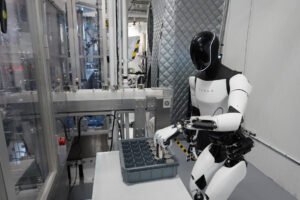
Tesla is converting its Fremont Model S and Model X line to produce one million Optimus robots annually, but with no consumer sales until late 2027 at the earliest and a $20,000-$30,000 retail price, the company faces a significant unresolved demand question as its automotive gross margins turn negative.
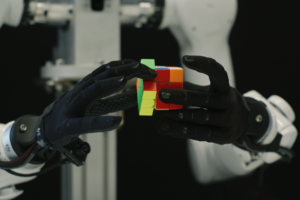
Despite record investment, viral demonstrations, and bold commercial timelines, the gap between what humanoid robots can do on camera and what they can reliably deliver in real industrial environments remains significant – and is being increasingly acknowledged by the people building them.