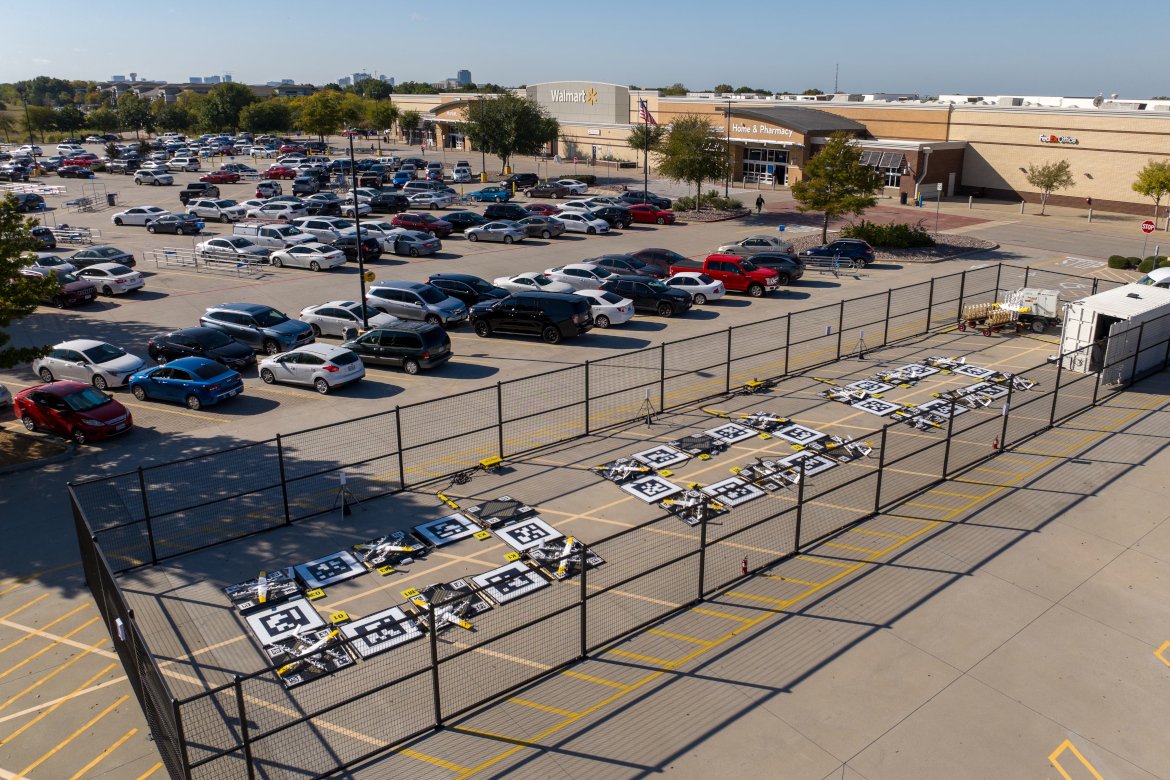
Wing and Walmart are significantly expanding their drone delivery partnership, announcing plans to add drone service to 150 additional Walmart stores across the United States over the next year. The move is designed to transform drone delivery from a regional convenience into a nationwide retail option, ultimately reaching more than 40 million Americans.
The expansion builds on years of testing and commercial operations in select markets, particularly in the Dallas-Fort Worth area and Metro Atlanta. In those regions, drone delivery has moved beyond novelty status and become a routine part of shopping behavior for many customers. According to the companies, usage has accelerated sharply, with deliveries tripling over the past six months and a core group of customers placing multiple orders per week.
By 2027, Wing and Walmart expect to operate more than 270 drone delivery locations across the country, forming what they describe as the largest residential drone delivery network in the world.
From Regional Pilots to National Coverage
The next phase of expansion will introduce drone delivery to major metropolitan areas including Los Angeles, St. Louis, Cincinnati, and Miami. These additions build on previously announced rollouts in cities such as Houston, Orlando, Tampa, and Charlotte. Operations in Houston are scheduled to begin in mid-January, marking one of the largest single-market launches to date.
The companies said the goal is not simply geographic growth, but consistency and scale. Drone delivery is being integrated directly into Walmart’s existing store operations, allowing orders to be fulfilled from local inventory rather than specialized distribution centers. This approach shortens delivery times and reduces friction for customers placing last-minute or urgent orders.
Wing’s drones are primarily used for lightweight items, including groceries, household essentials, and over-the-counter medications. Orders are delivered in minutes, often faster than traditional same-day or curbside options.
Why Drone Delivery Is Gaining Traction
Executives from both companies argue that the growing adoption reflects a shift in consumer expectations rather than a short-term experiment. Walmart sees drone delivery as a way to address immediate needs, particularly for time-sensitive purchases that do not justify a full shopping trip.
“Drone delivery plays an important role in our ability to deliver what customers want, exactly when they want it,” said Greg Cathey, Walmart’s senior vice president of digital fulfillment transformation. He pointed to strong adoption in existing markets as evidence that customers are willing to embrace the technology when it is reliable and easy to use.
Wing, which is owned by Alphabet, has spent years refining its aircraft, navigation systems, and air traffic coordination to support dense residential operations. The company emphasizes that its drones are designed to operate autonomously while meeting strict safety and noise standards, a key factor in securing regulatory approvals and community acceptance.
The Economics of Ultra-Fast Delivery
The scale of the expansion highlights a broader shift in retail logistics. While drone delivery has often been viewed as expensive or experimental, Wing and Walmart argue that high utilization changes the equation. In markets where demand is strong, drones can complete many short trips per hour, lowering the cost per delivery and reducing reliance on human drivers.
“We believe even the smallest package deserves the speed and reliability of a great delivery service,” said Adam Woodworth, chief executive of Wing. He said working with Walmart has allowed the company to demonstrate that drone delivery can operate as part of everyday retail, not just as a premium or niche offering.
Industry analysts note that Walmart’s national footprint gives the partnership a structural advantage. Thousands of stores located close to residential neighborhoods make it easier to launch drone services without building new infrastructure. If successful, the model could pressure other retailers to accelerate their own investments in autonomous delivery.
A Glimpse of Retail’s Next Phase
The coast-to-coast rollout signals growing confidence that drone delivery can move beyond pilot programs and into mainstream commerce. While regulatory hurdles and airspace coordination remain challenges, the scale of this expansion suggests that large retailers now see drones as a practical complement to trucks, vans, and gig-economy drivers.
For consumers, the promise is simple: faster access to everyday essentials. For the retail industry, the partnership represents a test of whether autonomous delivery can reliably operate at national scale.
As Wing and Walmart extend their network from Los Angeles to Miami, the question may no longer be whether drone delivery works, but how quickly it becomes an expected part of shopping in American cities.