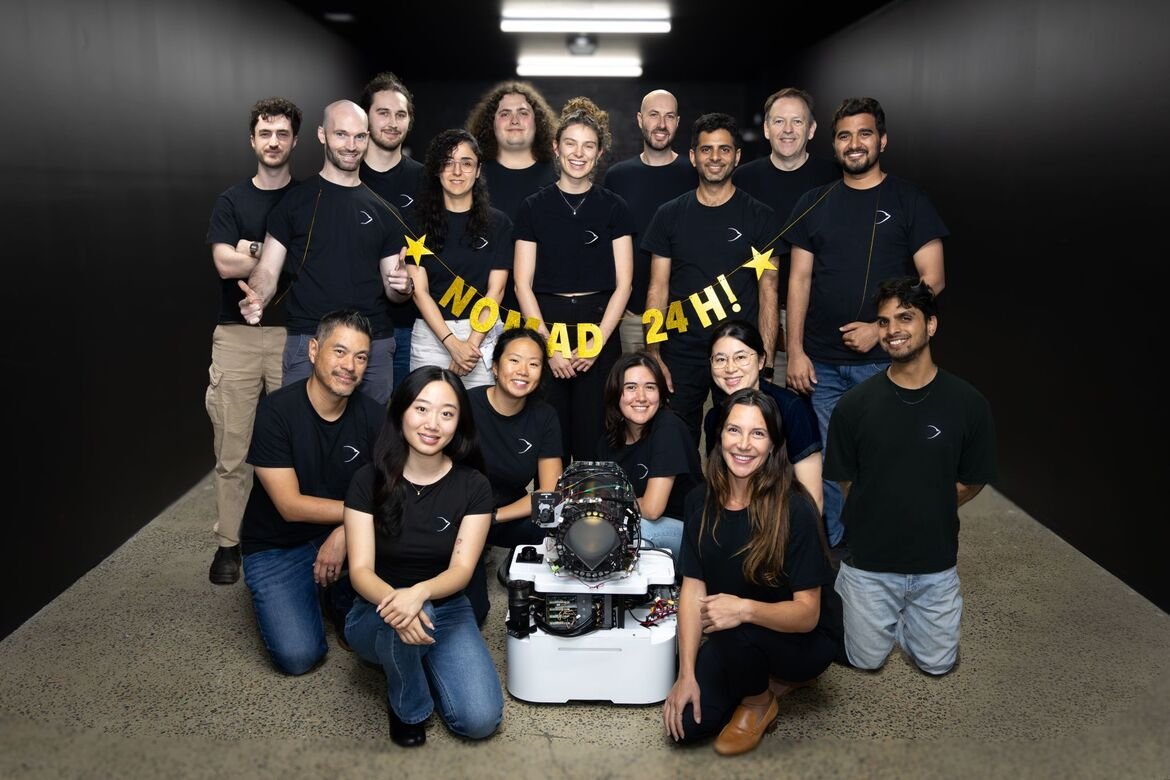

Australian startup Aquila has set two world records in laser-based power transmission by wirelessly powering a moving warehouse robot for 24 continuous hours. The demonstration delivered 4 kWh of energy by laser – establishing records for both the most power ever beamed by laser and the longest sustained wireless laser delivery. The robot received approximately 167 watts of continuous power throughout the test, with the tracking system maintaining laser focus on a receiver in motion across the duration.
The demonstration is significant not just as an endurance record but as a proof of concept for a specific operational problem in robotics: battery-constrained operating time. Warehouse robots, humanoid platforms, and autonomous mobile systems all face limits imposed by onboard energy storage. A wireless power system capable of continuously recharging a moving robot would eliminate scheduled downtime for charging and expand the operational envelope of autonomous systems in structured environments.
How the Technology Works
Aquila’s system uses a laser mounted on a tracking platform that maintains real-time focus on a photovoltaic receiver as the target moves. The feasibility of using lasers rather than sunlight to generate electricity was demonstrated at smaller scale by Mitsubishi Heavy Industries in 2025, which produced 152 watts from a 1-kilowatt focused laser beam. Aquila’s demonstration extends that baseline in two dimensions: higher sustained power output and continuous tracking of a moving target over 24 hours.
The tracking capability is the critical engineering advance. Powering a stationary receiver by laser is a solved problem. Maintaining beam focus on a receiver that moves continuously through a complex environment – navigating warehouse aisles, turning, accelerating and decelerating – requires high-precision optical tracking that must function without interruption across a full day of operation.
Military and Space Applications
The technology is advancing on multiple parallel fronts beyond commercial robotics. The U.S. Department of Defense’s PTROL-UAS program, partially funded by CENTCOM, is developing laser power delivery for unmanned aerial vehicles targeting near-perpetual flight times over distances of up to 5,000 feet. DARPA’s POWER program set its own distance record by transmitting 800 watts of power over 5.3 miles in a recent test – prioritizing range over the power levels Aquila demonstrated in its warehouse setting.
Aquila has also positioned the technology for space applications, arguing its earth-to-orbit approach could deliver power to satellites at approximately 500 times lower cost per kWh than space-based alternatives, with a shorter path to market. NASA has previously studied arrays of Earth-based laser telescopes as a mechanism for delivering continuous power to a lunar base during the lunar night, when solar panels are ineffective – a problem that becomes acute as plans for sustained lunar presence advance.
Implications for Robotics
For the robotics industry, the Aquila demonstration points toward a potential architectural shift in how autonomous systems are powered in structured environments. Warehouses, factories, and distribution centers – the same environments where humanoid and mobile robot deployment is accelerating most rapidly – are controlled enough to support fixed laser tracking infrastructure. If the technology scales from warehouse demonstration to commercial deployment, wireless power could reduce one of the primary constraints on autonomous robot operating time without adding battery weight or requiring dedicated charging stations that take robots offline.
Disclaimer: RobotsBeat is an independent media brand owned and operated by NuvexMedia LLC, publishing news, research, and insights on artificial intelligence, emerging technologies, automation, and related industries. NuvexMedia LLC invests in and collaborates with companies across the AI, Robotics, technology, software, and digital innovation sectors. These relationships do not influence RobotsBeat's editorial coverage, and the publication maintains full editorial independence to provide accurate, timely, and objective information. © 2026 NuvexMedia LLC. All rights reserved. This content is for informational purposes only and should not be considered legal, tax, investment, financial, or other professional advice.