Robotics Could Add $201 Billion to Australia’s Economy – If Adoption Gaps Close
New research suggests increased robotics adoption could add AUD $201 billion to Australia’s GDP by 2040, but commercialization and deployment remain key challenges.
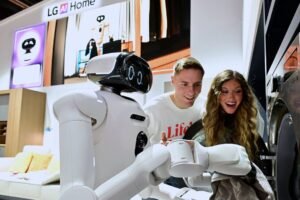
LimX Dynamics has introduced its new humanoid robot Luna at a consumer-facing event, signaling a shift from industrial robotics toward public interaction and lifestyle applications.
Sharpa has unveiled a humanoid robot capable of peeling an apple autonomously, highlighting advances in dexterous manipulation powered by multimodal AI systems.
Startup Icarus Robotics is preparing to test autonomous free-flying robots aboard the ISS, aiming to automate routine tasks in space operations.
Comtech is building a global ecosystem linking chips, software and robotics companies, aiming to accelerate commercialization of embodied AI systems.
Chinese robotics and automation firm Inovance is preparing a Hong Kong listing that could raise up to $2 billion, highlighting growing investor appetite for industrial and embodied AI technologies.
MegazoneCloud and Japan’s AVITA are partnering to integrate AI avatars with autonomous robots, aiming to bring conversational physical AI systems into real-world industries.
Agibot has produced 10,000 humanoid robots, signaling a transition from early deployments to large-scale commercial adoption of embodied AI systems.
Faraday Future has delivered new humanoid robots for dealership use while testing education-focused deployments, signaling a broader strategy to integrate embodied AI across services and learning.
Researchers have developed a system that allows robots to perform learned tasks faster than human demonstrations, addressing a key limitation in imitation learning.
U.S. lawmakers are introducing legislation to block government use of Chinese-made humanoid robots, reflecting growing concerns over data security and technological competition.
China has released its first industry standard for embodied artificial intelligence, establishing a unified framework to evaluate and deploy next-generation robotic systems.
SAIC-GM has introduced humanoid robots into a Buick battery assembly line, marking an early step toward integrating embodied AI into automotive manufacturing.
MIT researchers have developed an ultrasound wristband that translates muscle activity into real-time control signals for robotic hands, potentially advancing dexterity in humanoid robotics.
Figure AI’s third-generation humanoid robot appeared alongside First Lady Melania Trump at a White House summit, highlighting the growing political and commercial attention surrounding humanoid robotics.