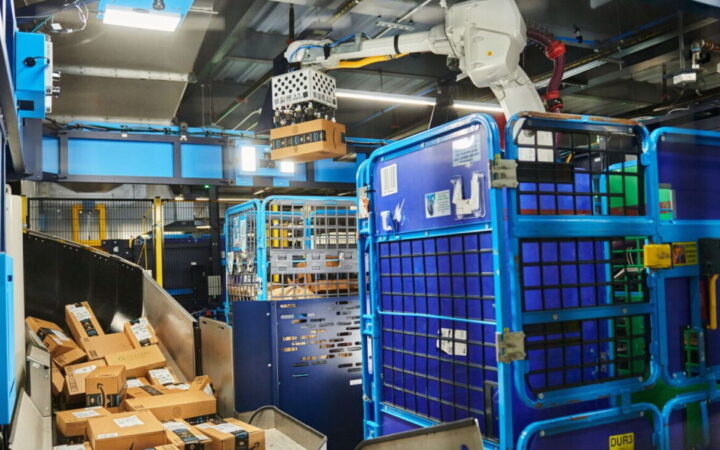
Amazon has announced plans to fill more than 500,000 roles with robots, according to reporting this week. The disclosure has intensified public debate over the pace at which automation is displacing traditional warehouse and logistics jobs. The scale of the number reflects the company’s continued push to embed robotics across fulfillment operations, from parcel handling and sortation to inventory transport and increasingly manipulation-heavy tasks. Amazon has been one of the largest institutional buyers of warehouse robotics globally and operates one of the most extensive proprietary fleets of mobile and manipulation systems in the sector.
The move sits alongside a broader industry pattern in which humanoid, mobile, and specialized robotic platforms are being tested and deployed at increasing scale across e-commerce and logistics operators. Amazon has previously integrated Agility Robotics’ Digit humanoid at research and development facilities, invested in Agility through the Amazon Industrial Innovation Fund, and continues to expand its stable of proprietary mobile robots developed by Amazon Robotics. Other logistics operators including GXO and Mercado Libre have also expanded humanoid pilots. The 500,000 figure, if realized, would represent one of the largest single-company shifts toward robotic labor documented to date.
The announcement has drawn commentary raising familiar concerns about long-term employment displacement, framed in editorial coverage against a history of fictional depictions of robotics dating to the 1927 silent film Metropolis and 1968’s 2001: A Space Odyssey. Critics have noted that state and local governments frequently offer tax incentives to companies expected to create human jobs, and that large-scale automation may complicate the framework for such support. Proponents of automation typically point to productivity gains, price effects, and reallocation of labor over time, arguments echoed in recent analysis from organizations such as the Information Technology and Innovation Foundation.
For the robotics sector, Amazon’s continued scaling represents both an anchor customer base and a benchmark against which competing platforms and vendors will be measured. The economic and political implications remain contested. Similar tensions are surfacing elsewhere, most visibly at Hyundai, where the labor union recently authorized a strike partly over Boston Dynamics Atlas deployment plans, and in policy commentary from Bill Gates and others suggesting that tax structures may need to evolve as automation broadens. Whether Amazon’s stated trajectory translates into net workforce reduction, task reallocation, or a hybrid workforce model will be one of the most closely watched indicators of how large-scale robotics deployment reshapes commercial logistics over the coming decade.
Disclaimer: RobotsBeat is an independent media brand owned and operated by NuvexMedia LLC, publishing news, research, and insights on artificial intelligence, emerging technologies, automation, and related industries. NuvexMedia LLC invests in and collaborates with companies across the AI, Robotics, technology, software, and digital innovation sectors. These relationships do not influence RobotsBeat's editorial coverage, and the publication maintains full editorial independence to provide accurate, timely, and objective information. © 2026 NuvexMedia LLC. All rights reserved. This content is for informational purposes only and should not be considered legal, tax, investment, financial, or other professional advice.