
Key Notes
- ROAM combines visual scene interpretation with learned navigation and walking controllers to guide an ANYmal D robot through unfamiliar outdoor terrain.
- Researchers reported 96.7% time-based autonomy on the 10.1-kilometer Zermatt hike, with human interventions required around construction hazards.
- A separate Seealpsee trial also needed assistance, while cloud connectivity and global route references remain dependencies of the research system.
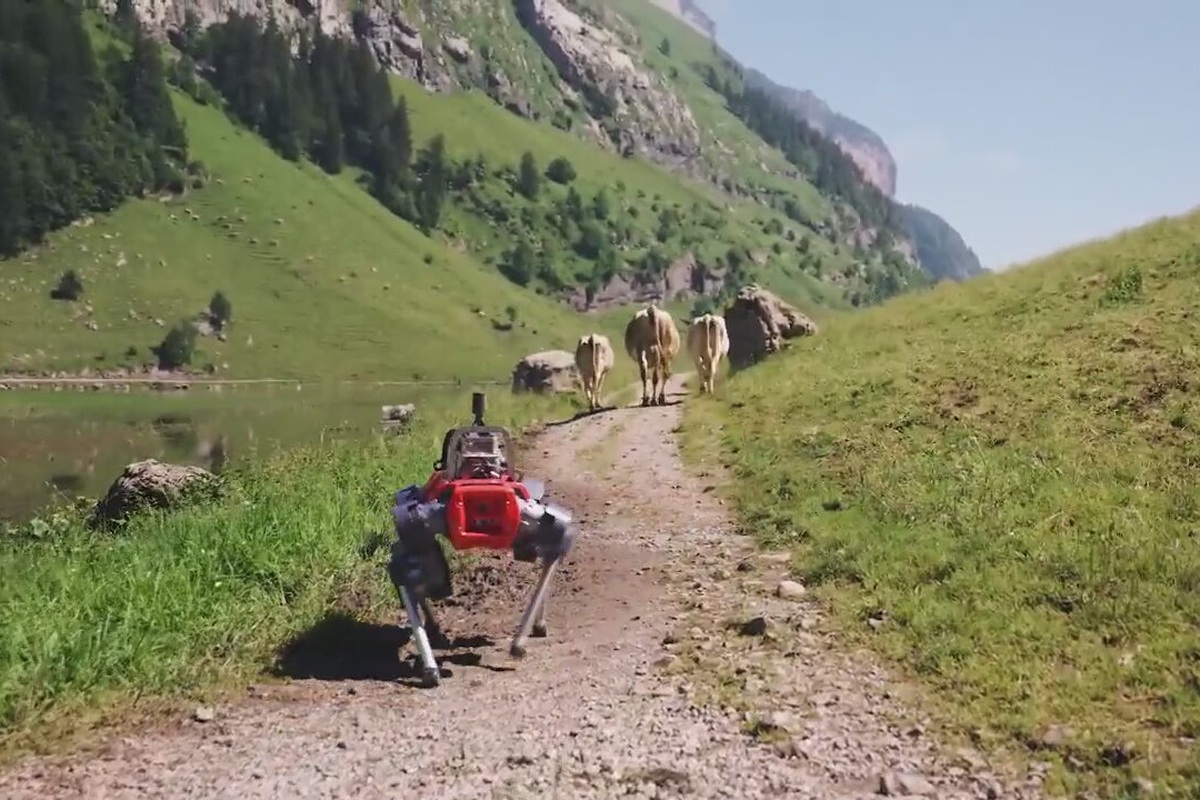
A robot dog equipped with ETH Zurich’s ROAM navigation system completed a 10.1-kilometer hike in the Swiss Alps, making its own navigation decisions for most of the journey. The ANYmal D quadruped combined visual scene understanding with learned walking and route-selection controllers, although researchers still had to intervene for safety.
The study, by researchers at ETH Zurich and an Apple-affiliated coauthor, appeared in Science Robotics in November 2026. The team’s project page dates the underlying field expeditions to June and August 2024. The results demonstrate progress in outdoor navigation, rather than a newly available autonomous hiking product.
Two Alpine Hikes Still Needed Human Help
The longer route ran from Gornergrat, above 3,000 meters near Zermatt, toward the Furi cable-car station, with 1,220 meters of descent. Researchers reported a 96.7% time-based autonomy rate. Two major interventions were needed around construction areas, including after the robot collided with a fence.
A separate 2.38-kilometer circuit around Seealpsee achieved 97.5% autonomy by mission time. Its three intervention events included a hazardous lakeside approach, a difficult slope and an impassable turnstile that required the team to carry the robot over. The embedded ETH documentary follows this shorter lakeside expedition.
Those percentages describe the observed missions, not a success probability for arbitrary trails. The paper reports the field deployments descriptively, with one run per method, so repeated performance across seasons, routes and weather remains an open question.
Visual Reasoning Guides Where the Robot Walks
ROAM, short for Robust Open-world Autonomous Mobility, separates interpretation from precise motion. A vision-language model identifies features such as paths, grass, water and people, then assigns values describing risk, suitability for stepping and preferred travel areas.
A segmentation system locates those features in camera images and converts the labels into maps. Combined with terrain-height information, these maps guide two reinforcement-learning policies trained in simulation: one handles local navigation, while the other controls locomotion. The language model does not directly issue joint commands.
This addresses a different problem from simply keeping a quadruped upright. Our coverage of ETH’s ANYmal research illustrates how the same broader robot platform can support very different learned skills.
Connectivity and Mapping Remain Important Limits
The research paper describes reliance on a cloud-based vision-language model and internet connectivity, alongside a global route reference. ROAM therefore does not show that a robot can independently plan every part of a remote expedition without network access or prior route information.
The researchers’ code repository publishes the visual-reasoning and segmentation components and their mapping interfaces. That is useful research infrastructure, but it should not be mistaken for a complete, ready-to-deploy hiking robot.
The findings add an outdoor research perspective to our coverage of commercial ANYmal X deployments. Its contribution is connecting scene understanding to physical navigation, with the recorded interventions showing where that connection still needs improvement.
Disclaimer: RobotsBeat is an independent media brand owned and operated by NuvexMedia LLC, publishing news, research, and insights on artificial intelligence, emerging technologies, automation, and related industries. NuvexMedia LLC invests in and collaborates with companies across the AI, Robotics, technology, software, and digital innovation sectors. These relationships do not influence RobotsBeat's editorial coverage, and the publication maintains full editorial independence to provide accurate, timely, and objective information. © 2026 NuvexMedia LLC. All rights reserved. This content is for informational purposes only and should not be considered legal, tax, investment, financial, or other professional advice.