Honor’s Humanoid Robot Wins Beijing Half-Marathon, Finishing Faster Than Any Human
A humanoid robot developed by Honor completed Beijing’s half-marathon in 50 minutes and 26 seconds, finishing ahead of all 12,000 human competitors and below the standing human world record for the distance.
A bipedal humanoid robot named Lightning, developed by Chinese smartphone maker Honor, won Beijing’s half-marathon on Sunday, completing the 13-mile course in 50 minutes and 26 seconds. The time placed Lightning ahead of all 12,000 human competitors in the race and below the current human world record for the half-marathon distance – set by Ugandan runner Jacob Kiplimo in Lisbon last month – by nearly seven minutes.
Honor’s robots also took second and third place, making it a clean podium sweep for the company. The result marks a significant escalation from last year’s inaugural event, when the fastest robot took 2 hours and 40 minutes to finish and only six of the 21 participating humanoids crossed the finish line.
The Race and What It Tested
The event, held in an industrial park in Beijing, featured more than 100 robots – a substantial increase in participation from the previous year. Nearly 40% of the competing units ran autonomously, navigating turns, uneven terrain, and course obstacles without remote input. The remainder were remote-controlled, with finishing times adjusted by category.
The conditions were not clean. Lightning crashed into a railing near the finish line and required assistance before recovering to complete the race. One robot face-planted roughly 200 feet from the start, continued the course with its upper body held together with packing tape, and finished. Another crossed the finish line and veered into a bush. Teams of technicians followed the field in golf carts, many equipped with stretchers.
The fastest human in the race, 29-year-old Zhao Haijie, finished in 1 hour, 7 minutes, and 47 seconds. At least four robots posted sub-one-hour times.
A Public Stress Test for Chinese Robotics
For several participating companies, the race served as a live performance benchmark. Intercity Technology used the event to validate a year of hardware and software upgrades to its child-size robot Xiao Cheng, including improved motor coordination, sensor arrays, and gait algorithms. “For us, this process is really about competing against who we were last year,” said Xue Qingheng, founder of Intercity Technology.
The race champion is set to receive orders worth over one million yuan (approximately $146,500), according to city officials. Hundreds of millions of viewers watched livestream coverage across Chinese platforms – an audience scale that underscores the event’s function as both a technical demonstration and a national showcase.
The Broader Context
China currently has more than 150 humanoid robot companies and research laboratories, operating under a state strategy that classifies robotics as a national priority. Government subsidies support both development and procurement, and Beijing’s 2026-2030 technology master plan includes humanoid-staffed factories as a stated objective.
The half-marathon format has limitations as a proxy for industrial readiness – straight-line locomotion at speed is a narrower capability than the dexterous manipulation and adaptive task execution required in most manufacturing or service environments. But as a public stress test of hardware durability, autonomous navigation, and the pace of iteration, the gap between this year’s results and last year’s is difficult to dismiss. “Robots today have the body of Mike Tyson but are still missing a brain like Stephen Hawking,” said Xue. “Once the brain problem is solved, the scope for imagination here is immense.”
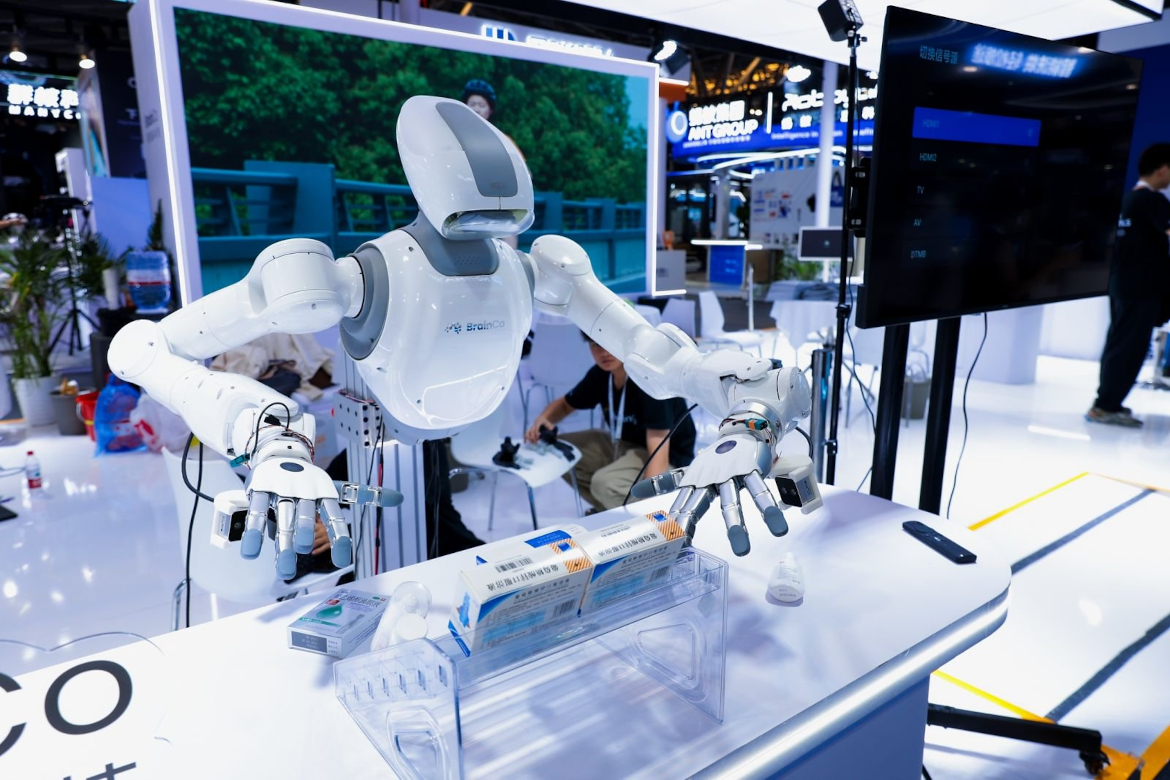
BrainCo has introduced a brain-to-robot AI platform that converts neural signals into commands for humanoids, robotic arms, and quadrupeds in under 200 milliseconds.