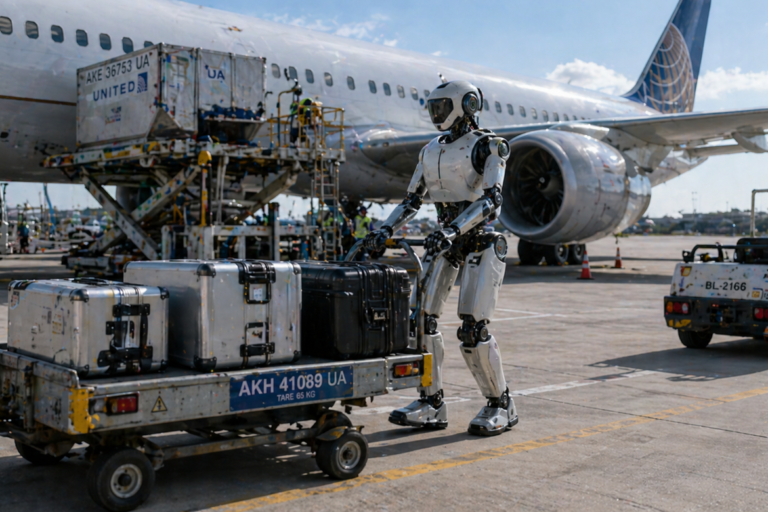
Humanoid Robots Are Being Trained by Gig Workers Filming Life at Home
Gig workers across more than 50 countries are recording household tasks to train humanoid robots, revealing a new data economy behind physical AI.
Researchers have developed a flexible sensor that allows robots to detect gentle touch with high precision, marking a step toward safer human-machine interaction.
Researchers are developing DNA-based nanorobots capable of delivering drugs and targeting viruses, though the technology remains in early experimental stages.
European companies are accelerating investment in humanoid robotics as the region seeks to regain technological momentum. Industrial expertise and automotive supply chains are emerging as key advantages.
Saronic has raised $1.75 billion to expand autonomous ship production and shipyard infrastructure. The funding highlights a shift toward software-defined maritime manufacturing at industrial scale.
Florida Polytechnic University has launched autonomous delivery robots integrated with a campus-wide point-of-sale system. The deployment signals a shift toward fully connected service robotics in everyday environments.
Xiaomi has introduced a redesigned bionic hand for its CyberOne humanoid robot, improving dexterity, tactile sensing, and durability. The upgrade reflects a broader push toward human-level manipulation in industrial robotics.
LimX Dynamics has introduced its new humanoid robot Luna at a consumer-facing event, signaling a shift from industrial robotics toward public interaction and lifestyle applications.
Sharpa has unveiled a humanoid robot capable of peeling an apple autonomously, highlighting advances in dexterous manipulation powered by multimodal AI systems.
Startup Icarus Robotics is preparing to test autonomous free-flying robots aboard the ISS, aiming to automate routine tasks in space operations.
Comtech is building a global ecosystem linking chips, software and robotics companies, aiming to accelerate commercialization of embodied AI systems.
Researchers have developed a system that allows robots to perform learned tasks faster than human demonstrations, addressing a key limitation in imitation learning.
SAIC-GM has introduced humanoid robots into a Buick battery assembly line, marking an early step toward integrating embodied AI into automotive manufacturing.
MIT researchers have developed an ultrasound wristband that translates muscle activity into real-time control signals for robotic hands, potentially advancing dexterity in humanoid robotics.
A humanoid robot appeared at the White House during an international AI education summit hosted by First Lady Melania Trump, highlighting growing interest in humanoid systems as future learning tools.