Key Notes
- Sandia has developed SPIINE to inspect narrow pipes at Hanford, with field testing at the nuclear-cleanup site still ahead.
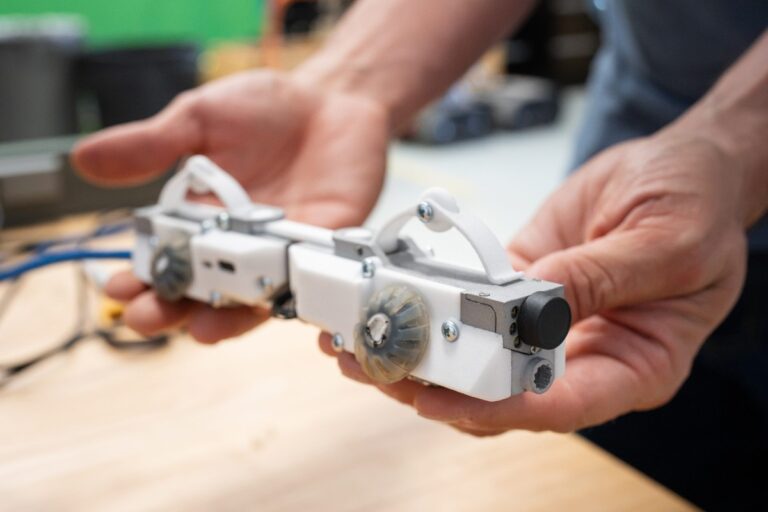
- The six-wheeled prototype uses a compliant body to negotiate tight bends while carrying a camera and a power-and-data tether.
- A published study reports travel through more than 60 meters of test pipe, while camera cleaning and fail-safe recovery remain development priorities.
Sandia National Laboratories has developed a small, flexible robot to inspect narrow pipes at the Department of Energy’s Hanford nuclear-cleanup site. Called SPIINE, the wheeled prototype is designed to bring a camera into passages that conventional inspection tools struggle to reach.
In a November 19 research update, Sandia says laboratory tests have succeeded, with testing at Hanford still ahead. The machine is remotely controlled and tethered, rather than an autonomous robot already working inside the site’s waste-transfer network.
A Flexible Body for Tight Pipe Bends
SPIINE carries a camera and adjustable LED lighting, with operators using a standard video-game controller. Its articulated body and adaptive wheels let it conform to the inside of a pipe as it moves through corners.
The engineering paper, published October 22 in Robotics, describes a compliant six-wheeled design for 53-millimeter internal-diameter pipes, commonly described as two-inch pipes. Tests included tight 90-degree elbows and movement through a bend in both directions from eight different starting roll orientations.
For this task, the robot’s shape is part of its mobility system. A machine that fits through a straight section still needs room for its body, wheels and cable to negotiate the next corner. That makes geometry a central design constraint, alongside motor power and camera quality.
Long Tethers Create Their Own Mobility Problem
The study reports travel through more than 60 meters of mixed horizontal and vertical test pipe. Separately, the researchers verified power and high-resolution video transmission over a 110-meter tether. The latter is a communications-and-power result, not evidence of 110 meters of demonstrated pipe traversal.
In straight steel pipe, SPIINE generated 16.5 newtons of pulling force. The paper also reports roughly 2–3.5 watts of measured power consumption across representative test segments; those measurements should not be treated as a guarantee for every pipe condition.
A tether provides power and a dependable data route, but dragging it around successive bends adds resistance. Reaching an inspection point and returning safely therefore require consideration of the cable as well as the crawler.
Hanford Testing and Recovery Work Come Next
Sandia is still developing camera-cleaning and fail-safe recovery functions, and exploring smaller ultrasonic sensors. The lab has published inspection footage showing the crawler’s view inside a pipe.
The project complements the broader push toward specialist nuclear-site machines covered in our AtkinsRéalis–Oxford report. SPIINE focuses on physical access to a confined space, with a human operator remaining in control.
The next milestone is evidence from the intended operating environment. Reliable retrieval, clear imagery and usable inspection measurements will matter as much as reaching a difficult bend.
Disclaimer: RobotsBeat is an independent media brand owned and operated by NuvexMedia LLC, publishing news, research, and insights on artificial intelligence, emerging technologies, automation, and related industries. NuvexMedia LLC invests in and collaborates with companies across the AI, Robotics, technology, software, and digital innovation sectors. These relationships do not influence RobotsBeat's editorial coverage, and the publication maintains full editorial independence to provide accurate, timely, and objective information. © 2026 NuvexMedia LLC. All rights reserved. This content is for informational purposes only and should not be considered legal, tax, investment, financial, or other professional advice.