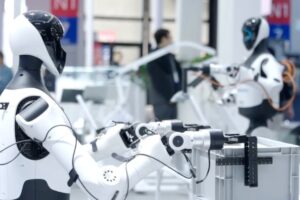
Beijing Targets 200,000-Robot Annual Capacity by 2028
Beijing’s new robotics roadmap pairs a 200,000-unit annual capacity goal with training data, stronger hardware and real-world applications through 2028.
Beijing’s new robotics roadmap pairs a 200,000-unit annual capacity goal with training data, stronger hardware and real-world applications through 2028.
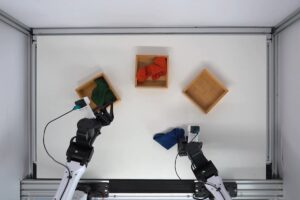
Runway has released Praxis-1 under Apache 2.0, giving robotics developers access to a video-action model, adaptation tools and robot-specific checkpoints.

Hedra’s new service combines researchers, AI agents and GPU infrastructure for robot models, with its gripper-adaptation result demonstrated only in simulation.
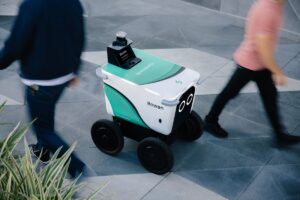
Serve’s new public API opens a sandbox for robot deliveries, while real fleet dispatch requires approval, production credentials and service-area access.

Sixth Wall Studio and Dynamic Creatures plan licensed character robots for entertainment venues, combining conversation, movement and permission-based memory.

Atlantic Net will combine uncrewed systems, underwater sensors and AI, with Ocean Infinity supporting a Royal Navy surveillance network in the North Atlantic.

Galbot’s compact humanoid wins a CES 2027 robotics award as the company promotes interactive learning for entertainment and service settings.

Gritt’s robotic attachments will expand across MasTec Renewables projects after field evaluations, with utility-scale solar providing the first focus.

Backed by Kleiner Perkins and Costanoa, Nidus is developing robot AI for precision assembly, starting with wire processing inside existing defense factories.
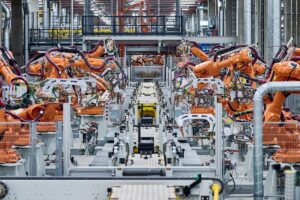
ABB’s large industrial robots will support welding, gluing, riveting and assembly at BMW’s Munich and Tiexi body shops, using OmniCore controllers.

DeepMind’s new robotics model follows tests on 200 tasks and an Apollo 2 parts-handling pilot at Mercedes-Benz, where the company reports 96% success.

Georgian led Path Robotics’ $300 million Series E as the welding-AI company expands into more manufacturing tasks and reports 17x ARR growth over 18 months.

Ring’s indoor Drone Cam films in 2K, follows mapped patrol routes and returns to its dock, alongside a $999.99 business security rover.
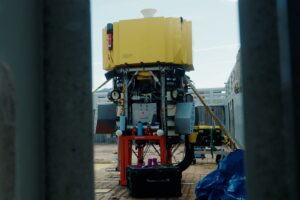
Impossible Metals says its autonomous Eureka robot recovered a 450-gram scientific sample in the Pacific, testing selective collection more than 4,000 meters down.
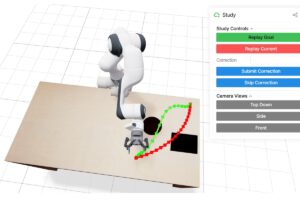
MIT and NYU researchers use language corrections to help robots generalize preferences, with simulation tests and a 12-person study presented at CoRL 2026.