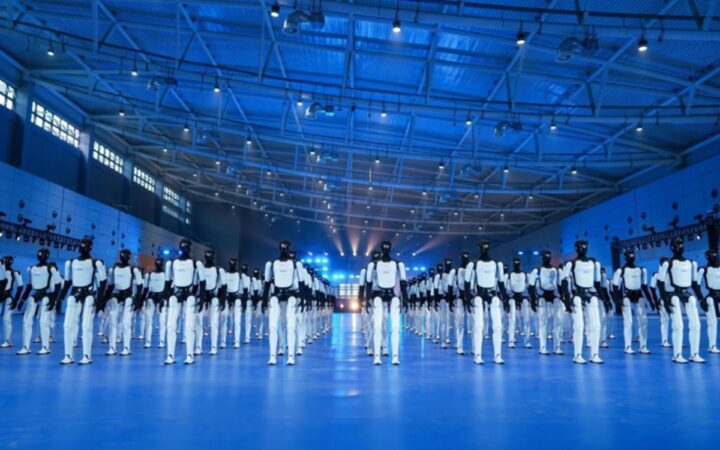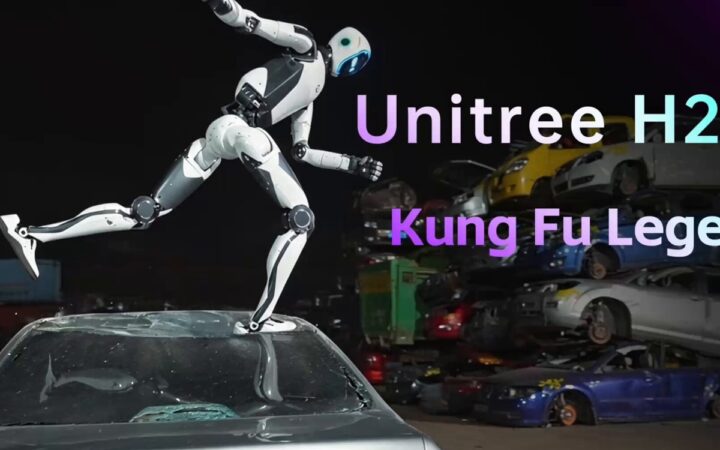
Humanoid robots performing martial arts, backflips, and synchronized dance routines captivated audiences during China’s Spring Festival Gala, the country’s most-watched annual television broadcast. The display, featuring machines developed by multiple domestic robotics companies, provided one of the clearest public demonstrations yet of how embodied AI is advancing beyond basic locomotion.
The performance was technically sophisticated. Robots executed coordinated movements with precise timing, maintained balance during jumps and spins, and operated in synchronized groups without falling. For viewers, the display represented a striking departure from earlier humanoid demonstrations, which often focused on simple walking or limited choreographed sequences.
But beyond spectacle, the performance also reflected China’s broader strategy to position humanoid robotics as a pillar of its future industrial and technological leadership.
A Public Showcase of Industrial Strategy
Public humanoid robot performances have become a recurring feature of China’s technology narrative. Experts say these demonstrations serve not only as engineering milestones but also as visible indicators of national technological progress.
Kyle Chan, a technology analyst at the Brookings Institution, noted that humanoid robots are particularly effective symbols because their capabilities are easily understood by general audiences. Unlike abstract AI systems, humanoids provide a tangible representation of technological advancement.
The scale and coordination of the gala performance offered a specific technical signal: the ability to operate multiple robots simultaneously with stable motion and consistent mechanical behavior. This requires reliable actuator control, precise synchronization, and repeatable performance across units – essential capabilities for future industrial deployment.
China’s investment in robotics reflects its broader industrial strategy. Robotics and AI have been identified as priority sectors in national development plans, aimed at transforming manufacturing from labor-intensive production toward automation-driven productivity.
Demonstration Capability vs Industrial Readiness
Despite the impressive performance, experts caution that stage demonstrations do not necessarily reflect readiness for real-world deployment.
Georg Stieler, managing director of robotics consultancy Stieler Technology and Marketing, emphasized that choreographed routines rely heavily on pre-programmed sequences and repetition. Robots performing on stage are trained extensively to execute specific motions under controlled conditions.
This differs significantly from industrial environments, where robots must respond dynamically to unpredictable conditions, handle variable objects, and recover from unexpected disruptions.
Dance routines primarily test locomotion and balance, areas where humanoid robotics has made substantial progress. However, manipulation – the ability to handle objects with precision – remains a more complex and slower-moving challenge.
Reliability is another critical factor. Industrial robots must operate continuously with minimal failure rates, a standard that humanoid robots are still working toward achieving.
A Signal of Intensifying Global Competition
China’s humanoid robot progress is occurring within a rapidly evolving global competitive landscape. The country has established a large robotics industry, supported by extensive manufacturing infrastructure and government investment.
According to industry estimates, China’s humanoid robot shipments are expected to increase significantly in the coming years. Technology leaders, including Elon Musk of Tesla, have acknowledged Chinese robotics companies as major competitors in the emerging embodied AI sector.
The rise of humanoid robotics reflects a broader shift in AI development. The first wave of AI focused on software systems, while the next phase emphasizes physical systems capable of interacting with the real world.
For China, humanoid robotics aligns with its long-term industrial transformation goals. As Marina Zhang, a professor at the University of Technology Sydney, noted, robotics could play a central role in shifting manufacturing toward higher-value, automated production.
Progress with Clear Limits
The Spring Festival Gala performance highlighted both the rapid progress and remaining challenges of humanoid robotics.
Advances in balance, coordination, and actuator control have enabled robots to perform complex physical routines that were previously impossible. These capabilities represent foundational steps toward real-world deployment.
At the same time, real-world applications require additional capabilities, including robust manipulation, environmental perception, and long-term reliability.
The gap between demonstration and deployment remains a defining challenge for the industry. But public showcases like this serve an important function: they reveal how quickly the underlying technology is advancing.
Humanoid robots may not yet be ready to replace human workers at scale. However, their growing physical capability suggests that embodied AI is moving steadily toward practical industrial and commercial roles.
As robotics companies continue to improve both hardware and AI systems, performances that once seemed futuristic are becoming technical milestones in a rapidly evolving industrial landscape.
Disclaimer: RobotsBeat is an independent media brand owned and operated by NuvexMedia LLC, publishing news, research, and insights on artificial intelligence, emerging technologies, automation, and related industries. NuvexMedia LLC invests in and collaborates with companies across the AI, Robotics, technology, software, and digital innovation sectors. These relationships do not influence RobotsBeat's editorial coverage, and the publication maintains full editorial independence to provide accurate, timely, and objective information. © 2026 NuvexMedia LLC. All rights reserved. This content is for informational purposes only and should not be considered legal, tax, investment, financial, or other professional advice.