Key Notes
- Four physical AI financings announced or reported from November 17 to 23 total $757 million, spanning robot hardware, world models and training-data infrastructure.
- Genesis AI’s $3.5 billion post-money valuation and Simplexity’s reported $1.6 billion valuation add to $5.1 billion in combined company value.
- Humyn’s $47 million package includes $26 million in equity and $21 million in debt, while neither Humyn nor Embo disclosed a valuation in the cited announcements.
Physical AI’s latest financing wave is backing several different businesses at once: complete robots, the models that control them and the data used to teach them. Four rounds announced or reported between November 17 and 23 total $757 million, led by Genesis AI’s $500 million Series A.
Genesis and Simplexity Robotics also carry combined disclosed valuations of $5.1 billion. That figure adds the value assigned to two companies; the financing total measures the new capital across all four deals. Humyn Labs’ package includes $21 million in venture debt, while Embo and Humyn have not disclosed valuations in their cited announcements.
| Company | Date | Stage | Financing | Disclosed valuation |
|---|---|---|---|---|
| Genesis AI | Nov 17 | Series A | $500M | $3.5B post-money |
| Humyn Labs | Nov 18 | Series A package | $47M: $26M equity + $21M debt | Undisclosed |
| Simplexity | Nov 23 | Pre-Series A | $100M | $1.6B reported |
| Embo | Nov 23 | Seed | $110M | Undisclosed |
The dates above identify the original announcements or reporting in November 2026. This is a comparison of four selected recent financings, rather than a total for the entire robotics market.
Genesis AI: $500M for an Integrated Robot Business
Genesis AI announced its Series A on November 17 at a $3.5 billion post-money valuation. Premji Invest, Khosla Ventures and Eclipse co-led the round, which is the largest financing in this four-company comparison.
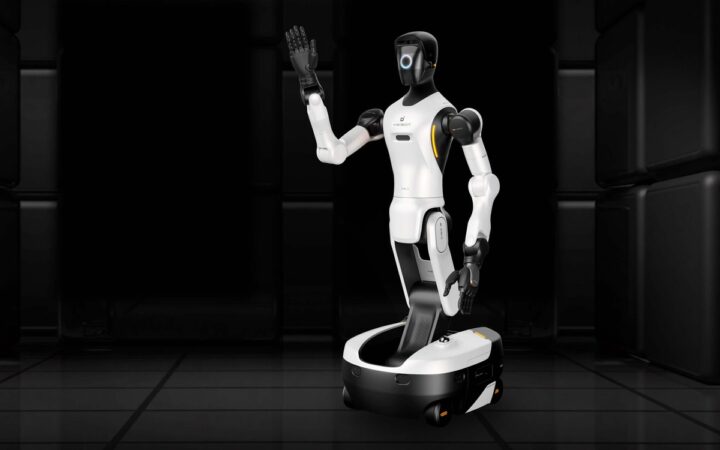
The company develops Eno, a mobile, two-armed robot, alongside its GENE foundation model, dexterous hands, data-collection gloves and simulation tools. Its approach links human demonstrations to robot behavior, then uses testing and deployment feedback to improve the wider system.
Genesis says the money will expand data acquisition and training, advance manipulation, support customer deployments and add researchers and engineers. Manufacturing, logistics and laboratories are early priorities. The scale of the round therefore supports hardware production as well as model development. Our Genesis report examines how that capital connects to Eno’s deployment plans.
Simplexity: Ant Group Leads a $100M Pre-Series A
Simplexity received $100 million in a pre-Series A round led by Ant Group, chairman and co-founder Wang Kai told Bloomberg News in a November 23 report. Existing investors including Tencent, HSG and Lanchi Ventures participated, and the transaction valued the company at $1.6 billion.
Its iX platform is a wheeled humanoid marketed for service tasks such as preparing drinks, guiding visitors and interacting with people. Those use cases require navigation, manipulation and communication to work together around a customer.
The financing gives another early-stage robot maker a billion-dollar valuation before a Series B. It also puts attention on the work needed to turn a service demonstration into a repeatable commercial operation. RobotsBeat’s Simplexity coverage separates iX’s service ambitions from the company’s earlier industrial robot shipments.
Embo: A $110M Seed Bet on Robot World Models
Embo launched on November 23 with a $110 million seed round led by Andreessen Horowitz. Khosla Ventures, DST Global, NVIDIA and other investors also backed the company. Its announcement did not disclose a valuation.
The company is building robot intelligence around world models: systems trained to predict how physical situations develop. Its plan combines internet-video pretraining, robot experience and reinforcement learning, including practice in imagined scenarios.
In its investment thesis, a16z highlights generalization and recovery: a robot should adapt when an object moves, a drawer sticks or the environment differs from its training examples. Those are development goals, rather than demonstrated reliability across all workplaces. Our Embo report looks at the connection between video learning and motor skills.
Humyn Labs: $47M for Data and Deployment Infrastructure
Humyn’s November 18 announcement details a $26 million equity round led by Accel and $21 million in venture debt led by Lighthouse Canton, with Trifecta Capital participating in the debt component. Together they form the stated $47 million financing package.
The business records people performing work in settings including factories, warehouses, farms and homes. Capture hardware and an enrichment pipeline turn those observations into labelled training data covering sight, sound, motion and touch, with source provenance attached.
Funding will support deployment-readiness infrastructure in Brazil, South Korea and India, improvements to capture and processing tools, and a wider presence near customers. The company occupies a different part of the robotics business from a manufacturer selling complete machines. Our Humyn analysis explains the preparation needed before recordings become useful model inputs.
What the Latest Robotics Rounds Are Funding
The four transactions reveal a common problem approached from different directions. Genesis and Simplexity need robots that can deliver useful work. Embo is pursuing more adaptable intelligence. Humyn is supplying structured experience from real jobs. A deployment can depend on all three: a suitable machine, a capable model and training data that transfers to the task.
Capital is concentrated even within this small sample. Genesis and Simplexity account for $600 million, or about 79% of the selected financing total. Their $5.1 billion combined valuation reflects investor pricing at these transactions, while the absence of disclosed valuations for the other two limits any broader comparison.
The next commercial evidence will come from completed workflows, intervention rates, deployment costs and repeat orders. The recent rounds provide resources to pursue those outcomes; sustained results at customer sites will show how much of the funding becomes productive robotic capacity.
Disclaimer: RobotsBeat is an independent media brand owned and operated by NuvexMedia LLC, publishing news, research, and insights on artificial intelligence, emerging technologies, automation, and related industries. NuvexMedia LLC invests in and collaborates with companies across the AI, Robotics, technology, software, and digital innovation sectors. These relationships do not influence RobotsBeat's editorial coverage, and the publication maintains full editorial independence to provide accurate, timely, and objective information. © 2026 NuvexMedia LLC. All rights reserved. This content is for informational purposes only and should not be considered legal, tax, investment, financial, or other professional advice.