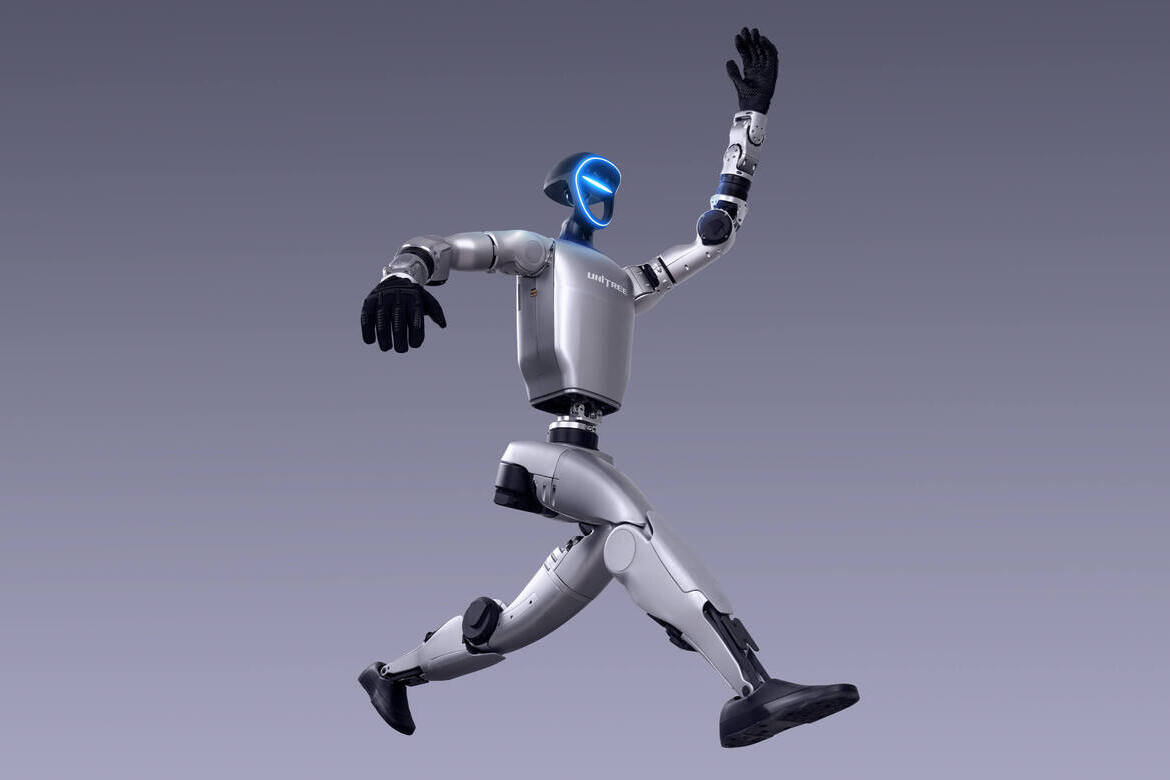

For years, humanoid robots have been defined by controlled demonstrations. Now, Unitree Robotics is moving its humanoids into production. The company recently released video showing its G1 humanoid robot assembling precision motor components on an active factory workbench, marking a transition from staged performance to real industrial work.
The deployment represents a milestone not just for Unitree, but for the broader humanoid robotics sector. The central question facing the industry has been whether humanoids can deliver consistent economic value in production environments. By placing its robots directly on assembly lines, Unitree is testing that proposition under real operational constraints.
Training Robots Through Production
The G1’s factory deployment is powered by Unitree’s UnifoLM-X1-0 embodied AI model, which integrates perception, motion planning, and manipulation control. Unlike systems trained primarily in simulation, Unitree is using real factory workflows as training environments.
This approach reflects a strategic shift toward what the company describes as a “data engine” model. As robots perform assembly tasks, they generate motion and interaction data that can be used to improve future performance. Each completed manipulation contributes to a growing behavioral dataset, helping refine grasping precision, force control, and error recovery.
The assembly of motor components presents a particularly relevant use case. It requires consistent accuracy, stable manipulation, and reliable repetition – core capabilities needed for manufacturing roles. Unlike dynamic demonstration routines, production tasks expose robots to sustained workloads and continuous operational cycles.
This method mirrors trends in AI development, where real-world data is increasingly viewed as essential for improving model robustness. Simulation remains important, but real physical interaction provides information that virtual environments cannot fully replicate.
From Demonstration to Industrial Utility
The G1 platform has already reached significant scale, with more than 5,500 units shipped in 2025. Until recently, most public demonstrations focused on dynamic mobility, coordinated movements, and athletic routines designed to showcase actuator performance and balance.
The shift toward factory assembly represents a more consequential milestone. Industrial environments impose strict requirements for consistency, uptime, and reliability. Success in such settings suggests humanoids are approaching practical deployment thresholds.
Unitree’s long-term objective, described by CEO Wang Xingxing as the “80/80 goal”, envisions robots capable of performing 80 percent of tasks across 80 percent of environments. Achieving that benchmark would mark a turning point where humanoid robots transition from niche applications to general industrial tools.
Strategic Timing in a Competitive Market
The timing of Unitree’s deployment is significant. The company is preparing for a potential public offering in 2026, and demonstrating factory utility strengthens the economic case for humanoid robotics.
More broadly, the robotics industry is converging around a shared realization: physical intelligence improves through real-world execution. Companies are increasingly deploying robots in controlled production roles not only to generate immediate productivity, but also to accelerate learning cycles.
Factories offer a uniquely structured training ground. Tasks are repetitive enough to generate large datasets, yet complex enough to expose robots to meaningful manipulation challenges. This environment allows embodied AI systems to refine capabilities under conditions that closely resemble future deployment scenarios.
The implications extend beyond Unitree. If humanoid robots can consistently perform assembly tasks, they could address labor shortages, improve production flexibility, and enable new manufacturing models.
The G1’s deployment suggests that humanoid robotics is entering a new phase. Rather than proving that robots can move convincingly, companies are now demonstrating that they can work reliably. That distinction may ultimately determine how quickly humanoids transition from engineering prototypes into industrial infrastructure.
Disclaimer: RobotsBeat is an independent media brand owned and operated by NuvexMedia LLC, publishing news, research, and insights on artificial intelligence, emerging technologies, automation, and related industries. NuvexMedia LLC invests in and collaborates with companies across the AI, Robotics, technology, software, and digital innovation sectors. These relationships do not influence RobotsBeat's editorial coverage, and the publication maintains full editorial independence to provide accurate, timely, and objective information. © 2026 NuvexMedia LLC. All rights reserved. This content is for informational purposes only and should not be considered legal, tax, investment, financial, or other professional advice.