Key Notes
- The 11-centimeter prototype weighs 98.2 grams and uses elastic rods as snapping limbs.
- Tests covered six surfaces, small steps and swimming with fins.
- Steering demonstrations included remote control and simple light-guided navigation.
Researchers at UCLA and the University of Michigan have built a palm-sized robot that hops across difficult terrain and swims using elastic rods that store energy and suddenly snap into a new shape. The design turns relatively slow motor movements into short, powerful bursts of motion.
The study, published in Science Advances on September 18, combines mathematical modeling, computer simulations and robotic-arm experiments to predict when a twisted rod will snap rather than bend gradually. The resulting prototype demonstrates how a robot’s mechanical structure can amplify its actuators. UCLA’s demonstration video shows the robot in motion.
Elastic Limbs Supply the Jump
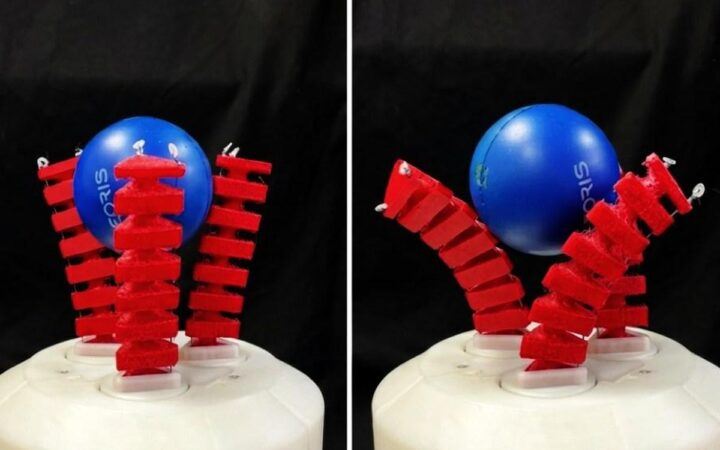
The robot’s two rear limbs are flexible rods bent into loops. Small motors twist them until they reach an unstable configuration and release stored elastic energy, propelling the body forward. The motors then reset the limbs for another cycle.
According to UCLA, the prototype measures 11 centimeters long and weighs 98.2 grams. Its advantage comes from controlling the rods’ geometry and loading, allowing the structure to deliver a rapid push without demanding equally rapid motion from the motor.
Six Surfaces and a Swimming Test
The untethered robot sustained hopping across wood, cloth, acrylic, leather, grass and sand. It reached a peak speed of 3.21 body lengths per second on wood, with a reported electrical cost of transport of 4.79. That metric relates the energy used for travel to the robot’s weight and distance covered.
The university reports an average speed of 2.46 body lengths per second across the six surfaces, compared with 0.79 for a rigid-legged comparison robot. Flexible fins added to the limbs enabled swimming at around half a body length per second. Demonstrations also included small steps and repeated backflips.
Steering Demonstrations Have Clear Limits
Michigan’s research account describes remote-controlled navigation through a sandbox with rocks, plus a simple light-sensor system that guided the robot toward illumination. These are specific steering demonstrations, rather than evidence of general autonomous navigation through unfamiliar environments.
The work complements other approaches covered by RobotsBeat, including MIT’s muscle-powered swimmer and SUTD’s ALBATROSS robot, which transitions from aerial descent to sailing. Each uses different physical mechanisms to move through its environment.
For the hopping robot, the immediate result is a tested propulsion mechanism. Applying it to practical machines will require evaluating durability, useful payload, operating time and control under the conditions of the intended task. The demonstrations establish mobility capabilities, without establishing a finished inspection or rescue product.
Disclaimer: RobotsBeat is an independent media brand owned and operated by NuvexMedia LLC, publishing news, research, and insights on artificial intelligence, emerging technologies, automation, and related industries. NuvexMedia LLC invests in and collaborates with companies across the AI, Robotics, technology, software, and digital innovation sectors. These relationships do not influence RobotsBeat's editorial coverage, and the publication maintains full editorial independence to provide accurate, timely, and objective information. © 2026 NuvexMedia LLC. All rights reserved. This content is for informational purposes only and should not be considered legal, tax, investment, financial, or other professional advice.