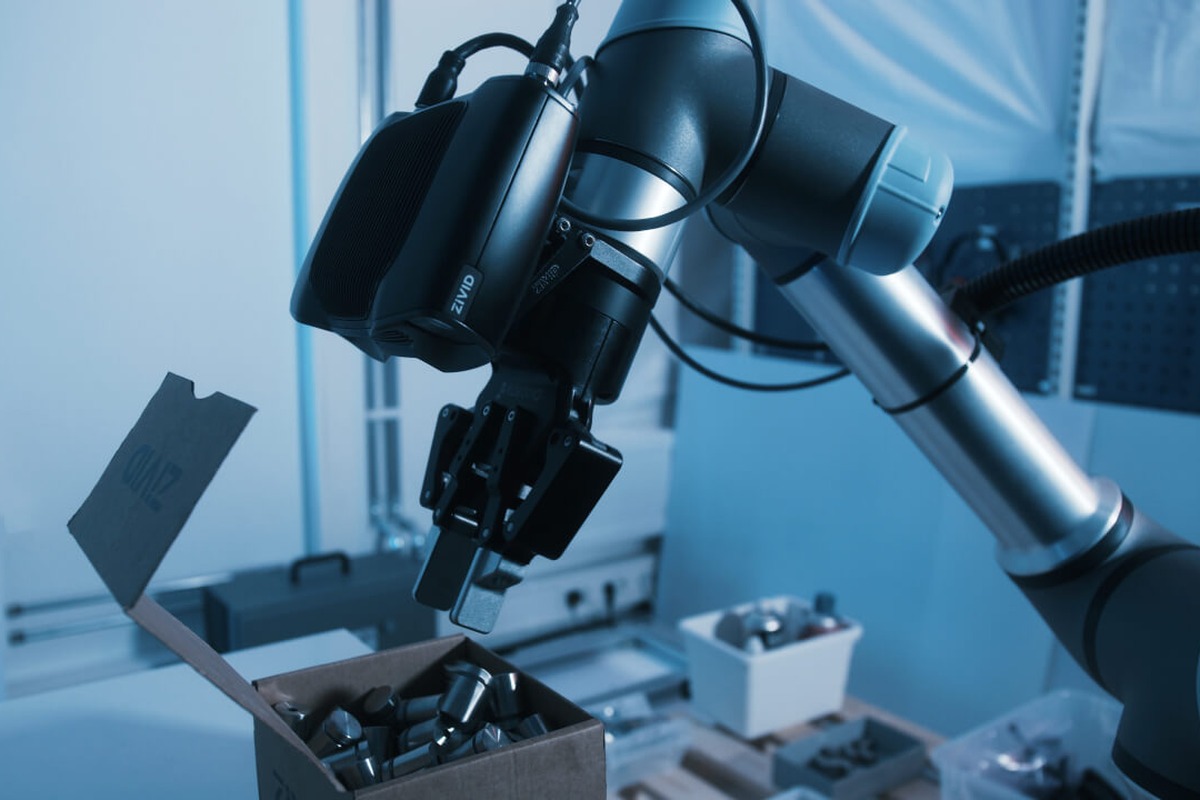
Reliable random bin picking connects useful 3D data with feasible grasps, clear withdrawal paths and accepted downstream results. Photo: Zivid
Random bin picking uses sensing and robot control to retrieve parts from a container whose contents are not presented in fixed positions. A useful system must locate an object, choose a feasible grasp, remove it without interference and deliver it in a condition the next process can accept.
This guide continues our coverage of machine vision and robot grippers. It explains how perception, access, handling and recovery fit together, and why a good first pick does not establish performance across an entire bin.
Key Takeaways
Specify bin picking around the complete downstream task, including object condition and placement accuracy, rather than accepting object detection or a successful lift as sufficient evidence.
Evaluate visibility, gripper access and withdrawal together across changing fill levels, because a clearly detected part may still be unreachable or trapped by neighboring objects.
Measure accepted output, unassisted completions, residual parts and recovery effort over representative bins, preserving the failed attempts and difficult conditions behind the overall result.
Define the Required Level of Disorder
Start by describing how parts arrive. Neatly layered components, loosely arranged identical parts and mixed objects with uncertain identities create different requirements.
A random-bin application should still have a defined operating envelope. Record the permitted part family, bin geometry, fill range, contamination and expected degree of overlap or entanglement.
Ask whether the input can be improved economically. A separator, shallow container or simple loading rule may remove a difficult manipulation problem without requiring a more sophisticated model.
Zivid’s application requirements connect point-cloud quality with the object and post-pick operation. Dropping a part into a container and accurately loading a machine require different evidence of success.
Describe the Complete Picking Chain
The workflow normally includes scene capture, object or grasp detection, candidate selection, motion planning, pickup, possession confirmation, withdrawal and delivery.
Define where each decision is made and which component owns the result. The camera may supply a point cloud while separate software estimates object poses, proposes grasps and commands the robot.
A detected pose is a hypothesis about the scene, not a guarantee that the robot can execute a useful action. The application has to connect that hypothesis with the tool geometry, robot reach and destination requirements.
Retain identifiers and timestamps through the chain. If the scene changes after capture, the program needs to know whether a previously selected candidate remains valid.
Choose Useful 3D Data
A point cloud represents sampled surface positions. Its value depends on whether it preserves the geometry needed for the task, including edges, holes or accessible gripping surfaces.
Shiny, dark, transparent or thin parts can complicate measurement. Assess the actual production material rather than assume a camera demonstration with a different surface represents the application.
Check the field of view and supported working range at both the top and bottom of the bin. A configuration that captures a full container well may provide less useful detail when only a few parts remain near the floor.
Compare capture settings using task outcomes. More points or a visually attractive cloud are useful only if they improve feasible grasp selection, placement or diagnosis within the available time budget.
Plan Around Occlusion
Parts and bin walls can hide relevant surfaces. In triangulation-based systems, both the viewing and projected-light geometry affect which surfaces can be measured.
Zivid’s occlusion guidance explains how object height, neighboring objects, dividers and camera arrangement create blind regions. Moving a camera can change visibility without making every surface observable.
Inspect the corners and walls of the actual bin, including low-fill conditions. A part beside a wall may be visible enough to recognize but lack enough exposed surface for a secure grasp.
Consider whether another viewpoint, a different container or an approved repositioning action is appropriate. Record the added time and complexity instead of assuming every new view is free.
Calibrate the Camera, Robot and Tool
The system must transform a perceived location into a physical robot action. That requires trustworthy relationships between the camera, robot base, tool center point and any relevant fixture.
A fixed camera and a robot-mounted camera have different calibration and observation workflows. With a moving camera, the robot pose associated with an image must correspond to the acquisition conditions.
Our calibration guide explains those relationships. Verify representative positions and orientations rather than checking only one convenient point above the bin.
Retain calibration records and mounting details. A camera bracket move or a gripper change can invalidate assumptions while leaving the perception software apparently healthy.
Select Grasps the Tool Can Execute
A grasp candidate needs a contact location, approach direction and tool configuration. It also needs enough space for the complete end-effector, not just the fingertips or suction surface.
Evaluate neighboring parts and bin edges around the approach. A thin visible feature may be unsuitable if the fingers cannot close around it or the tool body collides before contact.
Our vacuum guide covers sealing and possession checks for suction tools. Mechanical gripping has its own requirements for contact, closing range and load retention.
Distinguish a geometrically feasible grasp from a useful one. The robot may need to regrasp or reorient the object before placing it in a machine, adding equipment and cycle time.
Check Withdrawal and the Destination
Removing a part changes the scene. A component can snag a neighbor, lift two items together or shift the pile while leaving the robot’s nominal path collision-free in the old model.
Plan the withdrawal with the carried object and expected clearance. Include the bin lip and the object’s changing orientation, using supported sensing and control where the task requires additional feedback.
Our motion-planning guide distinguishes a target pose from an executable trajectory. For bin picking, evaluate the entire path to a useful delivered state.
Specify the destination’s acceptance condition. An object loosely held in an uncertain orientation might be acceptable for a sorting chute but unsuitable for precision machine loading.
Build a Complete-Cycle Time Budget
Consider an illustrative sequential cycle with 0.8 seconds for capture and processing, 0.4 seconds for selection and planning, 1.6 seconds for approach and pickup, and 2.2 seconds for withdrawal, delivery and return.
The total is five seconds, corresponding to an ideal ceiling of 12 completed cycles per minute. This excludes retries, replenishment, faults and other interruptions.
Some systems overlap operations, but the overlap must be physically valid. Capturing the next scene while the robot blocks the view or moves the pile can produce unusable information.
Measure the complete timeline before optimizing a single stage. Reducing image processing by 0.2 seconds matters less if repeated failed grasps consume several seconds each.
Define Recovery Before the Bin Is Difficult
Include explicit outcomes for no detection, no feasible grasp, failed possession confirmation, suspected double pick and a part left in an inaccessible corner.
Bound retries and identify what changes between attempts. Repeating the same approach to an unchanged failed candidate may add delay without improving the chance of success.
Decide whether the system may take another view, select a different object or request an operator. Any physical rearrangement action needs its own assessment and supported procedure.
Our integration guide explains state reconciliation. Maintain a known state for held material and receiving equipment when a task is interrupted.
Evaluate Whole Bins, Not Only Easy Picks
A useful acceptance plan covers full, intermediate and nearly empty bins, representative part variants and repeated replenishment. Test the corners and surfaces that operators will actually encounter.
Measure
What it reveals
What to retain
Accepted output
Useful delivered parts over elapsed time
Quality decisions and timing boundary
Unassisted success
Jobs completed without human rescue
All attempts and intervention reasons
Bin completion
Ability to handle difficult remaining parts
Residual count and stopping condition
Recovery effort
Support needed to restore operation
Actions, elapsed time and staffing
In a hypothetical test of 20 bins containing 50 parts each, delivering 980 accepted parts leaves 20 unresolved. Report which bins and conditions produced the leftovers, rather than letting the 98% overall completion figure hide a recurring corner problem.
Our acceptance guide explains test scope, denominators and configuration records. Keep assisted completions separate from unassisted results.
Validate the Integrated Application
Use qualified personnel and the manufacturer’s and site’s approved procedures for commissioning. Address access to the bin, carried loads, unexpected pile movement and connected machinery across the complete application.
Our safety guide explains why task perception and protective measures need separate assessment. A camera used for picking should not be assumed to provide protective detection.
Record the accepted camera settings, calibration, tool, part models, grasp rules, robot program and recovery behavior. Identify which tests must be reviewed after a fixture, camera or software change.
Include cleaning and inspection in handover. Dust on optics, worn gripping surfaces or a damaged bin can change behavior without any deliberate software modification.
Choose a Pilot That Can Produce a Clear Answer
Begin with one defined part family and downstream operation. Agree the required output, acceptable residual material and intervention burden before the trial.
Use comparable input batches when evaluating alternatives. A short run with a freshly arranged pile should not be compared directly with a full-shift trial containing difficult replenishment conditions.
Include integration, tooling, maintenance and recovery labor in the business case. Our ROI guide connects measured operating evidence with realizable value.
Random bin picking becomes useful when perception and handling produce repeatable downstream results. A well-defined pilot makes its capability, limitations and support requirements visible before the application expands.
Keep Scene Updates Consistent
Decide when the system captures a fresh scene and which changes invalidate the current set of candidates. Removing one component can move its neighbors, so remaining detections may need reconsideration before the next action.
Do not let a successful first pick conceal stale information on subsequent picks. Record whether the scene is reacquired, checked against a supported change model or otherwise verified, and include the resulting timing in the full-bin test. The appropriate policy depends on the objects and handling process.
Frequently Asked Questions
What is random bin picking? It is robotic retrieval of parts from a container where their positions and orientations are not fixed, using sensing and planning to choose executable picks.
Is a 3D camera the complete solution? No. The application also needs suitable detection or grasp logic, calibration, tooling, motion planning, interfaces and recovery behavior.
Why are the last parts often difficult? Remaining parts may lie beside walls, in corners or in awkward orientations, with less useful visibility or tool access than the initial pile.
Does detecting a part prove it can be picked? No. The tool must approach, establish a suitable grip, withdraw and deliver the object without unacceptable interference or damage.
How should performance be measured? Measure accepted output, unassisted completions, residual parts and recovery effort over representative bins and clearly defined elapsed time.
What should a first pilot include? Use a bounded part family, realistic bins and a defined destination, then test different fill levels, replenishment and approved recovery cases.
Elon Musk says Optimus could surpass every product category as Tesla ramps up humanoid manufacturing and shares AI technology across robots and vehicles.