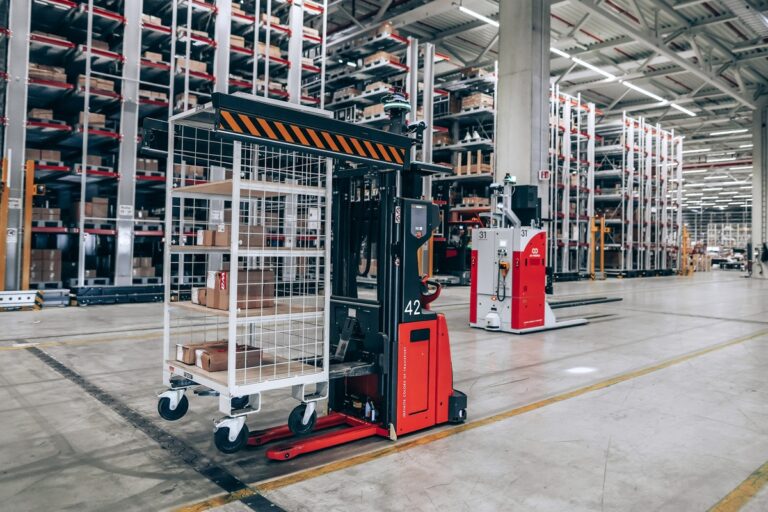
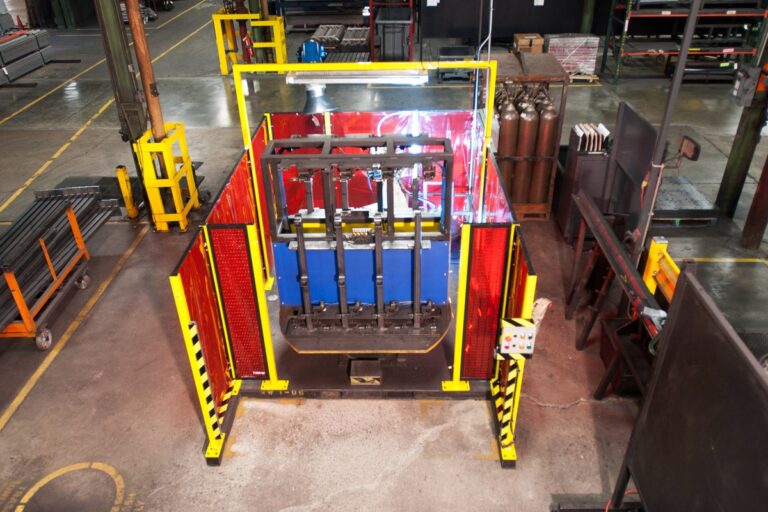
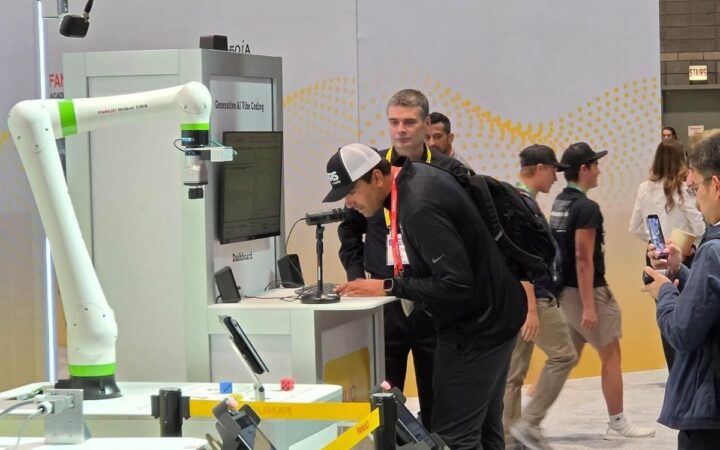
Robot safety depends on assessing the complete application and validating protective behavior across production, recovery and maintenance. Photo: WireCrafters / Wikimedia Commons
Learn how to organize robot-cell risk assessment, protective functions, recovery and validation, with clear responsibilities across the application lifecycle.
Robot safety is a property of the completed application: the robot, tool, workpiece, surrounding machines and the ways people interact with them. Selecting a robot with protective features is a starting point, while the installation still needs an assessment, suitable risk reduction and documented validation.
This guide explains how to organize that work for an industrial robot cell. It extends our cobot guide and provides a framework for discussing requirements with qualified integrators, safety specialists and the operating team.
Key Takeaways
Assess hazards across production, setup, recovery, maintenance and eventual removal, including the tool, carried load and neighboring equipment rather than the arm alone.
Define each required protective function through its detection, logic, machine response and reset behavior, then validate the completed chain under relevant conditions.
Keep the assessment, approved configuration, training and validation records connected, and review affected safeguards whenever the process or installation changes.
Define the Application and Its Boundaries
Start with what the cell does and who interacts with it. Identify the handled materials, process equipment, operating modes, access points and interfaces to other machines. Include reasonably foreseeable activities, not only the intended automatic cycle.
Record the physical boundary and the control boundary. A conveyor can carry a hazard through a perimeter opening, while a shared control signal can affect equipment outside the robot enclosure. Ownership should be clear at each interface.
OSHA’s robot guidance discusses hazards associated with robot systems and their applications. Use it as one authoritative reference alongside the requirements applicable to the installation.
This guide does not establish certification or a ready-to-use safeguard design. The practical output is a clear set of questions, responsibilities and evidence for the people qualified to design and validate the system.
Understand the Standards’ Scope
ISO 10218 distinguishes requirements relating to industrial robots from requirements for their integrated applications. The official scope of Part 2, published in 2025, addresses industrial robot applications and robot cells through their lifecycle.
Scope matters. Do not assume that a standard for an industrial cell covers every mobile platform, public-facing robot or specialist environment. Identify the relevant equipment and application requirements with competent specialists.
Safety-related control systems also have their own design and validation considerations. ISO 13849-1 provides general principles for safety-related parts of machinery control systems. A component label is not evidence that the completed function achieves its required performance.
Standards and law are related but distinct. Record the applicable editions and jurisdictional requirements for the project rather than declare compliance from a generic article or vendor brochure.
Assess Every Relevant Operating Mode
Activity
Questions to examine
Evidence to retain
Automatic production
Where can people encounter motion, process hazards or moving loads?
Layout, access arrangements and validated protective functions
Setup and teaching
Who enters, what motion is needed and which controls govern the activity?
Approved mode behavior, instructions and training
Fault recovery
What state can the robot, part and adjacent machines be left in?
Recovery sequence, authorization and restart checks
Service and cleaning
Which energy sources and stored loads must be controlled?
Equipment-specific isolation and service procedures
Observe the real process with operators and maintenance staff. A difficult replenishment point or frequent jam may lead people to seek access that the initial layout did not accommodate well.
Design legitimate work into the installation. If routine inspection requires entering a hazardous area, address that need explicitly rather than rely on instructions that are impractical to follow.
Look Beyond Contact With the Arm
Potential hazards include crushing between equipment, cutting from tooling or sharp workpieces, dropped loads and unintended movement of attached equipment. The process may add welding, heat, fumes or other hazards.
A low-speed movement can still create a trapping situation. A smooth collaborative arm may carry a sharp component. A gripper can retain stored energy or release a load independently of the robot’s joint motion.
Our gripper guide explains the physical handling interface. Include its failure modes and load condition in the cell assessment, including what happens when power or compressed air is unavailable.
Keep a hazard record tied to specific situations. “Robot collision” is less useful than identifying the person, activity, possible contact location and machine state that create the exposure.
Choose Risk Reduction in a Deliberate Order
First consider whether the design can remove or reduce the hazard: change the layout, improve part presentation, remove a trapping point or avoid a sharp tool near an access area. Then determine which safeguards and complementary measures are needed.
Information and training remain important, but they should not be used to excuse an avoidable design problem. A warning label does not prevent an unexpected movement or physically retain a dropped load.
Document the reasoning behind the chosen measures. Where a requirement can be satisfied through different arrangements, compare their behavior during normal work, foreseeable faults and maintenance.
NIST’s integration report discusses collaborative workcell deployment and the role of application assessment. Treat collaborative operation as a designed and evaluated interaction, rather than a property conferred on every task by the robot family.
Specify Protective Functions End to End
A protective function needs a defined trigger and a defined machine response. Identify what detects the condition, how the logic evaluates it and which equipment must react.
For an interlocked access arrangement, the assessment should establish the necessary behavior when access changes, when a fault is detected and when operation is restored. The reset and restart sequence deserves the same attention as the initial stop.
Specify response requirements and relevant performance targets through the appropriate design process. The sensor, logic and actuators need to work as a complete chain. A suitable scanner connected to ordinary software does not automatically create a suitable safety function.
Keep the functional specification understandable to the operating team: what event causes what response, which conditions permit recovery and how the function is verified. Technical calculations and implementation details should remain available in the engineering record.
Stopping Behavior Must Match the Installation
Protective placement and operating limits depend on the actual machine behavior. Load, speed, tool geometry and configuration can influence movement after a stop is initiated.
Use the manufacturer’s documented data and the required installation-specific measurements. Do not derive a safeguard position from a generic robot speed or a sensor’s advertised update interval alone.
Check the complete moving envelope, including the carried part and the space into which it could move or fall. An arm stopping inside a boundary does not establish that a long workpiece also remains inside it.
Our planning guide explains ordinary collision models. Keep those models distinct from the validated protective functions used to reduce risk to people.
Recovery Is Part of the Design
A stopped cell may contain a partly inserted component, an occupied gripper, a machine door in transition or an unfinished transfer. Define how the system establishes the actual state before the next movement.
For an illustrative machine-loading cell, a person may need to resolve a failed grasp. The approved recovery process must address access, retained load, neighboring machine state and the conditions for resuming the sequence.
Do not treat an acknowledged alarm as proof that the physical situation is corrected. Operators need clear instructions and the authority to escalate conditions outside the approved recovery procedure.
During validation, include representative interrupted states rather than demonstrate only an empty, correctly initialized cell. Record whether the system prevents ambiguous or unintended continuation.
Maintenance and Energy Control
Service can expose electrical, pneumatic, mechanical and other stored-energy hazards. An emergency stop does not substitute for the approved isolation arrangements required for the work.
OSHA’s energy-control overview explains why unexpected startup and energy release require specific procedures and training. Apply the relevant site and equipment requirements through authorized personnel.
Provide practical maintenance access, documentation and suitable service arrangements. A design that makes routine inspection unnecessarily difficult can create avoidable operational pressure.
Our maintenance guide connects fault evidence, approved repair and return-to-service checks. Changes made during repair can affect safeguards and should enter the change-control process.
Validate and Preserve the Evidence
Validation should determine whether the implemented measures satisfy the documented requirements. It involves more than observing a successful stop once or checking that a device appears in a configuration screen.
Define the test conditions, expected results, responsible people and acceptance criteria before commissioning. Include the relevant normal conditions, fault cases, operating modes and restoration behavior.
Keep the results linked to the exact hardware, software, parameters and layout tested. A later adjustment can invalidate part of the evidence even if the cell still looks unchanged.
The handover should include the assessment, function specifications, validation records, instructions, training requirements and ownership of future reviews. Make unresolved limitations visible rather than leave them as informal knowledge held by one engineer.
Training and Operating Ownership
Define the activities each role may perform, including production operation, teaching, recovery and service. Training should connect the actual cell’s controls and instructions to those responsibilities, with a clear route for reporting unfamiliar conditions.
Keep the instructions usable at the point of work. Operators should be able to identify the approved product and operating mode, recognize a condition outside the procedure and contact the responsible person. Record changes in responsibilities and training when the installation is modified.
Review Changes Through the Cell’s Life
New products, tools, cycle speeds, access arrangements and neighboring machines can alter hazards. Even a small fixture change may create a trapping point or modify the carried-load envelope.
Establish who may authorize changes and which checks are required before release. Review the affected assessment and safeguards rather than assume that a previous acceptance covers every future variant.
Capture operator reports, repeated interventions and near misses through the site’s reporting process. These can reveal exposure patterns absent from the original assumptions.
A useful robot safety program keeps the installation, the evidence and everyday work aligned. The goal is an application whose protective behavior is understood, validated and maintained as the process evolves.
Frequently Asked Questions
Does buying a cobot make an application safe? No. The tool, workpiece, layout and interaction still require assessment. Collaborative features support particular protective arrangements but do not remove every hazard.
Which robot safety standard should a project use? Determine the applicable standards, editions and legal requirements for the exact equipment, application and jurisdiction with competent specialists. Industrial-cell requirements do not automatically cover every robot environment.
Is collision avoidance a protective function? Ordinary navigation or motion-planning collision avoidance should not be assumed to provide validated protection for people. Assess the implemented safety architecture separately.
Is an emergency stop enough for maintenance? No. Maintenance may require control of several energy sources and stored loads through approved isolation procedures. The appropriate method depends on the work and installation.
When should a risk assessment be reviewed? Review affected assumptions after changes to the process, tooling, layout, control behavior or operating activities, and when operating evidence reveals a new concern.
What evidence belongs in the handover? Retain the assessment, protective-function requirements, approved configuration, validation results, instructions, training arrangements and responsibility for future changes.