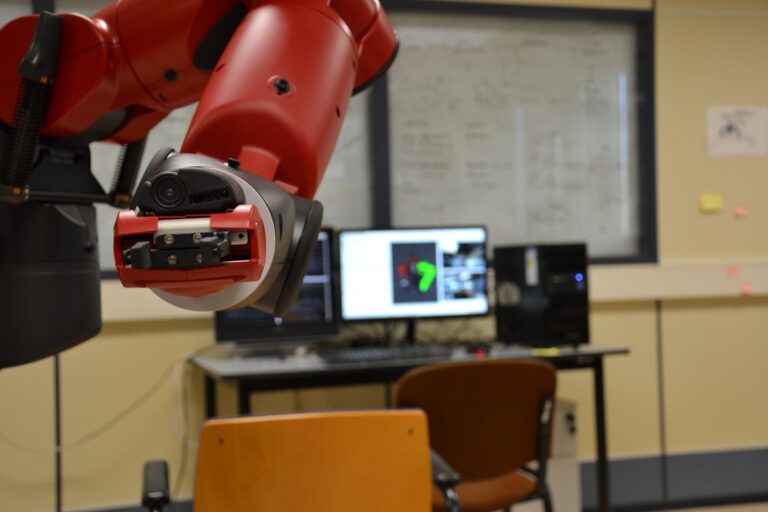
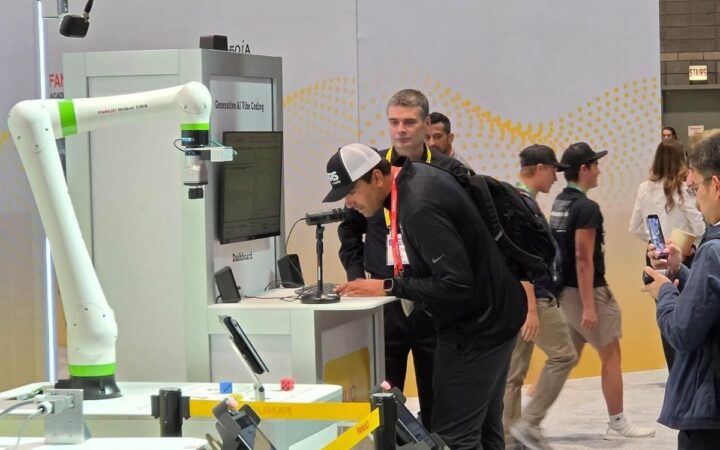
Robot grippers must acquire, retain and release real parts consistently while meeting the task’s motion and quality requirements. Photo: Gustavo A. Casañ / Wikimedia Commons
Compare mechanical, vacuum and soft robot grippers, then learn how payload, contact geometry, sensing and complete-cycle tests determine reliable handling.
A robot gripper is the device that holds an object while the robot moves or manipulates it. It can use mechanical fingers, suction or another suitable gripping method. Selecting it well is essential: an accurate arm cannot compensate for a part that slips, deforms or sits unpredictably in the tool.
This guide explains common gripper types, the difference between grasping and manipulation, and how to evaluate a tool using real parts. It builds on our cobot guide and focuses on the physical interface that often determines whether an automation project succeeds.
Key Takeaways
Choose a robot gripper for the complete pickup, movement and release sequence, using the real object geometry, surface condition and quality requirements rather than a single force rating.
The robot carries the tool as well as the object, so payload, center of gravity, clearance and the intended motion must be checked together with the gripper’s own limits.
Reliable grasping requires meaningful acquisition feedback and representative cycle tests that record damage, release failures, successful delivery and operator recovery work.
Grippers and End-Effectors
An end-effector is the equipment attached to a robot to perform its task. A gripper is one kind of end-effector; a welding torch, dispensing nozzle or inspection probe is another. The terms are sometimes used loosely, so a specification should state exactly what the tool must do.
Grasping establishes and maintains a hold. Manipulation changes an object’s position or relationship to something else, such as turning it, placing it in a fixture or inserting it into an assembly. A secure transport grip may still be unsuitable for a precise insertion.
Consider a component picked from a tray and placed into a machine. The tool must access it, acquire it in a known orientation, retain it during movement and release it without disturbing the final position. Every stage matters.
Start the selection process with those actions rather than with a preferred product. A familiar gripper may save integration effort, but it should not force the rest of the workstation into an unreliable arrangement.
Common Gripping Methods
Mechanical grippers use fingers or jaws to contact an object. Parallel jaws suit many parts with accessible opposing surfaces; other geometries can center a circular object or adapt around a shape. Robotiq’s selection guide distinguishes its models by factors including motion, stroke, environment and object geometry.
Vacuum tools use a pressure difference at a contact surface. They can be useful where the top face is accessible, but surface condition and the ability to maintain a seal or sufficient flow affect the result. Robotiq’s vacuum documentation separately lists tooling weight, material compatibility, energy supply and control signals.
Soft or compliant tools can accommodate shape variation, although flexibility can also make the final object position less certain. Magnetic tools are an option for appropriate ferromagnetic materials, with attention to release, residual magnetism and the specific application.
Method
Useful property
Question to resolve
Mechanical fingers
Defined contact and potentially repeatable positioning
Is there enough approach and opening clearance?
Vacuum
Access from an exposed surface
Does the real surface support reliable retention?
Soft or compliant
Accommodation of some shape variation
Is object pose controlled well enough for placement?
Magnetic
Holding suitable ferromagnetic parts
Can acquisition and release meet the process requirements?
There is no universal winner. Select the method that performs the complete task across the approved product range, with manageable maintenance and recovery.
Build an Object Specification
Record more than mass and maximum dimensions. Include geometry, dimensional tolerances, surface texture, coatings, porosity, stiffness and temperature. Identify areas that may be touched and areas that must remain free of marks.
Document how the object arrives. An isolated component in a fitted tray presents a different problem from the same component overlapping others in a bin. Packaging can also change the grip: a loose sleeve, seam or label may interfere with an otherwise suitable contact.
Include the least favorable approved condition. If a process normally leaves a thin oil film on a part, a dry sample from the design office is not representative. If cartons vary by supplier, collect examples from each relevant source.
Specify acceptable outcomes. A part can be delivered without falling yet still fail because its surface is marked, its orientation is wrong or its packaging is crushed. Those failures need to be visible in the trial record.
Payload Includes the Tool
The robot carries the gripper as well as the object. Universal Robots’ payload guidance says to include both and explains that the center-of-gravity offset affects the usable load. Configured mass, center of gravity and inertia influence motion performance.
In an illustrative design, a 3 kg product, 1.5 kg gripper and 0.5 kg mounting assembly produce a 5 kg carried load. Any additional equipment mounted at the wrist must also be considered. That sum is a starting point, not proof that a nominally 5 kg arm suits the task.
The object’s distance from the wrist and its orientation affect the load on the robot and tool. A long item held at one end creates different demands from a compact item centered near the mounting flange.
Have the supplier verify the proposed fingers, mounting, motion and load against the relevant limits. The robot’s payload rating and the gripper’s holding rating are different specifications, and both must suit the application.
Stroke, Clearance and Contact Geometry
Stroke describes the available jaw movement, but custom fingers determine the actual contact geometry. A gripper that can open around a part may still be unable to approach it inside a crowded tray or release it within a narrow fixture.
Review the whole motion with the jaws open and closed. Include the tool body, hoses, cables and mounting hardware. A collision check that represents only the robot arm omits some of the equipment most likely to enter a confined space.
Contact location also affects repeatability. Flat pads may permit a part to shift slightly; shaped fingers can constrain it more consistently but may suit fewer variants. The best choice depends on how accurately the next process needs the object positioned.
Check access before adding a larger opening range or stronger actuator. Sometimes moving parts farther apart in a tray or adding a locating feature creates a simpler and more reliable application.
Holding Force Is Not the Whole Story
A gripper must retain the object during the intended motion without damaging it. Grip behavior depends on contact geometry, surface condition, object properties and the forces created by movement. A static hold on a bench does not establish performance during rapid transfers.
More force can introduce a different failure. A thin-walled part may deform, packaging may collapse, or a compliant surface may shift as it is squeezed. The goal is a reliable grasp that preserves the required quality, not maximum actuator force.
For vacuum handling, check what happens to retention when the surface varies or one contact area becomes ineffective. For mechanical jaws, examine wear and the influence of contamination on the contact. The manufacturer or integrator should determine suitable operating margins for the application.
Test the intended movement with appropriate safeguards and competent personnel. Do not derive a production setting from an informal attempt to find the point at which a part falls.
Confirm That the Object Was Acquired
A close command confirms an instruction, not necessarily a successful grasp. Feedback might include jaw position, object detection, pressure, vacuum level, force or an additional image, depending on the tool and task.
Define what each signal proves. A jaw position can indicate that something is between the fingers but may not establish the correct orientation. A vacuum reading may indicate suction without confirming that only one sheet was picked.
Consider an illustrative sheet-handling task. The robot needs to distinguish an empty pickup, one correctly held sheet and an unintended double pickup. A single “tool active” bit does not necessarily distinguish those states. Additional sensing or process constraints may be needed.
Associate confirmation with the current cycle. Stale feedback from the previous grasp must not be mistaken for evidence that the next part is present. Timeouts and contradictory signals should have defined outcomes.
Release and Placement Need Equal Attention
Some applications fail at release rather than pickup. A part can stick to a pad, remain attached by residual suction or shift as fingers withdraw. Inspect the delivered result, especially when placement tolerance is important.
Allow for the tool’s withdrawal path. An object placed between neighboring components may be correctly positioned but leave no room for the fingers to open. That is a geometry problem, not a programming-speed problem.
If the next machine clamps the part, coordinate the handoff so responsibility for holding it is clear. Decide which confirmation allows the gripper to release and what happens if the receiving fixture does not report readiness.
A useful trial completes the entire pickup-to-placement sequence, including the next operation. Repeatedly lifting a part into the air tests only a fraction of the process.
Testing Reliable Grasping
NIST’s manipulation program develops performance metrics and test methods for grasping and assembly. Its work highlights the value of documented, repeatable comparisons rather than an impressive isolated pickup.
For a practical acceptance trial, build a matrix of the actual part variants, contact conditions, orientations and intended motions. Record failures by stage: acquisition, retention, placement, release or quality damage.
Representative inputs: Use approved variation, including difficult surfaces and geometry.
Complete cycles: Include the real route, fixture and release sequence.
Useful output: Count correctly delivered, undamaged parts rather than attempted grasps.
Recovery: Measure how often people intervene and how long restoration takes.
In a hypothetical 500-cycle test, 490 successful deliveries mean a 98% completion rate. If the ten failures each require three minutes of intervention, the test also creates 30 minutes of recovery work. That burden can matter more than shaving a fraction of a second from the nominal grip time.
Record the sample and conditions with the result. A fault-free short run does not establish reliability over every product variant or the tool’s service life.
Soft Grippers and Dexterous Hands
Research tools can rotate objects within a grasp, accommodate deformable items or use tactile feedback to adjust contact. These capabilities can expand the task range, but should be evaluated against a specific requirement.
Our report on a soft gripper describes in-hand rotation and the limits observed in testing. It is a useful example of why a demonstration of dexterity should not be treated as evidence of unrestricted handling capability.
For a production task that only needs a part moved between two known fixtures, additional fingers and complex control may add unnecessary maintenance or integration work. For a task requiring reorientation without release, those features may address a real constraint.
Compare the complete sequence, including quality, sensing, maintenance and recovery. A simpler tool with a well-designed fixture can outperform a more versatile hand on a narrowly defined job.
Maintenance, Changeovers and Safety
Plan for contact surfaces and consumable components to change with use. Define inspection, cleaning and replacement procedures using the manufacturer’s instructions. Keep approved spare fingers, cups or pads available where a worn component would stop production.
A tool change may alter mass, geometry, center of gravity and the robot’s collision envelope. Update the relevant configuration and review the application before returning it to service. Similar-looking fingers are not automatically equivalent.
Assess loss of power or air, a dropped workpiece and trapping points as part of the complete application. A collaborative arm does not remove hazards created by its gripper or the object it carries. Our cobot guide explains that distinction.
Choose the gripper by the result it must sustain: the correct object, held without damage, moved through the intended path and released in a usable state. That specification is more valuable than a single force or payload number.
When parts arrive in varying positions, our machine vision guide explains how sensing and calibration can support the grasp without replacing physical confirmation.
Frequently Asked Questions
Is a gripper the same as an end-effector? A gripper is one type of end-effector. Other end-effectors perform tasks such as welding, dispensing or inspection without necessarily holding an object.
Are vacuum grippers only suitable for smooth objects? No single rule covers all vacuum tools. Suitability depends on surface properties, contact geometry, available flow and the particular product specification. Test the actual material and condition.
Does a stronger gripper always hold more reliably? No. Extra force can damage or deform the object. Contact geometry, surface condition, sensing and the intended movement also determine whether a grasp is reliable.
Does robot payload include the gripper? Yes. Include the tool, object and relevant wrist-mounted accessories, then verify center of gravity, inertia and motion limits against the robot’s documentation.
Can one gripper handle many products? Sometimes. The useful range depends on geometry, contact, clearance and placement requirements. Compare a versatile tool with dedicated fingers or controlled changeovers for the actual product mix.
What is the best way to test a gripper? Run complete, representative cycles and record successful delivery, damage, release failures and interventions. A static hold or a few selected pickups does not verify the production process.