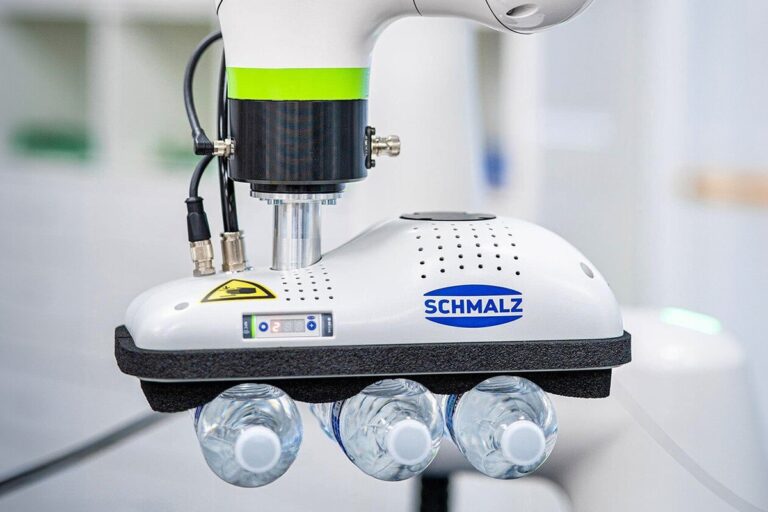
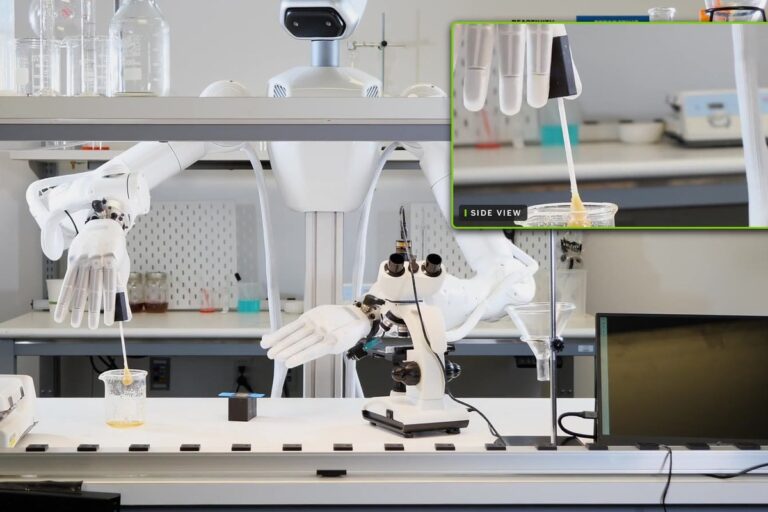
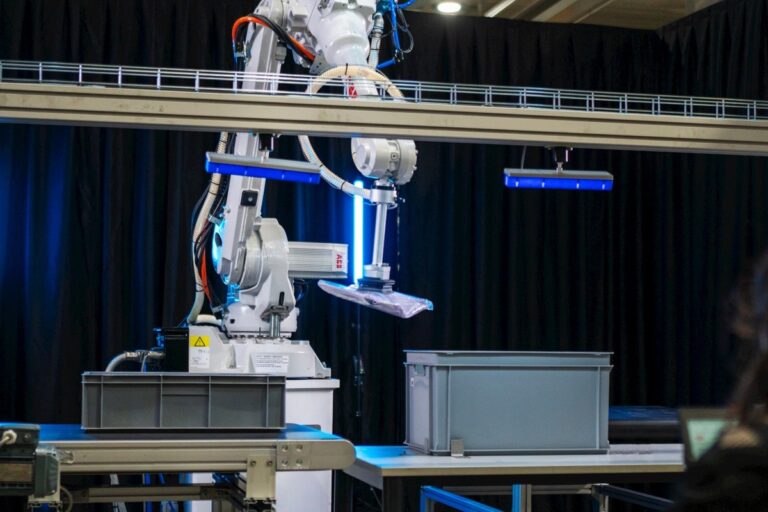
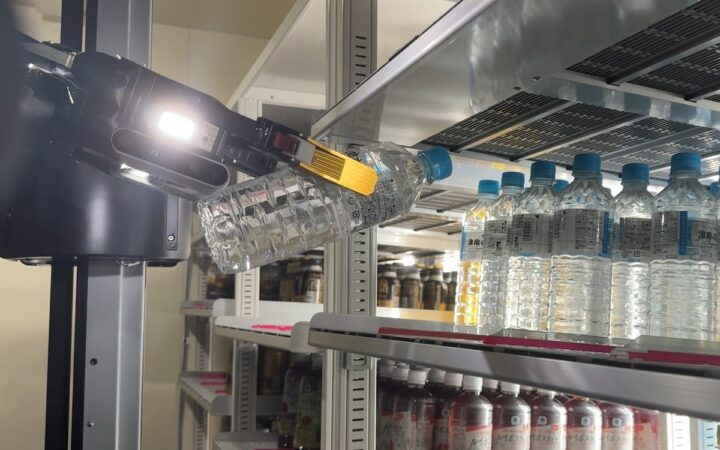
Robot foundation models connect learned manipulation with simulation and task orchestration, while deployment still requires physical validation. Photo: NVIDIA
NVIDIA’s GR00T 2 Robot Foundation Model: A Practical Guide to Simulation and Deployment
By Laura Bennett• 10 mins read
Published:
, Updated:
Learn how NVIDIA’s GR00T 2 robot foundation model works with simulation and agentic workflows, and how to plan adaptation, evaluation and physical deployment.
Robot foundation models aim to reuse experience across tasks and machines, reducing the amount of new data needed for each application. Turning that capability into dependable physical work requires a wider workflow: define the task, adapt the model, rehearse relevant conditions, evaluate failures and verify the complete system on hardware.
NVIDIA’s CoRL 2026 research offers a useful way to understand those stages. Our CoRL overview covers the announcements; this guide explains how GR00T 2, simulation and agentic programming fit together and what a practical evaluation should establish.
Key Takeaways
Separate the robot foundation model, simulation environment, evaluation framework and task coordinator, because each addresses a different development problem and needs its own evidence of suitability.
Evaluate adaptation against a defined robot, object family and operating envelope, keeping training demonstrations separate from held-out tests and recording both task success and intervention requirements.
Use simulation and agentic workflows to expose failures and improve inspectable task logic, then validate physical performance, recovery and protective measures before expanding the application.
Start With the Job, Then Select the Model
A useful starting point is a bounded physical task: identify a component in a tray, grasp it, place it in a fixture and confirm acceptance. Specify the permitted objects, initial arrangements and expected final state before choosing a learning method.
Define variation explicitly. A tray arriving at several known poses is different from an arbitrary object appearing anywhere in a building. Lighting, surface finish, object deformation and tool wear can each change the difficulty.
Also define unacceptable outcomes: damaged components, uncertain placement, excessive force or a task that needs repeated manual rescue. These conditions belong in the requirements even when the nominal sequence looks simple.
Our robot-learning guide introduces learning methods. Here, the next question is how a reusable model contributes to a specific application rather than whether a demonstration looks impressive.
What GR00T 2 Adds
NVIDIA describes GR00T 2 as a world-action model. It predicts future video and robot actions together, using recent images, an instruction and robot-state information. Predicting an expected visual outcome gives the model another representation of how its actions should change the scene.
The company’s research page describes training across human video, handheld demonstrations and robot data. The aim is to transfer useful behavior across embodiments: machines with different hands, arms or other physical configurations.
In its 50-task adaptation evaluation, NVIDIA reports 40% average trial success without task-specific demonstrations on the target robot, rising to 71% with one demonstration per task and 95% with five. Separately, 40 of the 50 tasks succeeded at least once without target-task demonstrations. That task-coverage count is not an 80% average success rate.
These findings describe the reported research setup. They do not establish the success rate for a different robot, object family or factory. The page lists code availability for December, so check which artifacts are actually available before planning a reproducible implementation.
Map the Development Stack
A model selects actions; a simulator provides a virtual environment in which actions have consequences. An evaluation framework organizes tests. A task coordinator decides how skills are sequenced and what happens after a failure.
Layer
Role in the workflow
Question to resolve
GR00T 2
Learned manipulation and predicted outcomes
Can it perform this task on this embodiment?
Isaac Lab and physics
Training and rehearsal environments
Do modeled interactions reflect relevant reality?
Isaac Lab-Arena
Structured policy evaluation
Which variations expose failures?
Task orchestration
Skill sequencing, verification and recovery
Can the full job finish with understandable exceptions?
NVIDIA’s CoRL announcement connects these areas, but they should not be treated as one interchangeable product. A team may use a learned skill with existing control software, or evaluate a policy in simulation without adopting every research project in the announcement.
Draw the intended architecture and assign ownership of each interface. Include sensing, robot control, station equipment, logging and operator intervention.
Check the Robot and Observation Interfaces
Cross-embodiment learning does not make mechanical differences disappear. A two-finger gripper and a dexterous hand differ in contact geometry, actuation and the actions they can physically execute.
Establish the supported action representation, required robot-state inputs, camera arrangement and timing. Determine how model outputs reach the robot controller and what validates commands before execution.
Calibration remains essential. An object location inferred from an image must correspond to the robot’s physical coordinate system. A camera move can invalidate that relationship even when the model itself is unchanged.
Our calibration guide explains tool, base and camera relationships. Test the complete observation-to-action chain before attributing every failure to the policy.
Collect Demonstrations That Answer a Defined Need
Demonstrations show the intended behavior, but their usefulness depends on what they contain. Record task identity, object variant, camera configuration, robot state and how success was established.
Cover the variation the application must handle. Five nearly identical demonstrations from one favorable arrangement may provide less useful coverage than a carefully chosen set spanning the permitted positions and grasp conditions.
Keep training, tuning and final evaluation data distinct. If the team repeatedly inspects a test set and changes the policy to fix its failures, that set has become part of development. Retain a separate evaluation set for assessing the resulting system.
Human video and teleoperation supply different information. Video can show visible behavior; instrumented demonstrations can also provide action or motion measurements. Our hand-data report explains one capture workflow. Check dataset and model licenses independently before incorporating either into a project.
Build Simulation Around the Failure Modes
Choose simulation detail according to what can derail the task. A rigid-block transfer may depend mainly on grasp geometry and friction. Cable insertion may also depend on deformation, contact and force response.
NVIDIA describes Newton as an extensible physics engine built on Warp and OpenUSD. Its scope includes contact, friction, rigid and soft bodies, and actuator and sensor modeling. Those capabilities create options for modeling; they do not guarantee that a particular scene has the correct parameters.
Compare relevant simulated behavior with measurements. Does the object slip under the expected conditions? Does the tool contact the fixture where predicted? Can the modeled controller reproduce the delays that matter to execution?
Our digital-twin guide explains validation of model predictions. Start with the properties that affect the decision being tested, then document the remaining limitations.
Vary Conditions Without Losing Track of Them
Simulation can expose a policy to different object poses, material properties, lighting and camera conditions. The variation should represent a deliberate test space, with recorded parameter ranges and reproducible configurations.
Separate ordinary production variation from stress tests outside the expected envelope. Both can be useful, but combining them into one headline score obscures what the application can reasonably support.
A hypothetical test could use four object variants at five initial poses under three lighting conditions, producing 60 combinations. Repeating each combination five times gives 300 trials. These numbers illustrate test design rather than establish sufficient coverage for any particular installation.
Inspect failures by condition. A high overall score can hide one object variant that consistently fails or one camera angle that makes a successful grasp unlikely.
Use Benchmarks as Structured Questions
Isaac Lab-Arena is NVIDIA’s framework for composing benchmarks, running policy evaluations in simulation and analyzing performance. A benchmark built on that framework supplies the tasks, variations and scoring rules.
Use benchmark results to ask whether the tested behavior resembles the application. Identify the robot, object set, initial-state distribution, success criteria, permitted retries and available adaptation data.
Report both full-task success and relevant intermediate outcomes. A grasp can succeed while placement fails. Completing one insertion does not establish that an entire multi-connector assembly was finished.
Our GR00T 2 report discusses the model results. When comparing systems, align evaluation conditions rather than place percentages from unrelated experiments in a single ranking.
Understand Agentic Control and Inspectable Programs
A long job involves decisions beyond one movement: select an object, invoke a skill, inspect the result and choose whether to continue. Agentic systems can help compose and revise that workflow.
The Graph-as-Policy project constructs executable graphs from reusable skills and refines them through simulation feedback. The graph makes data flow and success or failure routes available for inspection.
Its researchers report 18 successes in 20 physical trials for a popcorn-making experiment after simulation rehearsal. This is evidence for that experimental setup, rather than a general reliability guarantee. Their stated scope and limitations should accompany comparisons with other approaches.
For an application, review what each node can command, its preconditions and its evidence of completion. Bound retries and define when uncertainty requires an operator. Generating a graph does not establish that every action or recovery route is appropriate for the installed machine.
Measure Reliability Across the Full Workflow
Consider an illustrative four-stage job in which each stage succeeds independently with probability 95%. Without retries, complete-job success would be 0.95 to the fourth power, or about 81.5%.
Real failures are often correlated: poor localization may affect several stages simultaneously. The calculation therefore illustrates why individual skill scores are insufficient, rather than predicting an actual robot’s performance.
Measure complete accepted jobs, time per job, intervention frequency and recovery duration. Record whether success followed autonomous recovery or human assistance, and include failed attempts in the denominator.
Track output quality too. A misplaced component should not count as successful simply because the robot completed its commanded motions. Define acceptance at the process level and retain evidence that supports it.
Validate the Physical System in Stages
Begin with the supported hardware and a limited task envelope. Qualified personnel should follow the manufacturer’s and site’s approved commissioning procedures, with the protective measures required for the integrated application.
Compare physical outcomes with simulation predictions, then investigate discrepancies in perception, calibration, contact modeling, control timing and policy behavior. Preserve enough logs to distinguish those causes.
Progress from component checks to complete supervised tasks and representative operating periods. Include approved tests of interruption and recovery, such as an unavailable station or an uncertain grasp.
Our safety guide explains why task intelligence and protective functions need separate assessment. A reasoning model’s decision to stop is not a substitute for the validated protective design of the machine.
Keep a Reproducible Release Record
Before expanding the pilot, retain model and adapter versions, training data references, simulation assets, parameter ranges, calibration records, controller configuration and the accepted task graph.
Include the evaluation results and known failure conditions. Identify which tests need repeating after a camera move, tool change, object update or software revision.
The useful outcome of this workflow is a defined capability with measured limits and a manageable support burden. Foundation models can reduce some development work, while simulation and inspectable task logic help teams establish where further engineering is still needed.
Frequently Asked Questions
What is a robot foundation model?
It is a broadly trained model intended to provide reusable behavior across robotics tasks or embodiments, often followed by adaptation and integration for a particular application.
How is GR00T 2 different from a simulator?
GR00T 2 predicts robot actions and future video. A simulator models the environment and physical interactions used for training, rehearsal or evaluation.
Does five-shot adaptation guarantee 95% success?
No. NVIDIA’s 95% figure describes its reported 50-task evaluation with five demonstrations per task. A different robot or workflow requires its own testing.
What does agentic robotics add?
It can help sequence skills, inspect outcomes and develop recovery logic. The resulting program and its permitted actions still need review and validation for the application.
Can simulation replace physical testing?
Simulation helps explore conditions and diagnose failures, but conclusions depend on the model’s fidelity. Physical testing establishes behavior on the actual integrated system.
What should a first pilot measure?
Measure complete accepted jobs, quality, cycle time, failures, intervention requirements and recovery across a defined range of objects and operating conditions.
XPENG will demonstrate its latest IRON humanoid at AI Day in Guangzhou on November 25, putting on-device physical AI alongside robotaxi and mobility updates.