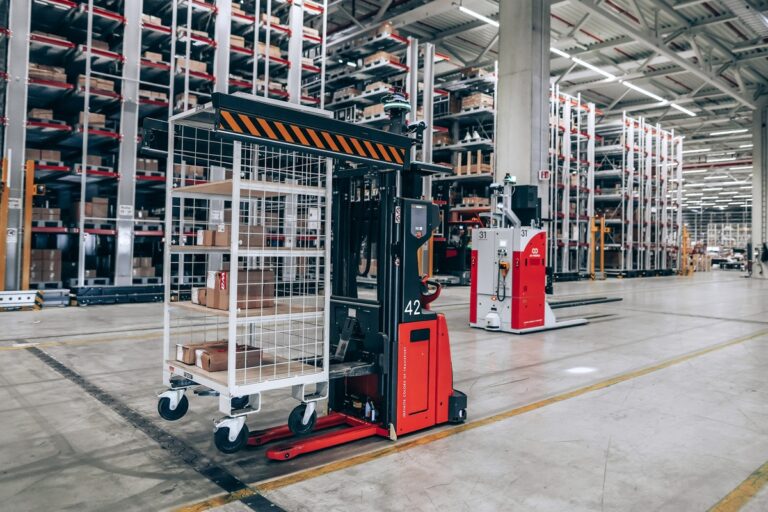
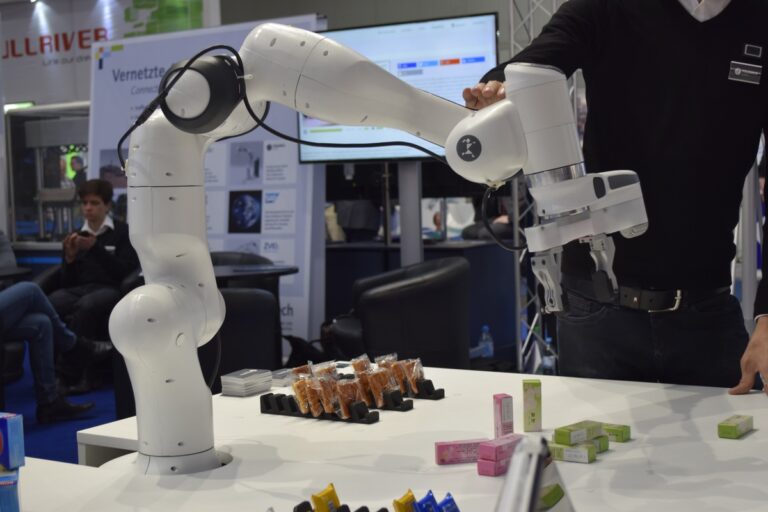
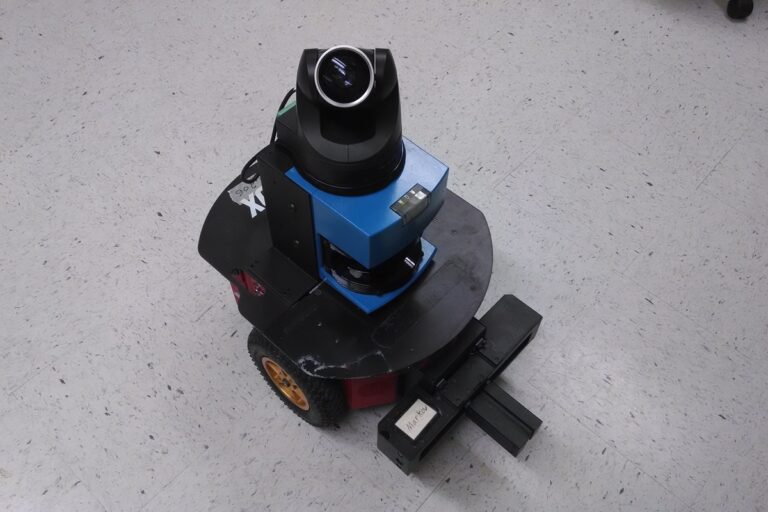
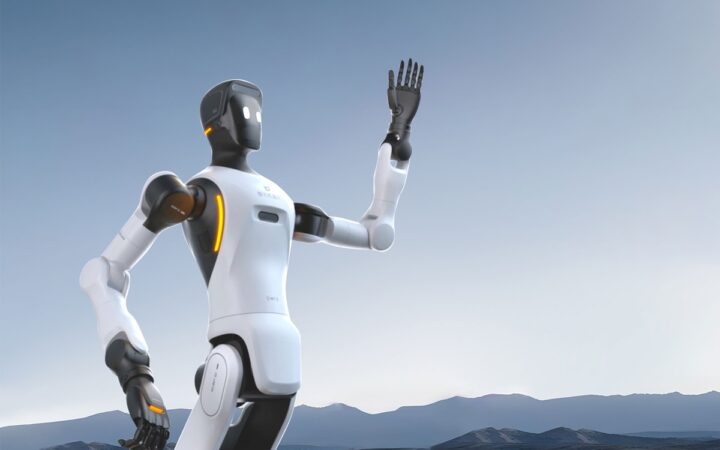
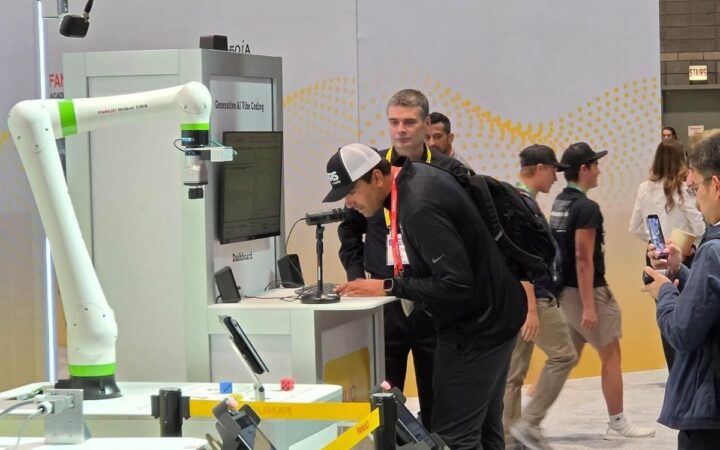
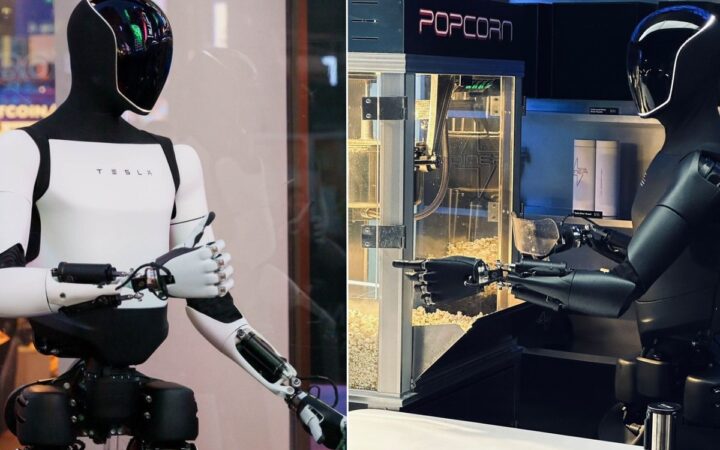
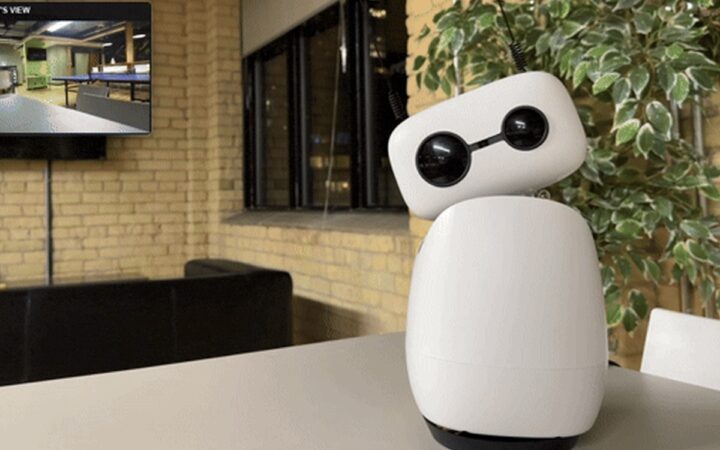
Robot learning becomes useful when representative data and independent physical tests support a clearly defined operating capability. Photo: Ims / Wikimedia Commons
Robot Learning Explained: Imitation, Reinforcement Learning and Real-World Tests
By Laura Bennett• 10 mins read
Published:
, Updated:
Understand robot learning methods, demonstration data and simulation transfer, then evaluate complete-task reliability, interventions and controlled deployment.
Robot learning uses data and optimization to develop parts of a robot’s behavior. A learned policy may map images and robot state to actions, while the surrounding system still provides sensing, control, task coordination and protective functions.
The useful question is not simply whether a robot learned a skill. It is what data it used, which conditions it can handle and how the complete application behaves when the learned component is wrong. This guide extends our robotics introduction with a practical framework for evaluating imitation learning, reinforcement learning and simulation transfer.
Key Takeaways
Choose a learning method around the task, available observations and action data, while keeping the learned policy’s role distinct from the complete robot application.
Collect representative, well-timed data and evaluate on independent episodes and operating conditions rather than mistake familiar-frame accuracy for reliable physical behavior.
Measure complete-task outcomes, interventions and recovery under controlled deployment conditions, with versioned models, documented limits and appropriate protective systems.
What Does the Robot Learn?
A learned component can perform perception, predict a useful grasp, select an action or generate a sequence of movements. These are different capabilities. A model that identifies an object does not automatically know how to manipulate it.
A policy is a rule for choosing actions from available information. Its observation may include camera images, joint state and previous actions. Its output might be a desired pose, joint command or another representation that the controller can execute.
Define that interface before comparing models. An impressive policy result can depend on a particular camera arrangement, control rate, robot geometry and carefully prepared workspace.
Our sensor guide explains why data quality and timing matter. Learning does not remove the need to understand what the robot can actually observe.
Imitation Learning and Reinforcement Learning
Approach
Main learning signal
Practical question
Behavior cloning
Recorded examples of observations and demonstrated actions
Do the demonstrations cover the states the deployed policy will encounter?
Reinforcement learning
Rewards associated with actions and resulting experience
Does the reward encourage the intended physical result, and how is experience obtained?
Interactive imitation
Additional expert guidance on states encountered during learning
Who supplies corrections, under what conditions and at what cost?
Hybrid workflow
A combination of demonstrations, rewards, models or other feedback
Which evidence supports each stage and its final deployment behavior?
These categories can overlap in a development workflow. A team may initialize from demonstrations and refine a policy using additional interaction. Compare the actual training process rather than treat a label as a complete technical description.
OpenAI’s RL introduction defines observations, actions, policies and reward-based learning. In a physical application, those abstractions must be connected to measured states and executable commands.
Learning From Demonstrations
Demonstrations can come from teleoperation, guided movement or another suitable method of recording expert behavior. The dataset needs the observations and action representation required by the chosen method.
A video alone does not necessarily contain the robot commands, forces or geometry needed for direct behavior cloning. Some research reconstructs information from video, but the required estimation and supervision should be stated explicitly.
The ALOHA project’s ACT research demonstrates learning manipulation from teleoperated examples with an action-chunking approach. It provides a concrete research example, not a guarantee that a small demonstration set will solve every industrial task.
Record how demonstrations were selected. A dataset containing only ideal starts may teach the main motion while providing little evidence for recovering from a slipped object or a slightly incorrect approach.
Why Small Errors Can Accumulate
During deployment, a policy’s own actions influence what it observes next. A small error can move the robot into a state that was uncommon in the demonstrations, where the next action is less reliable.
This distribution mismatch is different from predicting an action on a familiar recorded frame. Evaluation needs complete rollouts in which the policy experiences the consequences of its choices.
The DAgger paper studies a method that collects expert guidance on states visited by the learned policy. The general deployment lesson is to examine state coverage and correction requirements, not only the number of original examples.
Where interactive correction is used, document who supplies it, what information is recorded and how subsequent model versions are evaluated independently. Human assistance is part of the development cost and should not disappear from reporting.
Actions Over Time and Diffusion Policies
A policy can predict one action at a time or produce a short sequence. Longer predictions may help describe coordinated movement, but execution still needs an appropriate update strategy and feedback.
Diffusion Policy represents robot behavior through a conditional diffusion formulation and studies action-sequence generation. Its results concern specified tasks and experimental settings; the method’s name does not establish general-purpose competence.
Ask how often the system observes the scene, how much of a predicted sequence it executes and how it reacts to an interruption. A plan based on an old image may be inappropriate after an object moves.
Also identify the action interface. Cartesian targets, joint targets and low-level commands place different demands on calibration and control. Our planning guide explains why paths, timing and physical execution need separate checks.
Reinforcement Learning and Reward Design
Reinforcement learning uses experience and a reward signal to improve a policy. The reward is an engineered description of what the training process should favor, not an automatic statement of the real business objective.
A reward for moving an object close to a target may not establish correct insertion, stable placement or acceptable contact. A task can score well under an incomplete measurement while failing the intended physical requirement.
Define independent success checks alongside the training reward. Review unintended strategies and failure cases. If safe interaction is required during training, the experiment needs suitable supervision and an approved physical setup.
Be explicit about whether learning occurs in simulation, on hardware or from recorded data. The cost, coverage and limitations of those sources differ, even when they produce a similarly named policy.
Simulation and the Reality Gap
Simulation can provide controlled variation and large amounts of experience without repeating every trial on a physical machine. Its usefulness depends on whether relevant aspects of the task are represented well enough.
Differences can include contact, friction, compliance, sensor appearance, delays and actuator behavior. A visually convincing scene is not necessarily an accurate model of these effects.
NVIDIA’s randomization research studies varying simulated visual conditions to support transfer. Randomization is a technique to evaluate, not proof that every unmodeled real-world condition is covered.
Our simulation guide explains why a model needs validation for its intended use. Confirm transferred behavior with independent physical trials and document the remaining operating limits.
Build a Dataset That Can Be Audited
Store observations and actions with clear units, timing and frame definitions. Record robot configuration, tool, sensor mounting, software version and task conditions. Those details determine what the examples mean.
Keep episodes and collection sessions identifiable. Adjacent frames from the same run are highly related; spreading them randomly between training and test sets can make an evaluation look stronger than independent deployment performance.
Define splits that answer the actual question. Testing on new sessions checks a different kind of generalization from testing on new objects, lighting or hardware. Do not claim the broader capability from the narrower experiment.
Track unusable data and corrections. A clean dataset requires documented filtering rather than silently removing difficult examples after inspecting test results.
Our calibration guide explains how mounting and reference changes affect geometry. A changed camera or tool may require both configuration review and renewed model evaluation.
Evaluate Complete Physical Tasks
Write an independent success definition: the correct object is placed in the required location, remains stable and passes the relevant quality check. Include the initial conditions and the permitted human involvement.
For a hypothetical evaluation, 95 successful placements in 100 trials is an observed 95% success rate under those conditions. It is not a guarantee of the next shift’s performance or evidence of the same rate on untested objects.
Record failed attempts, interventions, resets, cycle time and any damage or quality issue. If a person repositions the object between every attempt, that preparation belongs in the description of the task.
Evaluate representative variation and report results by important condition. An overall average can hide poor performance on one material, grip direction or starting pose.
For production decisions, include the time and labor required for recovery. A policy that succeeds often but needs lengthy resets may deliver less useful output than a narrower, more predictable system.
Keep evaluation protocols versioned alongside the model. If a team changes initial conditions, success rules or permitted assistance between runs, the resulting percentages are not directly comparable. Record trial selection before testing and retain unsuccessful runs. Where training is sensitive to randomness, assess more than one training run rather than report only the most favorable model.
Deploy the Policy as One Component
The application still needs task identity, permissions, state tracking and result confirmation. Our integration guide explains how those responsibilities connect software to a physical sequence.
Define behavior for missing observations, invalid outputs and conditions outside the tested range. Monitoring should make failures observable, and operators need an approved route to recover or stop the task.
Keep protective functions separate from ordinary learned behavior unless a suitable safety case establishes otherwise. A policy’s training success rate does not validate protection for people; our safety guide covers the application-level process.
Release model versions through a controlled process. Save the weights, configuration, dataset lineage and evaluation results needed to reproduce the accepted behavior. A later fine-tuning run is a new change that needs review.
Choose a Useful First Learning Project
Start with a bounded task whose outcome can be measured independently and whose variation is understood. Compare the learned approach with simpler perception, planning or fixture improvements before expanding the training program.
Budget for demonstration collection, annotation, computing, evaluation and ongoing support. The number of training examples is only one part of the engineering effort.
Robot learning becomes useful when data, method and application evidence remain connected. A repeatable, clearly scoped capability with understandable recovery is a stronger foundation than a broad claim supported by selected successful clips.
Frequently Asked Questions
What is a robot policy? It is a rule that selects actions from available observations or state information. The output must match an interface that the robot’s control system can execute.
Is imitation learning the same as reinforcement learning? No. Imitation learning uses demonstrated behavior as a learning signal, while reinforcement learning uses rewards and experience. A development workflow can combine them.
Can a robot learn directly from any video? Not automatically. Ordinary video may lack action commands, forces and geometry. Methods that infer or reconstruct those quantities have additional assumptions and limitations.
Does simulation success prove real-world reliability? No. Sensor, contact, timing and actuator differences can affect transfer. Validate the policy on hardware under representative conditions and record the limits.
How many demonstrations are enough? There is no universal count. Required data depend on task variation, observation quality, method and the operating conditions that need coverage.
What should a deployment evaluation report? Report complete-task success, initial conditions, interventions, recovery, cycle time and performance across relevant variation, with a clear definition of human involvement.