Design robot and PLC interfaces with clear task ownership, handshakes, timing and recovery, then test the complete physical sequence across interruptions.
Robot integration connects a robot’s actions with the machines, sensors and information systems around it. A useful interface makes every participant agree on what work is requested, which conditions permit it and how the result is confirmed.
The difficult cases are often interruptions: a signal arrives late, a controller restarts or a transfer stops halfway through. This guide extends our automation guide with a practical method for designing PLC interfaces, task handshakes and recoverable cell behavior.
Key Takeaways
Assign clear ownership of sequence state, physical permissions and completion evidence before choosing the communication protocol or mapping signals.
Use explicit task identity, acknowledgement and result handling so retries, controller restarts and delayed messages do not silently trigger duplicate or ambiguous physical work.
Validate timing, communication loss and interrupted recovery with the real equipment, while keeping ordinary coordination separate from validated protective functions.
Begin With the Physical Sequence
Write the operation in plain language: a station presents a part, the robot collects it, the receiving machine accepts it and the robot clears the machine’s operating envelope. Identify the evidence required at each step.
Then assign responsibilities. The robot controller may own motion, a PLC may coordinate the cell and a manufacturing system may issue production orders. Other arrangements are possible. What matters is that the same decision is not independently controlled by several participants.
Document who can request work, who can accept it, who can cancel it and who confirms its physical result. Avoid beginning with a large signal list whose meanings are only understood after the software is written.
The Roles of Robot Controllers and PLCs
A robot controller manages the mechanism and its application program. A PLC commonly coordinates machine logic, sensors, actuators and sequences. Neither label proves which device should own every part of the process.
For example, the robot can report that it reached a release pose, while a station sensor confirms that the part actually arrived. The cell’s completion condition may require both pieces of evidence.
Our gripper guide explains why movement and successful handling are distinct. Design the interface around the finished operation rather than substitute a motion status for a product result.
Keep manual actions in the sequence model. If an operator replaces a part or clears a station, the controllers need an approved way to establish the resulting physical state before continuing.
I/O, Industrial Networks and Information Models
Interface layer
Typical role
Question to settle
Discrete I/O
Defined status and command signals
How are signal persistence, acknowledgement and loss detected?
Industrial network
Structured cyclic or requested data exchange
Which data are valid, how fresh are they and what happens on a connection fault?
Information model
Consistent descriptions of equipment, state and production information
Which meanings and capabilities are actually implemented by each device?
Application interface
Job requests, results and coordination with software systems
How are identity, cancellation, retry and physical completion represented?
Choose the supported interface that meets the requirement and can be maintained by the operating team. A richer protocol does not eliminate the need for a state model, while a small I/O interface still needs precise definitions.
The OPC Foundation’s robotics specification defines an information model for vertical integration. Do not assume that supporting OPC UA automatically provides a universal motion-command interface or identical application behavior across manufacturers.
Record implemented versions, optional capabilities and data mappings. Interoperability needs a tested agreement between the actual products, not only matching protocol names on their brochures.
Maintain a data dictionary for every exchanged item: meaning, units, valid range, owner, update behavior and interpretation when unavailable. Distinguish an absent value from a measured zero. For structured messages, define compatible versions and the response to an unknown field or unsupported recipe. These details prevent two correctly functioning programs from assigning different meanings to the same data.
Design the Task Handshake
A handshake establishes that a request was seen and accepted before the sender assumes execution is underway. The exact implementation varies, but the states should be explicit and observable.
An illustrative job might contain a job identifier, operation type, recipe reference and request status. The receiver checks the request and reports accepted, rejected or unavailable. Execution then produces a result associated with the same identifier.
Acceptance is not completion. Keep those events separate. A robot that has accepted a loading task may still be waiting for a machine permission, approaching a part or recovering from an interruption.
Define what clears each state and who may clear it. If the sender removes a request before the receiver observes it, a short pulse may disappear without producing work. Persistent, acknowledged state is often easier to diagnose than an undocumented timing assumption.
Task Identity and Duplicate Requests
Communication can fail after a physical action but before its acknowledgement is received. The sender may not know whether the action happened. Blindly resending “place the part” can therefore create a duplicate or inconsistent operation.
Use job identity and retained result information where the architecture requires it. The receiver should have a documented response to a repeated identifier, and the application should distinguish a new task from a retry.
That design does not make physical work magically transactional. A partly inserted component cannot generally be rolled back like a database change. Define how uncertain physical states are checked and reconciled.
When automatic reconciliation is not reliable, provide an approved operator recovery route. Record the reason and resulting state so the system does not resume an obsolete task after intervention.
Permissions, Readiness and Completion
List the conditions required before each action: correct recipe, available station, part presence, fixture state and necessary machine permissions. Clarify which conditions are ordinary process coordination and which belong to protective control.
A “ready” signal should have a specific meaning. Ready to receive a request, ready for immediate movement and ready to accept a physical load are different conditions. Broad labels can hide assumptions between teams.
Likewise, completion should describe the required result. A transport task may need received-load confirmation, while a machine-tending step may also require the arm to be clear before the next process begins.
Our AMR guide develops the same issue for pickup and delivery stations. Interface design should follow the whole handoff regardless of whether the robot is fixed or mobile.
Timing and Data Freshness
A network update period is not the complete application response time. Sensor acquisition, controller scheduling, filtering, communication and receiving logic all contribute.
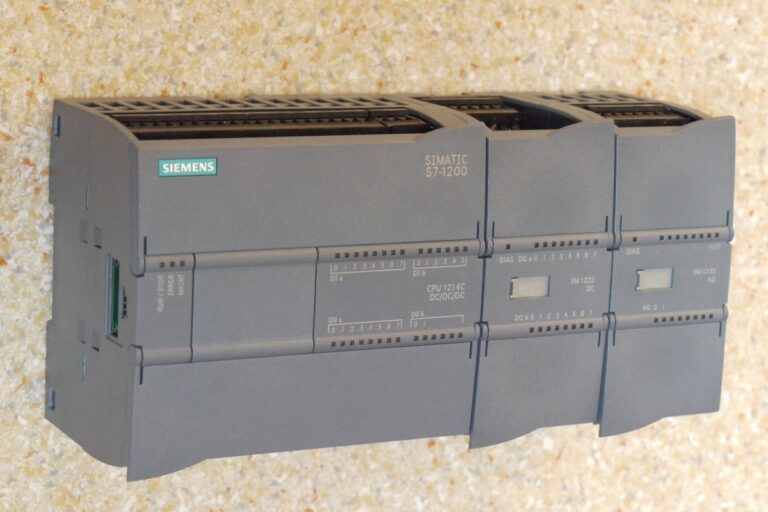
Siemens’ controller manual explains process-image and program-execution concepts. Check the exact controller configuration rather than assume that every physical input and output changes simultaneously with one program statement.
Define how stale data are recognized. Depending on the interface, that may involve connection status, sequence information or timestamps with an appropriate clock relationship. A value remaining unchanged does not prove that communication is healthy.
For an illustrative moving process, 100 milliseconds of unaccounted delay at 0.5 meters per second represents 50 millimeters of travel. This shows why response timing must be connected to physical motion; it is not a universal network-performance requirement.
Faults, Cancellation and Restart
Define fault categories that lead to understandable responses. A rejected recipe, unavailable station and interrupted motion should not all appear as an unexplained generic failure.
Cancellation also needs a meaning. It can mean do not start, stop through an approved sequence or complete the current noninterruptible step before reporting cancellation. Confirm which behavior applies before exposing a cancel command.
On restart, establish which state is retained and which must be re-observed. The robot position, held part, fixture condition and neighboring machine may not match a saved software variable.
Our maintenance guide explains why fault evidence and a verified baseline matter. Preserve event order and identifiers so engineers can reconstruct the first abnormal condition.
Connecting ROS 2 and Higher-Level Software
ROS 2 applications provide several communication patterns. Topics distribute streams, services support request-response interactions and actions support longer-running goals with feedback and cancellation concepts.
The ROS 2 action design describes these goal-oriented interactions. A software action result still needs an application-specific definition of success and a valid connection to the physical controller.
Keep the bridge’s responsibilities explicit. It should not silently reinterpret a PLC job identifier, substitute a new coordinate frame or retry an ambiguous physical operation without an agreed policy.
Our ROS 2 guide provides the wider software context. Treat business systems, middleware and machine controllers as distinct participants with documented failure behavior.
Security and Protective Control
Limit who can issue production commands, change recipes and alter configurations. Distinguish read-only monitoring from authority to move equipment. Remote support and third-party software should have defined access and ownership.
NIST’s OT security guide addresses operational technology networks and their constraints. Involve the responsible IT and control teams in access, network design, backups and updates before commissioning.
Keep ordinary handshakes separate from validated protective functions. A process permission transmitted through normal application software should not be assumed to provide the required safety behavior.
Our safety guide explains how protective functions are specified and validated for the completed application.
Acceptance Tests for the Interface
Agree the test plan before the integration teams separate. Start with ordinary sequences, then test interruptions through approved procedures under controlled conditions.
Normal work: Confirm accepted, executing and completed states for each supported job and recipe.
Invalid requests: Verify clear rejection of unavailable operations, incorrect versions and unsuitable data.
Interruption: Test communication loss, delayed responses and relevant controller restarts without ambiguous continuation.
Recovery: Confirm that repeated requests, uncertain loads and operator intervention produce the documented state.
Retain signal definitions, state diagrams, timing requirements, logs and configuration versions with the handover. Assign an owner for interface changes so one team cannot alter a meaning without the other participants’ review.
A dependable integration makes the physical sequence observable and recoverable. The useful result is not merely that devices exchange data, but that they agree on what happened and what is allowed to happen next.
Frequently Asked Questions
Does every robot cell need a PLC? No single architecture fits every application. The cell still needs clear ownership of sequence logic, physical permissions, interfaces and recovery, whether those functions reside in a PLC or another suitable controller.
What is a robot handshake? It is a defined exchange that establishes request, acknowledgement, execution and result states. It prevents participants from relying on an unconfirmed signal or ambiguous timing.
Does OPC UA make robot programs interchangeable? No. Shared communication and information models do not guarantee identical supported commands, motion behavior or application semantics. Verify the implemented capabilities and mappings.
Why should tasks have identifiers? Identifiers help connect requests, feedback and results, especially after retries or interruptions. They support reconciliation but do not automatically make physical actions reversible.
Is a network timeout proof that a task failed? No. The action may have occurred before its acknowledgement was lost. Define how the physical state and retained result are checked before another action is issued.
What should integration acceptance include? Normal jobs, invalid requests, timing, communication loss, restarts and approved recovery. The test should prove the physical sequence and result, not only successful data exchange.