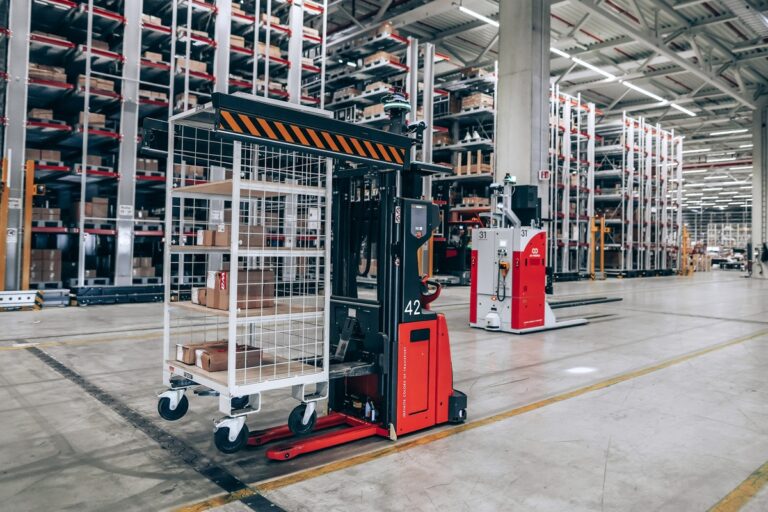
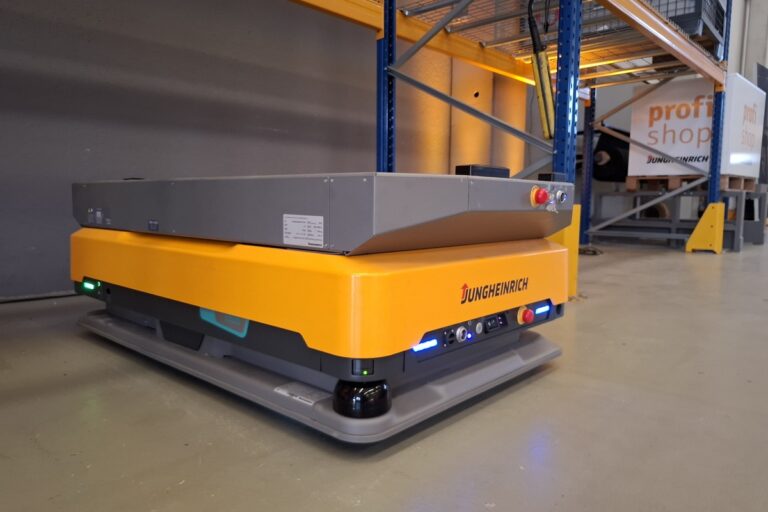
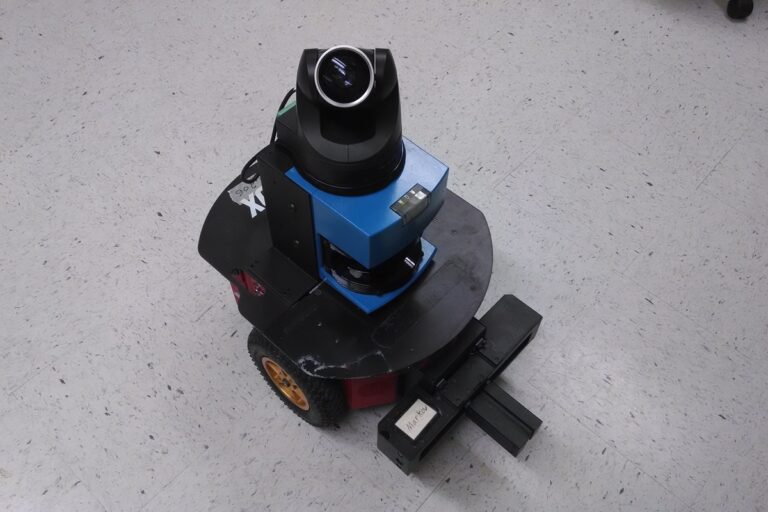
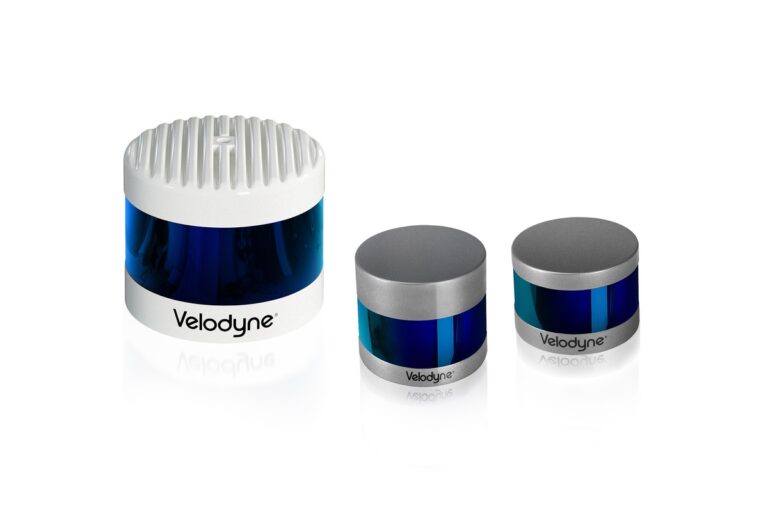
Autonomous mobile robots connect material flows when routes, load transfers and fleet capacity are designed around the actual operation. Photo: Marc Auledas Noguera / Wikimedia Commons
Autonomous Mobile Robots Explained: A Practical AMR Guide
By Laura Bennett• 10 mins read
Published:
, Updated:
Learn how autonomous mobile robots move materials, how AMRs compare with AGVs, and how to evaluate routes, handoffs, fleet capacity and deployment costs.
Autonomous mobile robots, or AMRs, move materials through a facility using onboard sensing and navigation software. In factories and warehouses, their most useful role is often straightforward: take a defined load from a known pickup point to a known destination, then repeat that mission reliably alongside the rest of the operation.
The difficult part is rarely the empty-floor demonstration. It is maintaining material flow when aisles become busy, stations are occupied, batteries need charging and people change the arrangement of the site. This guide extends our autonomy guide with a practical framework for evaluating mobile transport systems.
Key Takeaways
Autonomous mobile robots automate defined transport missions, while picking, loading and receipt confirmation depend on the equipment and processes integrated around the mobile base.
Fleet capacity should be calculated from measured end-to-end mission times and peak demand, including station queues, charging and the effect of unavailable robots or routes.
A useful AMR pilot tests representative traffic, failed handoffs and recovery procedures, then measures on-time deliveries and interventions rather than robot activity alone.
What an AMR Actually Automates
A transport AMR automates movement between locations. Depending on its equipment, it may carry shelves, lift a trolley, transfer a tote through a conveyor attachment or handle pallets. The load interface is part of the system: a mobile base cannot automatically collect every object that fits within its advertised weight capacity.
Picking, identification, loading and unloading may remain separate operations. For example, a person can place a tote on a robot, a conveyor can transfer it automatically, or another machine can complete the handoff. Those alternatives create different staffing, throughput and integration requirements.
Mobile Industrial Robots lists material transport, production supply, pallet movement and finished-goods workflows among its application areas. Treat these as categories of use, then define the exact mission your operation needs. “Automate the warehouse” is too broad to specify or test.
A useful mission description identifies the load, pickup point, delivery point, request signal and completion condition. It also states who handles exceptions. This turns an attractive machine into a process that can be compared with the current method.
AMRs, AGVs and Conveyors
An automated guided vehicle, or AGV, is commonly associated with prescribed routes, while an AMR typically uses a map and local perception to select or adjust its path. MiR’s comparison describes that navigation distinction. Actual products vary, and a label alone does not tell you what happens at a blocked aisle.
Conveyors provide another option. They can be effective where material follows a stable, repeated flow and the building can accommodate a fixed connection. Mobile systems can serve changing destinations, but share floor space and transport capacity with other activities.
Option
Useful starting point
Question to test
AMR
Several destinations or changing mission demand
Can the fleet complete deliveries during peak traffic?
AGV
Predictable transport along specified routes
How does the system handle route changes and obstructions?
Conveyor
Stable, repeated flow between connected points
Does the fixed layout suit the required product mix and access?
Evaluate all three against the same load and service requirement. A comparison based only on purchase price can overlook building work, stations, controls and the labor needed at either end.
Navigation Is More Than Obstacle Avoidance
Localization estimates where the robot is within its operating map. Planning chooses how to reach a destination. Local motion control responds to nearby conditions. These functions interact, but they answer different questions.
A robot that detects a pallet blocking an aisle may stop, wait or take another permitted route. It cannot create a passage through a physically blocked building. If every alternative is unsuitable, a person or another process must resolve the obstruction.
Map changes also need ownership. Moving a rack, altering a docking station or changing an access restriction can affect the mission. Agree who may edit the map, how changes are checked and how a previous working configuration can be restored.
During evaluation, ask the supplier to demonstrate lost localization, a temporarily occupied destination and an unavailable route. Record the operator instructions and the time required to return to service. These cases are more informative than watching a robot steer around a single box.
Survey the Facility Before Selecting a Robot
Walk the complete route with the people who use it. Measure usable aisle widths with normal material in place, not just the spacing on a floor plan. Include turning areas, door openings, thresholds, gradients, floor condition and the space occupied by the load.
Observe the site at busy times. A route that is empty between shifts may be crowded during replenishment. A proposed waiting area may already serve as a temporary staging zone. The robot’s working envelope must fit the actual operation.
Physical route: Document surfaces, turns, clearances and the full load envelope.
Shared traffic: Identify pedestrians, forklifts, other robots and crossing points.
Stations: Check approach space, load alignment and the response to an occupied destination.
Infrastructure: Confirm charging locations, communications and any doors or lifts that require integration.
Specify environmental limits against the manufacturer’s documentation. An indoor AMR should not be assumed suitable for wet floors, outdoor loading yards or an unusual temperature range because it navigates successfully in a clean demonstration area.
The Handoff Can Be the Bottleneck
A mission is not finished when the robot reaches a coordinate. The correct load must arrive at a usable station and be available to the next process. That handoff needs mechanical alignment, a clear signal and a way to detect incomplete transfer.
For a conveyor station, decide which device initiates transfer and which confirms that the load has cleared. For a trolley, check coupling, load stability and the space needed to collect it. For manual loading, define how the operator requests a mission and confirms readiness.
Avoid ambiguous states such as “probably delivered.” The business system may need to know that a tote was received, rather than merely that the robot visited the station. Identification and task completion should remain tied to the same mission record.
Test a full destination, a missing load and an interrupted transfer. Specify whether the robot waits, returns, seeks another location or calls an operator. A well-defined exception prevents the fleet from accumulating unfinished work.
Fleet Size: A Worked Capacity Example
Begin with demand over time. Daily averages conceal short periods in which many stations request material together. Record missions per hour, pickup and delivery locations, load types and how late a delivery can be before it affects production.
Consider an illustrative round trip: two minutes traveling to pickup, one minute loading, three minutes traveling to delivery and one minute unloading. The seven-minute cycle has a theoretical capacity of about 8.6 missions per robot per hour, before charging, waiting or interruptions.
If a trial shows that one robot completes six useful missions per scheduled hour, a peak demand of 18 missions per hour would consume the measured capacity of three robots. That does not establish a resilient three-robot design: it leaves no spare capacity at that operating point.
Now test whether different pickup timing, batching or station placement reduces demand or cycle time. Adding robots to a congested aisle can make the problem worse. Fleet sizing should be based on the service target and observed constraints, with contingency justified by the consequences of delay.
Use the example as a calculation method, not a rule of thumb. No universal number of missions per hour applies across sites.
Charging and Network Behavior
Charging changes available transport capacity. Compare the proposed charging plan with the actual mission schedule, including busy periods and overnight operation. Identify what happens when the usual charger is unavailable or a robot finishes a long mission with less energy than expected.
Separate onboard movement from fleet communications. Ask which functions continue if the wireless network drops, which tasks require a server, and how pending missions are reconciled after reconnection. Different architectures can behave differently.
The appropriate test is a controlled loss of the relevant service under supplier supervision, with the operating team observing recovery. Do not assume that a robot safely stopping means the order-management system has correctly recorded every unfinished delivery.
Include information technology staff early. They should understand network requirements, software updates, access control, logs and remote-support arrangements before the pilot becomes a permanent operational dependency.
Safety and Traffic Management
OSHA’s robot guidance includes mobile robots and highlights hazards associated with moving machinery and its application. Sensors and protective functions must be evaluated with the actual load, route and surrounding equipment.
Decide how people and other vehicles interact at crossings, blind corners and stations. A load may extend beyond the base or obstruct a view. A safe operating plan must address the completed transport application, not only the empty robot.
Use competent integrators and the applicable standards and local requirements for the installation. Keep routine navigation performance distinct from validated protective behavior. Operators also need a clear reporting route for blocked aisles, damaged loads and repeated stops.
Measure Service, Not Distance Traveled
A busy robot is not necessarily a productive robot. Empty repositioning, repeated failed docking attempts and waiting at a full station can all generate activity without completing useful deliveries.
Track completed missions, on-time deliveries, end-to-end lead time, intervention frequency and recovery duration. Review results by route and load type. A fleet-wide average can conceal one destination that consistently misses its service target.
Our coverage of warehouse automation illustrates why material variation, maintenance and integration belong in the deployment discussion. For your own installation, use a mission log to determine where delays begin rather than attribute every disruption to navigation.
Agree the acceptance test before purchase. Specify representative demand, shift duration, product mix and the circumstances under which the test must be repeated. A quiet-hour trial cannot demonstrate peak-hour capacity.
Costs and a Sensible First Pilot
Budget for the complete transport service: robots, top modules, stations, chargers, fleet software, interfaces, site preparation, training and ongoing support. Include internal engineering time and the labor that remains at loading and unloading points.
Start with a meaningful route that has manageable variation and a visible operational problem. Establish the manual baseline, then compare the pilot using the same service measures. Keep the scope small enough that the cause of a failure can be understood.
Before scaling, confirm that one successful route has not hidden shared constraints. Additional robots may compete for chargers, a doorway or a single receiving station. Model and test those common resources before assuming that doubling the fleet doubles output.
The central question is whether material reaches the right process reliably and economically. Our automation guide provides the broader framework for connecting that technical result to a useful business case.
The software behind mission state is covered in our ROS 2 guide, while the digital twins guide explains how to assess a model used for fleet-planning decisions.
Frequently Asked Questions
What does AMR stand for? AMR stands for autonomous mobile robot. In industrial logistics, it usually describes a robot that uses onboard sensing and navigation to move loads between defined locations.
Does an AMR pick products automatically? Not necessarily. Transport, picking and load transfer are separate capabilities. A mobile base needs the appropriate tooling and integration to collect or place a load without human help.
Can AMRs work around forklifts? Some installations involve mixed traffic, but the route, protective measures and traffic procedures require assessment and validation. Compatibility cannot be inferred from obstacle avoidance alone.
How many robots does a warehouse need? Calculate from peak demand, measured complete mission times, charging and the required delivery service level. Then test shared bottlenecks and the effect of an unavailable robot.
Will an AMR always drive around an obstacle? No. It needs a suitable permitted route and sufficient space. Some situations require waiting or an operator response, which should be included in the operating procedure.
What is the best first AMR project? A defined transport route with repeatable loads, clear handoffs and a measurable problem is a useful starting point. Choose a pilot that can reveal operational constraints before fleet expansion.
Tesla confirms production-quality Optimus robots are leaving Fremont’s high-volume lines, but Musk says a 20,000-per-week pace remains at least a year away.