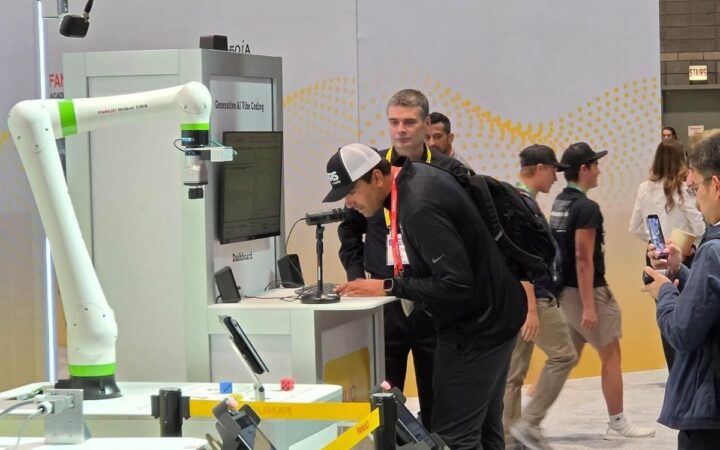
A credible robot ROI case links complete project costs with measured output, realizable benefits and transparent operating assumptions. Photo: Larry D. Moore / Wikimedia Commons
Build a credible robot ROI case using complete costs, realizable benefits, ramp-up and downside scenarios, with worked payback and discounted cash-flow examples.
Robot ROI analysis asks whether an automation project creates enough useful financial benefit to justify its full cost and risk. The calculation should describe the completed operation, including integration, retained labor, maintenance and the output the business can actually use.
A short payback claim is easy to produce by assuming perfect utilization and counting every operator hour as a cash saving. This guide develops the business-case discussion in our automation guide into a practical model that can be checked against a pilot and updated after deployment.
Key Takeaways
Compare automation with a measured baseline and realistic alternatives, using complete installed costs and benefits that can be realized by the actual operation.
Keep labor savings, released capacity, quality improvement and additional contribution separate so the model does not count the same benefit more than once.
Test payback and discounted cash flow across credible demand, uptime, ramp-up and support scenarios, then use pilot evidence to revise the investment decision.
Define the Decision Before the Spreadsheet
State the operational problem: overtime at a particular station, quality losses, unavailable capacity or an unsuitable working task. Define the required result and the time over which the business expects to use the system.
Compare meaningful alternatives. These may include improving fixtures, changing part presentation, adding a simpler machine, outsourcing work or retaining the current method. A robot should not win merely because the comparison omitted a practical lower-cost option.
Identify which assumptions are supported by measurements, supplier commitments or estimates. Assign an owner to uncertain items. A detailed spreadsheet with unexplained inputs is less useful than a simpler model with traceable evidence.
Measure the Current Process
Record good output, staffing, overtime, scrap, rework, changeovers and interruptions over representative operating periods. Include product mix and demand rather than extrapolate from the fastest observed cycle.
Separate scheduled hours from productive running time. A station can have a short nominal cycle while losing much of its shift to replenishment or waiting for upstream work.
Also establish the constraint on useful output. If a downstream operation is already full, additional robot capacity may not increase shipments. If demand is seasonal, year-round maximum utilization may be unrealistic.
Our robot arm guide explains complete-cycle measurement. Use the same definition of good output for the manual baseline and proposed automation.
Count the Complete Installed Cost
Cost group
Items to examine
Common omission
Equipment
Robot, tooling, fixtures, process equipment and controllers
The accessories needed to handle the real product range
Integration
Engineering, interfaces, software, safeguarding and validation
Internal engineering time and acceptance changes
Deployment
Site preparation, installation, training and production transition
Lost output or temporary staffing during ramp-up
Operation
Service, consumables, energy, licenses and retained labor
Recovery work, support coverage and periodic revalidation
Include the timing of expenditure. Deposits, engineering payments and final acceptance payments can occur before the installation produces useful output. Working capital or spare inventory may also tie up cash.
The U.S. Small Business Administration’s cost framework distinguishes one-time and ongoing expenses. Apply that discipline to the project rather than treat the robot’s purchase price as the entire investment.
Document what each supplier quote includes and excludes. A low equipment quote can become a high installed cost when tooling development, machine access or interface work sits outside the contract.
Consider cash tied up in spare tooling, service stock and additional work in progress. If automation changes batch size or replenishment, inventory requirements may change as well. Keep these effects visible in the timing model instead of burying them in a general equipment allowance.
Separate Cash Savings From Released Capacity
Removing manual touches does not necessarily reduce payroll. The operator may still replenish material, inspect output, handle exceptions or work elsewhere. Determine what actually changes in staffing and cost.
Avoided overtime, an avoided future hire and redeployed staff are different benefits. Each needs its own evidence and timing. Do not label all three as immediate labor cash savings.
Released capacity can still have value. If an operator moves to a genuinely constrained activity, that may improve useful output. Count the resulting benefit where it occurs, while avoiding a second claim for the same hours.
Our integration guide explains why loading, confirmation and fault recovery remain part of the system. Measure those duties before assuming the entire station becomes unattended.
Quality, Throughput and Other Benefits
Quality benefits can include reduced scrap, rework or warranty costs. Use the actual cost avoided, not automatically the product’s selling price. Establish whether the robot changes the defect mechanism and whether inspection can verify the improvement.
Additional output creates financial benefit only when it can be sold or otherwise used. Evaluate incremental contribution after relevant variable costs, rather than equate extra revenue with extra profit.
Do not count an avoided scrap cost and additional contribution on the same unit twice. Map each benefit to a distinct change in cash flow or operating capability.
Ergonomic improvement, resilience and traceability may be important even when they are difficult to monetize. Present them explicitly and explain the evidence, rather than force an unsupported dollar value into the payback calculation.
A Worked Payback Example
Consider a hypothetical project with a complete installed cost of $180,000. The annual steady-state model identifies $110,000 in documented labor cash savings and $20,000 in avoided scrap and rework.
Annual incremental operating costs are estimated at $25,000, covering service, consumables, energy and software. The resulting annual net operating benefit is $105,000: $130,000 of benefits minus $25,000 of costs.
Simple payback is approximately 1.7 years, calculated as $180,000 divided by $105,000. This is an illustrative steady-state result before tax, financing and the time value of money. It is not a forecast for a particular robot.
Now suppose first-year benefits reach only 60% of steady state while the full $25,000 operating cost is incurred. First-year net benefit becomes $53,000. The project has not followed the original constant-benefit payback pattern.
NIST’s investment guidance describes several evaluation methods, including payback and net present value. Select the method that fits the decision and keep its limitations visible.
Payback, ROI and Discounted Cash Flow
Payback describes how long cumulative benefits take to recover the investment. It is useful for understanding exposure but does not, by itself, describe the value of benefits after recovery.
“ROI” can use different conventions. State the period, numerator and denominator whenever reporting a percentage. An annual operating-benefit ratio and a multi-year net-return ratio are not interchangeable.
Net present value discounts future cash flows using a stated rate and compares them with the investment. The result depends on timing, useful life, residual value and the organization’s assumptions about the appropriate rate.
For the worked example, a five-year model with a $53,000 first-year net benefit and $105,000 in each of the following four years has an NPV of roughly $171,000 at a 10% annual discount rate, assuming end-of-year cash flows and no residual value. Changing those assumptions changes the result.
Use the finance team’s conventions for taxes, depreciation, financing and risk. Do not mix nominal cash flows with an inconsistent discount-rate assumption or add interest costs twice through incompatible treatments.
Run Sensitivity and Downside Scenarios
Identify the few inputs most likely to change the decision: realized labor savings, useful demand, operating availability, cycle time, installed cost and ramp-up duration. Vary them transparently.
In the steady-state example, reducing labor savings from $110,000 to $70,000 lowers annual net benefit to $65,000, assuming the other figures remain unchanged. Simple payback lengthens to about 2.8 years.
If installed cost also rises to $220,000, the same $65,000 benefit produces about 3.4 years of simple payback. This combined case is more informative than changing each uncertain input separately and ignoring their possible interaction.
NIST’s analysis tool supports investment evaluation methods. A tool can help calculate scenarios, but the organization still owns the quality of its operational inputs.
Do not present the downside case as an arbitrary percentage penalty. Link it to plausible events such as slower product qualification, retained staffing or a lower-demand schedule.
Check Capacity and Bottlenecks
A robot can increase one station’s capacity while moving the bottleneck elsewhere. Evaluate upstream supply, downstream processing, inspection, replenishment and shared resources before assigning revenue to additional robot cycles.
For mobile systems, our AMR guide explains why station queues and charging affect service capacity. For fixed cells, fixtures and changeovers can play a similar limiting role.
Use measured useful output per scheduled hour. Do not multiply the fastest cycle by every scheduled minute while separately claiming perfect availability and perfect quality.
Where simulation informs the capacity assumption, validate the model for that question. Our digital twins guide describes the evidence needed to trust a planning model.
Use a Pilot to Retire Uncertainty
Design the pilot around the assumptions that matter financially. If retained labor determines viability, observe the complete staffing pattern. If scrap reduction drives value, measure representative defects and downstream outcomes.
Agree acceptance criteria before the trial. Specify product mix, operating duration, changeovers and the treatment of interruptions. A demonstration on selected easy parts cannot validate a broader production forecast.
Turn findings into revised inputs and a decision record. The outcome may be deployment, redesign, a narrower scope or rejection. A pilot is useful when it improves the decision, even if it shows the initial proposal was unsuitable.
NIST’s robotics analysis discusses broader technology and integration barriers. At project level, treat the evidence behind each assumption as a real engineering deliverable.
Track the Result After Deployment
Keep the approved business case and compare it with realized costs and benefits. Separate temporary ramp-up effects from persistent limitations, and assign action owners for significant gaps.
Include service and downtime evidence from the maintenance plan. Review whether changes in products or demand alter the original utilization assumptions.
A credible robot ROI case connects physical performance to realizable business value. It makes uncertainty explicit, avoids double counting and remains useful after the purchase decision has been made.
Frequently Asked Questions
How do you calculate robot payback? For a simple constant-benefit model, divide complete investment cost by annual net benefit. Use cumulative cash flows when ramp-up, changing benefits or later expenditure make that shortcut unsuitable.
Is the robot purchase price the full project cost? No. Include tooling, fixtures, integration, safeguarding, installation, training, production transition and relevant operating costs.
Are saved operator hours always cash savings? No. Determine whether payroll, overtime or hiring actually changes. Redeployed labor can have value, but it should be identified separately and supported by a realizable use.
Should extra output be valued at sales revenue? Use the relevant incremental contribution after costs and confirm that demand and surrounding capacity can use the output. Extra cycles do not automatically become sales.
What is the most important downside test? Test the assumptions that drive the decision, such as retained staffing, demand, ramp-up and installed cost. Include combined scenarios when uncertainties can occur together.
What should a robot pilot prove? It should provide representative evidence for the technical and financial assumptions that determine viability, including good output, staffing, recovery, quality and integration.