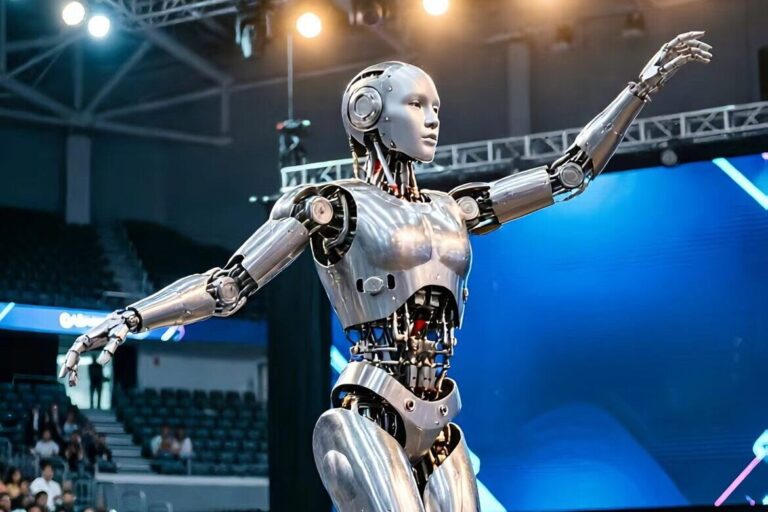
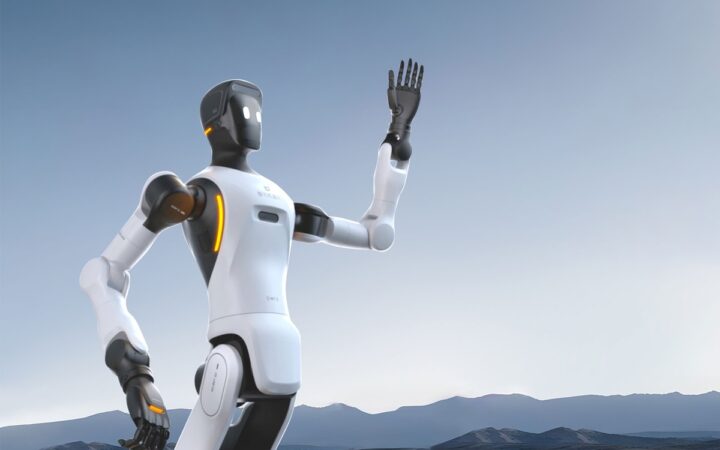
The second World Humanoid Robot Games concluded in Beijing on August 26, with approximately 2,000 humanoid robots from 666 teams and 16 countries competing across more than 30 events. The five-day competition produced both a genuine athletic milestone and a candid demonstration of where humanoid robot control remains unreliable in dynamic, unstructured environments.
The headline result was robot Lightning completing the 100-meter sprint in 9.32 seconds – faster than Usain Bolt’s human world record of 9.58 seconds set in 2009. The achievement follows Unitree’s unveiling of its Superman platform ahead of the games, which claimed a top speed of 12.66 meters per second and a 2-meter standing jump.
What Went Wrong
The sprint events also illustrated the gap between peak performance and operational consistency. Multiple robots overturned during races, collided at full speed with safety mats, tripped over competitors, and folded at the knees mid-run. Football matches saw robots consistently miss the ball, collide with both opponents and teammates, and fail to track moving objects under game conditions. Boxing events produced robots punching air, falling, and tumbling beyond the competition boundaries. Weightlifting attempts ended with robots dropping barbells onto themselves. At least some robots apparently attempted to approach referee tables during events.
The failures are not surprising given the technical context. The games were explicitly designed to test robots in dynamic, unscripted competitive scenarios – precisely the conditions that current physical AI systems handle least reliably. Factory deployment works because the environment is controlled, tasks are defined, and variation is bounded. A football match is the opposite: moving targets, unpredictable opponents, and required adaptation across every second of play.
Why the Events Are Industrially Relevant
The Beijing Games organizers explicitly framed the competition as an industrial development mechanism. Many competition rules are expected to evolve into practical technical standards – the performance benchmarks that can translate into commercial procurement criteria and deployment certification. Organizers stated before the games that robots mastering these skills could “turn medals into orders and move directly from the competition arena to real-world workplaces.”
Viewed in that light, the failures are as informative as the records. The consistent collision and balance problems visible in football and boxing identify the specific control and perception gaps that need to close before humanoid robots can operate reliably in environments with moving obstacles – a capability requirement shared by retail service, healthcare, and emergency response applications. The sprint record, meanwhile, demonstrates that humanoid locomotion has crossed human biological thresholds in controlled, straight-line conditions.
The games ran alongside the World Robot Conference 2026, which opened on August 19 with more than 300 exhibiting companies and 150 product debuts, making the final week of August the most concentrated public display of Chinese humanoid robot capability and limitation to date.
Disclaimer: RobotsBeat is an independent media brand owned and operated by NuvexMedia LLC, publishing news, research, and insights on artificial intelligence, emerging technologies, automation, and related industries. NuvexMedia LLC invests in and collaborates with companies across the AI, Robotics, technology, software, and digital innovation sectors. These relationships do not influence RobotsBeat's editorial coverage, and the publication maintains full editorial independence to provide accurate, timely, and objective information. © 2026 NuvexMedia LLC. All rights reserved. This content is for informational purposes only and should not be considered legal, tax, investment, financial, or other professional advice.