Key Notes
- Musk says Cybertruck production at Gigafactory Texas will wind down around mid-2027 to make room for increased Cybercab output.
- Tesla’s separate Optimus programme is ramping in California with a Texas project under construction, rather than a newly announced conversion of the Cybertruck line to humanoids.
- The change advances Tesla’s autonomy strategy, but production targets, deployment readiness and commercial results must be assessed for each programme separately.
Tesla plans to wind down Cybertruck production at Gigafactory Texas around mid-2027 to make room for increased Cybercab output, Elon Musk said on November 6. The move gives the company’s shift toward autonomous systems a concrete manufacturing consequence, as Tesla also invests in its separate Optimus humanoid-robot programme.
Musk confirmed the plan on X, identifying Cybercab production as the reason for reallocating space in Texas. His statement does not say that the Cybertruck line will be converted directly to Optimus manufacturing, nor does it provide a detailed shutdown schedule or a new Cybercab production target.
Factory Capacity Moves Toward Robotaxis
The distinction between the two projects matters. Cybercab is Tesla’s purpose-built robotaxi vehicle, while Optimus is a humanoid designed for physical tasks. Both sit within the company’s broader autonomy strategy, but they require different hardware, production processes and routes to commercial adoption.
The Cybertruck change is therefore a decision about vehicle-manufacturing capacity first. Its robotics significance lies in where Tesla is directing that capacity: away from one consumer vehicle and toward a product built around autonomous transport. The statement alone does not establish a new humanoid production line or quantify a transfer of spending into Optimus.
Optimus Has Its Own Manufacturing Ramp
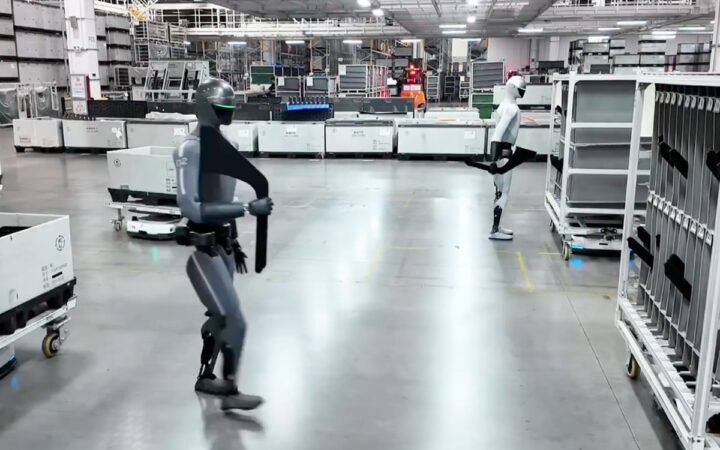
Tesla’s Q3 update lists Optimus operations in California as an early ramp and a Texas Optimus project as under construction. The company says production-quality robots have begun coming off its Fremont lines, while it continues to iterate on the hardware and manufacturing process.
Those disclosures provide the direct humanoid context for the latest factory decision. Our earlier Optimus production report examined the difference between starting builds and achieving sustained high volumes. A production ramp still needs reliable components, repeatable assembly and robots capable of useful work after they leave the line.
Shared AI Ambitions, Different Products
The quarterly presentation also describes training infrastructure intended to support both vehicle and humanoid autonomy software. Tesla targets 400 MW of training compute by year-end. That is a company plan for infrastructure, rather than a measure of either product’s real-world autonomy or deployment readiness.
The common challenge is turning data and computation into dependable action. A robotaxi must operate within its service conditions; a humanoid must perceive objects, manipulate them and recover from mistakes. Progress in one programme can inform the other, but it does not automatically prove that the other system is ready for customers.
The Financial Commitment Is Growing
In its quarterly filing, Tesla reports research and development spending of about $2.76 billion for Q3, compared with approximately $1.63 billion a year earlier. The filing attributes increased spending to several programmes, including AI, Optimus, silicon development, battery technologies and new vehicles. It does not isolate an Optimus-only figure.
The same filing identifies manufacturing ramp-up, component availability, regulatory requirements and the infrastructure needed for autonomy as potential constraints. Reassigning factory space is one practical step in a larger strategy; it does not resolve those engineering and operational requirements on its own.
What to Watch Next
The next useful milestones are a more detailed Texas production timetable, actual Cybercab output and evidence of the Optimus ramp’s scale and reliability. Musk’s mid-2027 timing remains a forward-looking plan, rather than a completed reduction in Cybertruck manufacturing.
Our coverage of Optimus Academy follows the parallel effort to generate experience for physical tasks. Together, the projects show the breadth of Tesla’s ambition: manufacturing autonomous vehicles and humanoids at scale, while developing the software that makes them useful. Their commercial progress needs to be measured separately.
Disclaimer: RobotsBeat is an independent media brand owned and operated by NuvexMedia LLC, publishing news, research, and insights on artificial intelligence, emerging technologies, automation, and related industries. NuvexMedia LLC invests in and collaborates with companies across the AI, Robotics, technology, software, and digital innovation sectors. These relationships do not influence RobotsBeat's editorial coverage, and the publication maintains full editorial independence to provide accurate, timely, and objective information. © 2026 NuvexMedia LLC. All rights reserved. This content is for informational purposes only and should not be considered legal, tax, investment, financial, or other professional advice.