Key Notes
- Daimon Robotics is connecting tactile sensors, data collection and simulation as infrastructure for developers building contact-aware robot applications.
- Its W2 sensors list 120 Hz sampling while the described feedback pipeline runs at 30 Hz, two specifications that refer to different parts of the system.
- The public Daimon-Infinity repository describes an initial 1,000-hour data release and a larger collection target, while industrial performance remains to be demonstrated publicly.
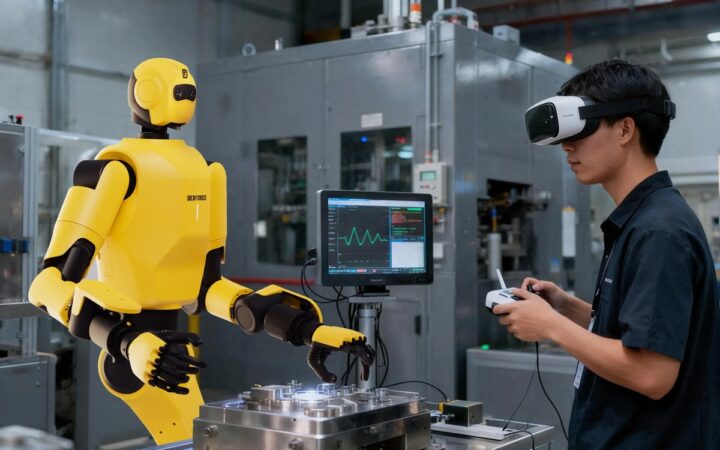
Daimon Robotics is building a tactile-intelligence infrastructure stack that connects robot touch sensors with data collection, simulation and model development. Its aim is to help other robotics companies learn from physical contact, improving manipulation where cameras alone cannot reveal whether an object is slipping, a part is binding or a grip is too strong.
In an October 19 interview with The Robot Report, the company described an infrastructure-provider strategy rather than a bid to build every downstream robot model itself. Its work targets the tools and physical-interaction data that developers need to make contact-rich tasks more reliable.
Touch Becomes Part of the Training Stack
Vision is useful for finding a component and estimating its position. Once a gripper touches it, however, the important information can change: resistance may indicate a poor fit, while sideways force can signal that an object is moving inside the grasp.
Daimon’s technology overview connects three activities: hardware, data services and deployment. The company also describes Daimon-TWM as a tactile-grounded world-model effort, placing contact information alongside visual perception in its physical AI strategy.
That makes sensing only one part of the product. A useful dataset must connect the measured contact with the robot’s action, the object and the resulting movement, so a learning system can examine what changed and why.
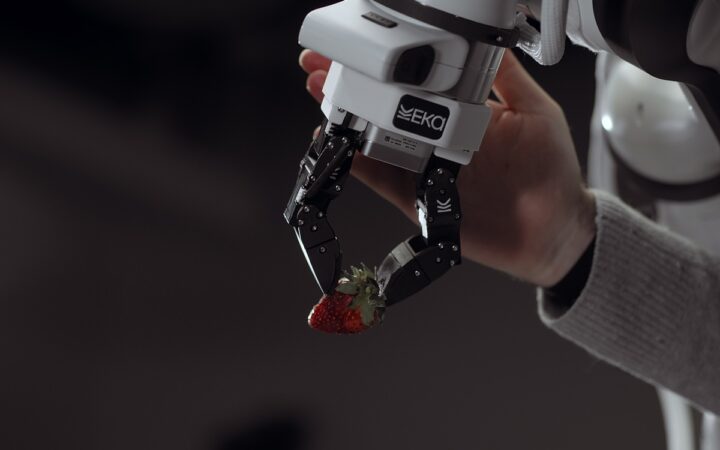
The approach addresses a problem also visible in Eka’s force-aware AI: recognizing an object and controlling the final contact are related but different capabilities.
Sensor Speed and Control Speed Are Different
Daimon’s W2 specifications list 110,592 effective sensing points, 120 Hz sampling, USB 2.0 connectivity and IP67 protection. The company says the sensors provide information including contact shape, deformation and force distribution.
These are manufacturer specifications, including durability claims of five million presses and 200,000 abrasion cycles. They describe the sensing hardware, rather than independently measured performance of a complete robot application.
The Robot Report separately describes a 30 Hz tactile-feedback and control pipeline. That figure should not be confused with the W2’s 120 Hz sensor sampling: a system can acquire measurements more frequently than the software produces a new control decision.
Daimon-Infinity Links Human Actions With Contact Data
The company’s public dataset repository says its first release comprises 1,000 hours of data, with an ambition to open-source more than 10,000 hours. Those are different stages of the project, so the larger target should not be presented as an already released dataset.
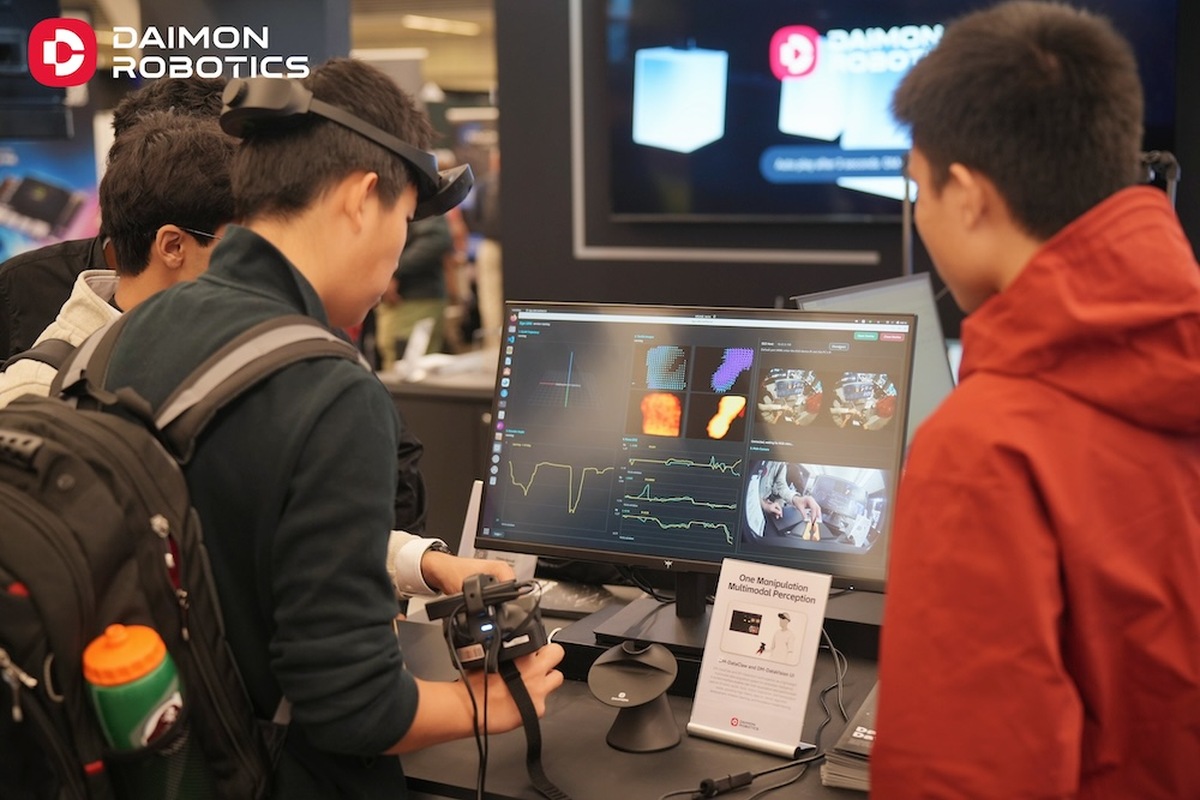
The documentation describes DM-DataClaw collection devices combining cameras, spatial tracking, tactile sensors and gripper-state measurements. A corresponding robotic gripper is intended to make it easier to test learned behavior on hardware with a similar configuration.
The repository also describes DM-DataDex, which records hand motion and contact through an instrumented wearable system. Together, the approaches show how physical interactions can be captured from different forms of human demonstration rather than only from a robot repeating a programmed motion.
Our coverage of robot training work examines the labor behind demonstration data. Adding touch makes the records richer, but also makes calibration and consistent alignment between the recorded signals more important.
Assembly and Packaging Put the Approach to Work
At IROS 2026, Daimon demonstrated tasks including bracelet threading, applying heat-transfer designs to bags and collecting broken glass, according to the interview. The company said it had also moved into assembly lines and warehouses, but did not identify customers or publish deployment results in that account.
Daimon is working to calibrate simulation against measured real-world interactions. Friction and material deformation are difficult to reproduce accurately, yet they can decide whether a controller trained virtually succeeds when it reaches a physical gripper.
That challenge connects with our reporting on simulation-based training. More data and better sensors can support development, while the practical measure remains whether a system handles changing objects reliably with less application-specific engineering.
Daimon’s proposition is to supply that connecting infrastructure. Its commercial value will depend on how effectively customers can turn recorded touch into useful robot behavior across their own hardware and production tasks.
Disclaimer: RobotsBeat is an independent media brand owned and operated by NuvexMedia LLC, publishing news, research, and insights on artificial intelligence, emerging technologies, automation, and related industries. NuvexMedia LLC invests in and collaborates with companies across the AI, Robotics, technology, software, and digital innovation sectors. These relationships do not influence RobotsBeat's editorial coverage, and the publication maintains full editorial independence to provide accurate, timely, and objective information. © 2026 NuvexMedia LLC. All rights reserved. This content is for informational purposes only and should not be considered legal, tax, investment, financial, or other professional advice.