Plan robot palletizing around packaging, gripping, reach and complete-cycle output, with worked throughput examples and practical load-validation checks.
Robot palletizing automates the placement of cases, crates, bags or other products onto a pallet in a defined arrangement. A useful installation must do more than repeat a stacking motion: it must accept real packaging, produce a stable load and keep working while pallets, materials and operators move through the area.
This guide builds on our robot arm guide and gripper guide. It explains how to define the application, check capacity and validate the complete end-of-line process before committing to production.
Key Takeaways
Define the finished pallet and its handling requirements before selecting equipment, because a fast stacking cycle does not establish that the load will remain acceptable during storage and transport.
Evaluate the complete carried load, usable workspace, packaging variation and pallet-exchange process, including the difficult locations and cases that a demonstration may omit.
Measure accepted output over representative operating periods with replenishment, protective measures and recovery included, then maintain controlled recipes for each approved product and pattern.
Start With the Finished Load
Specify the products, pallet type, layer arrangement, maximum overall height and mass, and any label-facing or separation requirements. Include the downstream wrapping, conveying, forklift handling and storage process.
A pattern that fills the available footprint is not automatically suitable for the package or distribution conditions. Overhang, uneven support, carton strength and load restraint require a packaging assessment appropriate to the product.
Describe acceptance in observable terms: correct quantity, permitted alignment, undamaged packaging and a load that meets the agreed handling requirements. The robot’s successful program completion is only one part of that evidence.
Collect representative products before trials. Include approved extremes of dimensions, mass, surface condition and fill level rather than supply only the strongest, cleanest carton.
Choose the Architecture Around the Product Mix
An articulated arm can handle several patterns and destinations, while a dedicated layer-forming palletizer may suit a different throughput and product mix. A collaborative arm is another option, with its suitability determined by the complete application.
Single-case picking offers flexibility but requires one or more movements per case. Multiple-case or layer handling changes the gripper, carried mass, presentation and cycle requirements.
Compare systems using the same operating requirement. Include footprint, pallet access, product changeovers, operator duties and the available upstream buffer.
Our cobot guide explains why the arm’s label does not determine the safeguarding or production performance of a completed workstation.
Control Product Presentation
A conveyor should present products in a condition the cell can recognize and handle. Define spacing, orientation, availability and the response to a missing, skewed or damaged item.
A fixed pickup location may simplify the application when the conveyor can reliably locate the case. Vision can help where position or product identity varies, but it adds sensing and validation requirements.
Check what upstream equipment reports. “Case available” should mean the intended product is in a usable pickup state, not merely that a sensor saw something earlier.
Use our vision guide when assessing cameras. Test actual print, tape, reflections, deformation and lighting changes where they affect recognition or placement.
Select the Gripper With Real Packaging
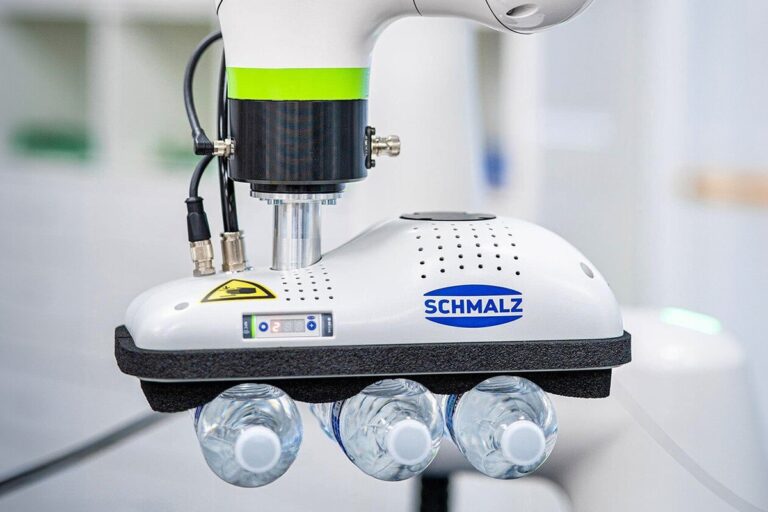
Vacuum tooling is common in case handling, but a cardboard surface is different from an airtight metal sheet. Porosity, tape, dust and carton deformation can affect the grip.
Schmalz’s packaging guidance identifies abrasive, porous and nonrigid boxes as application considerations. Treat the complete vacuum system and package interaction as a testable requirement rather than choosing from a nominal suction-force figure alone.
Mechanical or hybrid tooling may suit other products. Evaluate contact surfaces, clearance between neighboring packages and whether the tool can release an item without disturbing the layer.
Define how the application detects a failed pickup or lost product, and how the affected package is accounted for. Recovery should preserve a known pallet state rather than silently advance the item counter.
Include All Carried Mass and Geometry
The robot carries the gripper, adapters, accessories and product. If it picks several cases together, include every case in the load calculation.
Universal Robots’ payload documentation relates capacity to the load’s center-of-gravity offset and distinguishes the tool from the handled workpiece. Use the applicable model’s limits and supported configuration.
For an illustrative inventory, a 3 kg gripper carrying two 6 kg cases creates a 15 kg carried mass before additional adapters or accessories. That arithmetic does not establish that a particular arm can perform the task.
Ask the supplier to check the complete mass distribution, inertia, orientation and required movement. A long tool or widely spaced cases can create a different wrist loading condition from the same mass held close to the flange.
Validate Reach at Every Pallet Location
Check the lowest and highest layers, near and far corners, and the complete approach and departure paths. Reaching the center of a pallet is not enough.
Include the open gripper, package envelope, cables, surrounding equipment and already placed products. A feasible empty-tool path may be unusable while carrying the largest case.
Some applications use a vertical lift or another positioning axis. That introduces an additional moving subsystem, coordinate relationship and maintenance responsibility that must be included in the design.
Our planning guide explains why a reachable pose and a valid complete trajectory are separate questions. Verify both with the installed equipment and approved motion conditions.
Build and Control Pallet Recipes
A recipe should identify the product, package dimensions, pallet reference, layer patterns, placement sequence and any separator handling. Keep it connected to the correct gripper and robot configuration.
Universal Robots’ palletizing template illustrates software support for patterns, layers, pallet features and separators. Such features organize movement; they do not independently validate the finished load’s transport performance.
Locate the pallet repeatably or use an approved method to establish its position. Our calibration guide explains how programmed references relate to the physical installation.
Control recipe changes as production changes. A new package height can affect more than one placement point, including clearance, total stack height, stability and the number of products on a pallet.
Measure the Complete Cycle
Cycle element
What to include
Common omission
Acquire product
Presentation, gripping and confirmation
Waiting for usable spacing
Transfer and place
Loaded motion, settling and release
The farthest upper-layer location
Build the load
Pattern changes and separator handling
Actions between layers
Exchange pallets
Removal, replenishment and restart
Operator and downstream availability
Recover
Failed picks and uncertain pallet state
Manual intervention and rejected cases
Time the application with its intended protective measures active. A short demonstration may prove motion feasibility while omitting the routine interruptions that determine scheduled output.
Record the mix of pallet positions in the test. Reporting only a fast placement on an easy layer can conceal a slower average across the full pallet.
A Worked Throughput Example
Suppose a hypothetical single-case application averages eight seconds per accepted placement. A pallet holds 60 cases, so the nominal building time is 480 seconds.
If pallet exchange and the agreed restart require another 60 seconds, the full modeled interval is 540 seconds for 60 cases. That corresponds to about 6.67 cases per minute, or 400 per hour, before other losses.
Looking only at the eight-second placement would suggest 450 cases per hour. The 50-case difference shows why pallet exchange belongs in the capacity calculation.
These numbers are arithmetic examples, not equipment ratings. Add measured upstream waiting, separators, recovery and product changes where they occur, then compare accepted output with the actual line demand.
Plan Buffers and Pallet Exchange
If incoming products continue during an exchange, they need a suitable buffer or another permitted destination. Estimate accumulation using the arrival rate and the time the palletizing function is unavailable.
At a hypothetical arrival rate of five cases per minute, a 60-second interruption produces five incoming cases. That figure is a starting inventory calculation; extra allowance depends on variability and the agreed operating margin.
Two pallet positions can support alternate loading, but do not assume the exchange is fully overlapped. Access arrangements, removal equipment and operator availability may still restrict the usable sequence.
Define what happens when the finished pallet cannot leave or a replacement is missing. The cell needs a planned response that preserves product identity and avoids pushing an unresolved problem upstream.
Test the Finished Pallet Through Its Next Process
Inspect stacking consistency, packaging condition and product orientation across representative runs. Include the approved difficult package variants and ordinary variation in incoming presentation.
Then evaluate the load through the required downstream handling and packaging-validation process. A neat stationary stack does not establish performance under transport, storage or environmental conditions.
Keep robot placement capability separate from packaging capability. A robot may place every case at the programmed position while the chosen pattern, pallet or packaging still fails the distribution requirement.
Document acceptance evidence and the configurations it covers. A material, supplier or package-design change may require review even when the outside dimensions stay the same.
Design Access, Recovery and Maintenance Together
Assess the arm, gripper, carried products, moving pallets and surrounding machinery as one application. Pay attention to access for pallet replenishment, clearing damaged cases and servicing tooling.
Our safety guide explains application-level assessment and validation. A collaborative-capable arm does not remove hazards from dropped products, trapping points or associated equipment.
Recovery needs an authoritative record of the pallet’s physical state. After a power interruption or manual removal of a case, establish where the next placement belongs through the approved procedure.
Maintain gripping surfaces, sensors, locating fixtures and documented backups. Use the evidence in our maintenance guide to distinguish packaging variation from equipment deterioration.
Build a Business Case for the Whole Workstation
Include the robot, tooling, conveyors, pallet fixtures, any lift axis, interfaces, protective measures and integration. Account for trials, commissioning, training and the production disruption required for installation.
Evaluate realized labor capacity, accepted output and package damage against the current process. Replacing repetitive handling can be valuable even when a downstream machine limits total shipments, but state the benefit accurately.
Our ROI guide shows how to separate installed costs and recurring expenses from benefits that can actually be used.
A dependable palletizing cell produces the right load at the required rate while people can replenish, recover and maintain it through defined procedures. Start with that operating result and select the robot around it.
Frequently Asked Questions
What is robot palletizing?
It is the automated placement of products onto a pallet in a specified arrangement, including coordination with product supply and pallet handling.
Can any cobot palletize boxes?
No. The complete load, usable reach, package interaction, cycle requirement and application safeguards determine suitability.
Does the robot’s payload rating include the gripper?
The carried load includes tooling and handled products. Check the manufacturer’s complete limits for mass distribution, inertia and movement.
How many cases per minute can a palletizing robot handle?
There is no universal rate. Measure the complete application, including difficult placements, separators, pallet exchange, waiting and recovery.
Does a pallet pattern guarantee a stable load?
No. Packaging, support, restraint and the intended handling conditions also matter. Validate the finished load through the appropriate packaging process.
What should a first palletizing trial prove?
It should demonstrate acceptable packages and completed pallets, sustained output, repeatable exchange and approved recovery under representative operating conditions.