Robot Teleoperation: A Practical Guide to Remote Control and Supervision
Understand robot teleoperation, feedback delay and control handovers, then plan operator staffing, communication tests and reliable remote-task recovery.
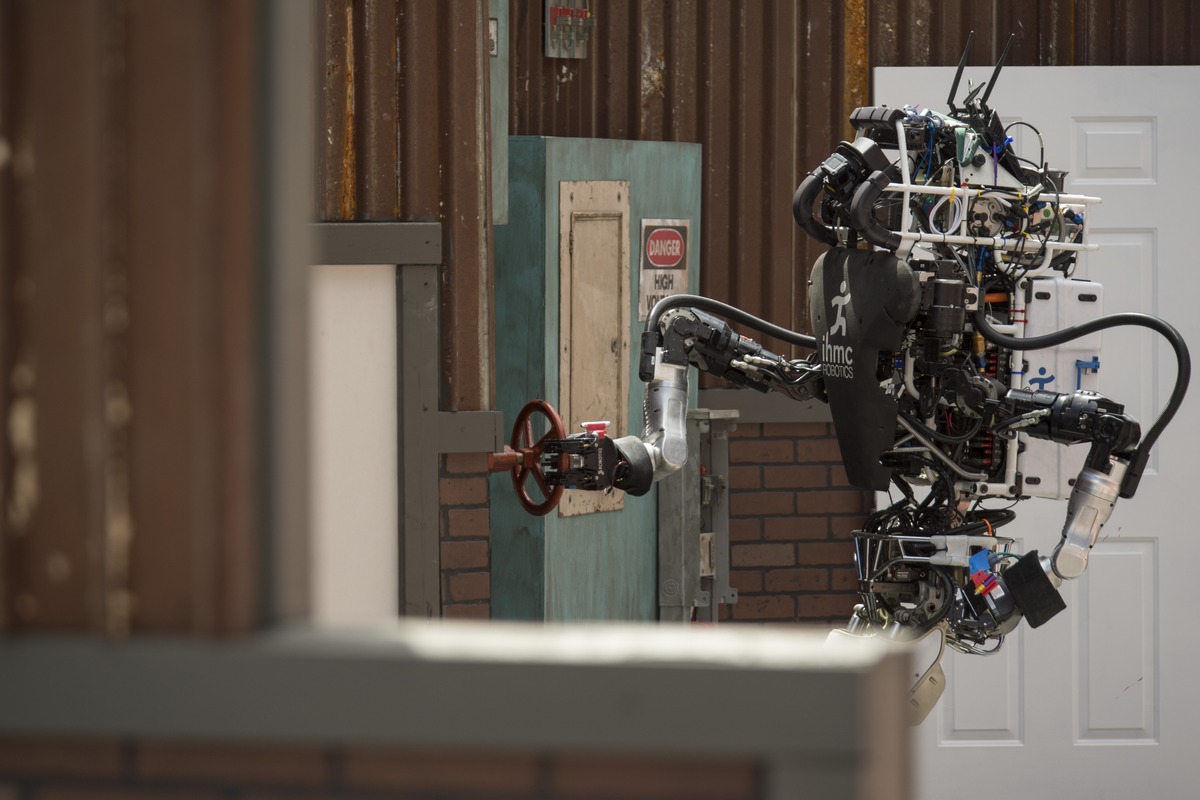
Effective robot teleoperation connects operator judgment with useful feedback, explicit control ownership and validated interruption recovery. Photo: John F. Williams / U.S. Navy
Robot teleoperation allows a person to direct a robot from another location, using feedback such as video, position or force information. It can support inspection, manipulation, training and recovery when direct access is impractical or when a task still needs human judgment.
The engineering challenge is the complete interaction between operator, interface, communication link and robot. This guide builds on our autonomous robot guide and explains how to define control authority, evaluate feedback and qualify useful remote work without confusing human assistance with autonomous performance.
Key Takeaways
Specify whether the operator continuously commands motion, selects bounded actions or provides occasional assistance, because these arrangements create different interface, staffing and response requirements.
Measure the age of feedback and the delay to physical response across the complete system, including variation and interruptions, rather than judging teleoperation by network ping alone.
Validate the operator-and-robot combination on representative tasks with explicit control handovers, communication-loss behavior and outcome records, while keeping protective functions independently assessed.
Direct Control, Supervision and Remote Assistance
Arrangement
Operator role
Question to validate
Direct teleoperation
Continuously commands supported movement
Can the operator perceive and control the complete task?
Supervisory control
Selects actions or goals executed by the robot
Are action boundaries, completion and interruption clear?
Remote assistance
Helps an otherwise automated process resolve a defined exception
Can assistance arrive within the accepted waiting conditions?
Telepresence
Uses remote sensing and interaction to observe or communicate
Does the interface provide the awareness needed for its purpose?
These categories can overlap in a single deployment. A robot might navigate automatically, request help at an ambiguous location and then accept a bounded instruction before resuming its normal operation.
Describe the actual arrangement rather than relying on an “autonomous” or “human-in-the-loop” label. A hidden operator can make a demonstration useful, but that demonstration does not establish unassisted capability.
Define the Remote Task First
Write the required outcome, permitted environment and operator responsibilities. Inspecting an instrument, retrieving an object and supervising transport require different views, controls and completion evidence.
Include the robot’s starting condition and the intended end state. A task that begins with ideal alignment omits the approach, orientation and recovery work that may dominate real operation.
Establish the consequences of an unavailable operator. Some applications can remain in an approved waiting condition; others require a different local response. Make that a system requirement rather than an assumption about staffing.
Our automation guide explains how input, output and exceptions define an application. Use the same discipline before adding a remote control station.
Understand the Complete Feedback Loop
The robot’s camera captures an earlier scene, which is processed, transmitted and displayed. The person interprets it, chooses an action and sends a command that must reach the robot and produce a physical response.
Delay therefore exists in both directions, with additional processing and human response time. The operator may be acting on information that is already out of date.
A NIST-authored teleoperation study discusses command and feedback latency in vehicle applications. Its context illustrates the need to assess the complete loop; numerical findings from road vehicles should not be treated as universal limits for robot arms or other tasks.
Measure the system used in the intended deployment. A short network round trip does not include every camera, encoder, display, input and actuator delay.
A Simple Delay Example
Suppose an illustrative moving robot travels at 0.4 meters per second. If the displayed video is 0.2 seconds old and the next command takes another 0.1 seconds to begin affecting motion, the robot travels 0.12 meters during those two intervals at unchanged speed.
That is 0.4 multiplied by 0.3. The calculation excludes human reaction time, braking, acceleration changes and other processing, so it is not a stopping-distance or safe-separation calculation.
Its purpose is to show why feedback age matters physically. The same delay can have different consequences at another speed or during a fine manipulation task.
Also measure variation. A predictable delay and a stream that alternates between fresh frames and long freezes create different operator demands, even when their average delay is similar.
Provide Views That Support the Work
A forward-facing camera may show a travel direction while hiding the robot’s sides, rear, tool or carried load. A manipulation task may need an overview plus a view that reveals contact and depth.
Choose views from the decisions the operator must make. More video is useful only if it improves awareness without obscuring important information or overloading the person.
Indicate stale or interrupted feedback clearly. A frozen image that still looks live can be more misleading than an explicit unavailable-camera message.
Our sensor guide explains why a measurement needs context. The operator should understand what each view or reported quantity represents and what it cannot establish.
Make Control Frames and Limits Understandable
An input device can command motion relative to a camera, tool, robot base or another reference. The mapping must be clear, particularly when cameras rotate or the robot changes orientation.
A motion that feels intuitive in one view can become confusing after switching to another. Train and test the actual combinations of views, command modes and reference frames.
Use supported motion scaling, constrained actions or other assistance where appropriate to the equipment and task. These functions need validation; a convenient interface setting does not itself establish a protective limit.
Our motion guide covers feasible movement and constraints. A human-issued command still needs to operate within the completed system’s accepted capabilities.
Establish One Accountable Control Owner
Decide who may command each resource and how control transfers between local staff, automation and remote operators. The interface should make the active owner and operating mode visible.
Boston Dynamics’ lease documentation provides one product-specific example: leases represent command ownership of robot resources and support controlled delegation or transfer. Other platforms may implement different mechanisms.
Ownership is distinct from authentication. A person can be authorized to use the system without being the current motion-command owner.
Validate both directions of a handover. Establish the robot and task state before control changes, confirm that the intended new owner can act, and prevent stale commands from an earlier session from being mistaken for current intent.
Plan Communication Loss and Reconnection
The application needs defined behavior when video, commands or status updates become unavailable. These channels can fail independently; a working picture does not prove the command path is healthy.
Follow the robot supplier’s supported connection monitoring and stop behavior. Boston Dynamics’ service documentation illustrates a software communication-monitoring mechanism whose availability and configuration depend on the product version. It is not a universal description of every robot’s protective architecture.
Reconnection should establish a known state before motion resumes. Restoring a network link does not establish that the robot, tool or workpiece is where the operator last saw it.
Define responses to a command whose outcome is uncertain. Use supported status and task-state evidence rather than assume that retransmission cannot repeat a physical action.
Keep Remote Operation Within the Assessed Application
Moving a person away from the robot can reduce some exposure, but it does not remove hazards to people near the robot or to the surrounding process.
Assess the tool, load, environment and local access together. The design must account for intervention by on-site staff, not only the remote operator’s view.
Our safety guide explains application assessment and validation. Do not treat ordinary video, an operator’s attention or a general software button as proof of a safety-rated protective function.
Keep emergency response responsibilities clear. Specify how local personnel identify the active remote session, communicate an issue and invoke the installation’s approved procedures.
Measure the Operator-and-Robot Combination
Test useful outcomes: task completion, quality, elapsed time, unintended contacts where relevant, interventions and recovery. Record the interface, operator training and communication conditions behind each result.
NIST’s response-robot program develops methods covering capabilities including sensing, communications and human-robot interfaces, and supports operator proficiency assessment. The broader lesson for a deployment is to evaluate the person and equipment together on relevant tasks.
Compare operators only with a defined test procedure. A developer who knows every interface detail and a newly trained production operator are not equivalent test conditions.
Repeat trials with representative variations. A single successful operation does not establish dependable performance across clutter, lighting changes, different objects or a sustained working period.
Test Communication Conditions Against Physical Performance
Collect measures of delay, variation, interruptions and image availability alongside task results. A network metric becomes useful when its relationship to operating capability is understood.
NIST’s radio test report describes evaluating robot task performance under attenuated radio conditions. It provides an example of connecting communications testing with what the robot and operator can accomplish.
Use qualified personnel and approved test arrangements for the actual installation. Do not introduce uncontrolled radio interference or hazardous faults into an operating facility.
Include the locations where the system will work, not just the operator’s desk or a laboratory access point. Infrastructure, obstructions and competing traffic can change the communication conditions.
Plan Staffing for Peaks, Not Only Averages
One operator may supervise several robots when the robots usually work independently and assistance requests fit the staffing design. That is different from continuously controlling several robots at once.
For a hypothetical workload, 12 robots each requesting one four-minute intervention every two hours create 24 minutes of intervention work per hour on average. That is 40% of one operator-hour before handovers, documentation, breaks or other duties.
The average does not show simultaneous requests. Two urgent requests arriving together can exceed one operator’s immediate capacity even when total hourly workload looks modest.
Our fleet management guide covers shared resources and queues. Apply that reasoning to human assistance, including the accepted robot waiting state and escalation route.
Separate Demonstration Data From Autonomous Capability
Teleoperation can produce useful demonstrations for robot learning, but record what the human did and which robot assistance was active. A dataset without that context can hide how success was achieved.
Keep autonomous trials separate from training demonstrations and operator-assisted recovery. Report interventions and selection of favorable attempts alongside completion results.
Our learning guide explains the distinction between demonstrations and independent evaluation. Human expertise can teach a robot without proving that the resulting policy handles the whole deployment task.
Retain appropriate permissions and data controls for recorded video, actions and workspace information. Collect what the project needs and define who may access or reuse it.
Qualify a Supportable Remote Service
At handover, document permitted tasks, control modes, operator qualifications, supported communication conditions and the expected response to interruptions. Include an on-site recovery route where the application requires one.
Maintain software versions, interface configurations and session records that support diagnosis. Review affected tests after changing cameras, controls, network arrangements or robot behavior.
Use our maintenance guide to organize fault evidence and controlled changes. A remote operator should receive understandable state information rather than be expected to improvise around undocumented failures.
Effective teleoperation connects human judgment with reliable feedback and bounded physical action. Judge it by useful completed work, clear control ownership and recovery that remains dependable when conditions become difficult.
Frequently Asked Questions
What is robot teleoperation?
It is remote direction of a robot by a person using feedback and supported commands. The person may continuously control movement or supervise bounded actions.
Is remote assistance the same as direct teleoperation?
No. Assistance may resolve a defined exception without continuous motion control. Specify the operator’s actual authority and responsibilities.
What latency is acceptable?
There is no universal limit. Evaluate complete feedback and command delay, variation and interruptions against the robot, speed, task and approved operating conditions.
Does a fast network ping prove good teleoperation performance?
No. Camera capture, processing, display, human response and robot execution also affect the complete loop.
Can one operator supervise many robots?
It may be feasible when assistance frequency, duration, simultaneous demand and waiting conditions support it. An average workload alone does not establish adequate staffing.
Does a remotely completed task prove autonomy?
No. Report human commands, supervision and interventions separately from independently completed autonomous work.
What should a teleoperation pilot demonstrate?
It should show representative task quality, operator proficiency, clear handovers and approved interruption recovery under the communication conditions expected in deployment.
Elon Musk says Optimus could surpass every product category as Tesla ramps up humanoid manufacturing and shares AI technology across robots and vehicles.