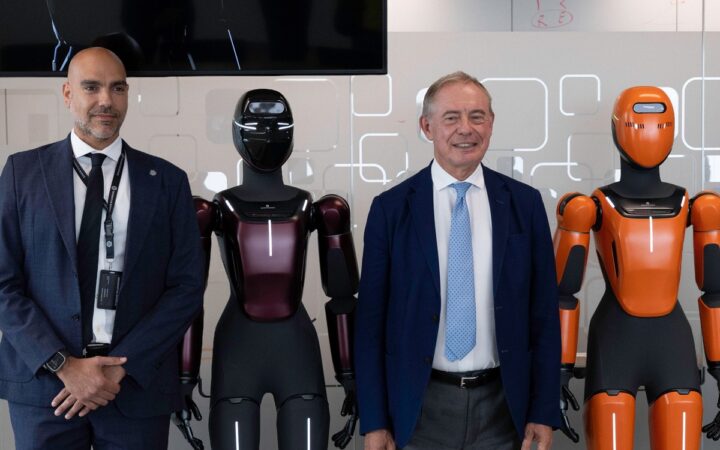

Wandercraft, the Paris-based robotics company that began with AI-powered rehabilitation exoskeletons, is in talks to raise approximately €100 million in a new funding round at a pre-money valuation of roughly €750 million, according to people familiar with the matter cited by Bloomberg. Goldman Sachs is advising on the round. If completed, it would be Wandercraft’s largest raise to date, coming just over a year after its $75 million Series D in June 2025.
Renault, which made a minority investment in Wandercraft in June 2025, is both a financial backer and the company’s first commercial customer for the Calvin-40 humanoid robot. The automaker plans to deploy approximately 10 Calvin robots by the end of 2026 and scale to 350 units across its French and Spanish factories by end of 2027, targeting a 30% reduction in vehicle assembly time.
The Calvin-40 Platform
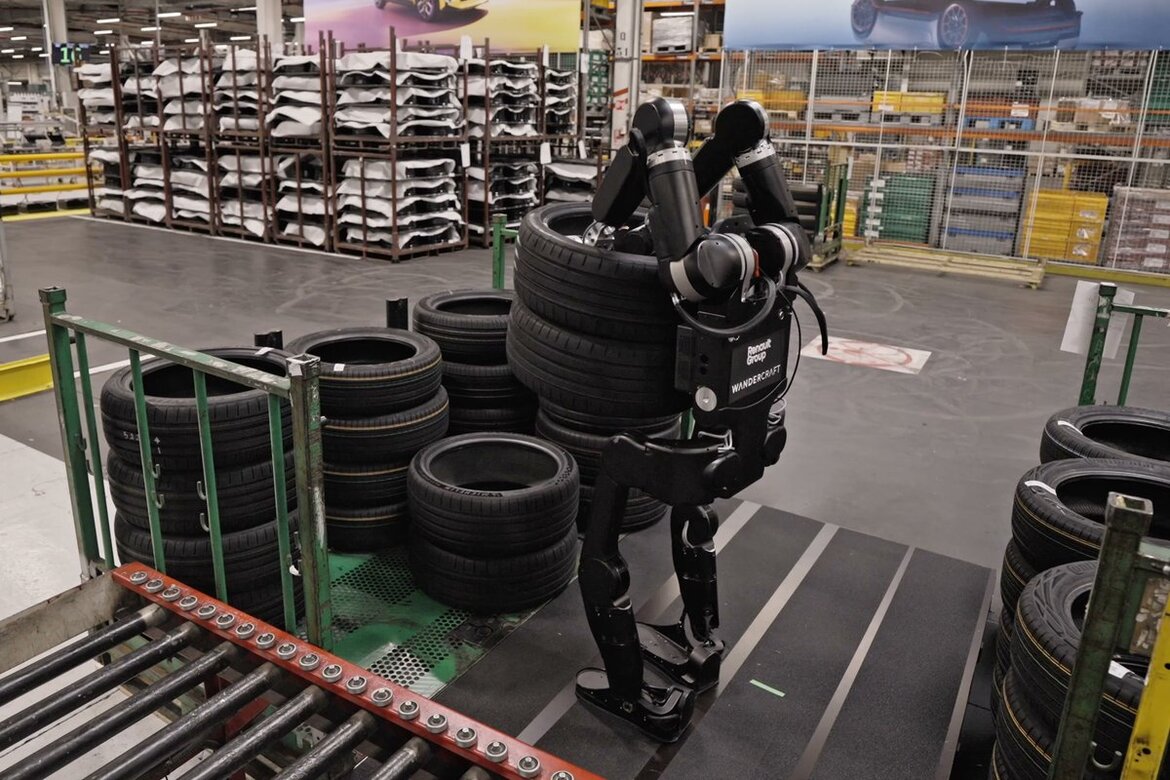
The Calvin-40 is Wandercraft’s first industrial humanoid, distinct from its Atalante X rehabilitation exoskeleton that is deployed in more than 100 hospitals and rehab centers worldwide. The robot is powered by NVIDIA’s Isaac GR00T N1 foundation model and runs on the Jetson computing platform. It can lift up to 40 kilograms repeatedly without rest and is already operating at Renault’s Douai plant in France, where it loads tires onto the production line.
The robot took 40 days to build in its first iteration – a figure the company uses to illustrate rapid development pace rather than production cost. The Calvin name extends to a family of platforms, with the 40 designation reflecting the 40-kilogram payload capacity that defines the current industrial model.
The Renault Relationship as Competitive Differentiator
What separates Wandercraft from most humanoid robotics startups is the nature of the Renault relationship. Renault is simultaneously a financial investor, a product co-development partner, and a committed first commercial customer with specific deployment targets and a production line already receiving robots. That combination – captive customer with a factory already waiting, technical feedback loop from real deployment, and aligned financial interest – is structurally different from cold market sales.
Few robotics startups get a committed customer at this stage. Most are selling into markets where procurement cycles are long, evaluation periods are extended, and the risk of deployment failure falls entirely on the startup. Wandercraft has those risks shared with a partner that has an operational stake in the technology’s success.
The Funding Context
Humanoid robotics startups globally raised $8.6 billion in the first half of 2026 alone – 1.8 times all of 2025, according to Dealroom data. Wandercraft’s €100 million target is modest by the sector’s recent standards: Figure AI raised over $1 billion at a $39 billion valuation, Apptronik’s Series A exceeded $935 million, and Neura Robotics raised up to $1.4 billion in a Tether-led round. The €750 million pre-money valuation reflects Wandercraft’s European positioning, its exoskeleton revenue base, and the early but concrete Renault deployment – a more grounded valuation than companies with larger war chests but fewer live industrial deployments.
The round’s closure and the Renault 350-unit target by end of 2027 will be the two milestones that determine whether Wandercraft’s decade of exoskeleton engineering translates into a defensible position in the industrial humanoid market.
Disclaimer: RobotsBeat is an independent media brand owned and operated by NuvexMedia LLC, publishing news, research, and insights on artificial intelligence, emerging technologies, automation, and related industries. NuvexMedia LLC invests in and collaborates with companies across the AI, Robotics, technology, software, and digital innovation sectors. These relationships do not influence RobotsBeat's editorial coverage, and the publication maintains full editorial independence to provide accurate, timely, and objective information. © 2026 NuvexMedia LLC. All rights reserved. This content is for informational purposes only and should not be considered legal, tax, investment, financial, or other professional advice.