Key Notes
- Tesla demonstrated a redesigned Roadster at SpaceX’s Texas facility and targets production in 2028, while its announced 0–60 mph time of 0.81 seconds remains a company demonstration claim.
- MotorTrend reports that Optimus-derived actuators operate the rear wing and thruster valves, but the humanoid’s appearance in the driver’s seat does not establish that it controlled the car.
- Performance, Thrust and Rocket offer different capabilities, with the invitation-only flying Rocket configuration explicitly not approved for public-road use.
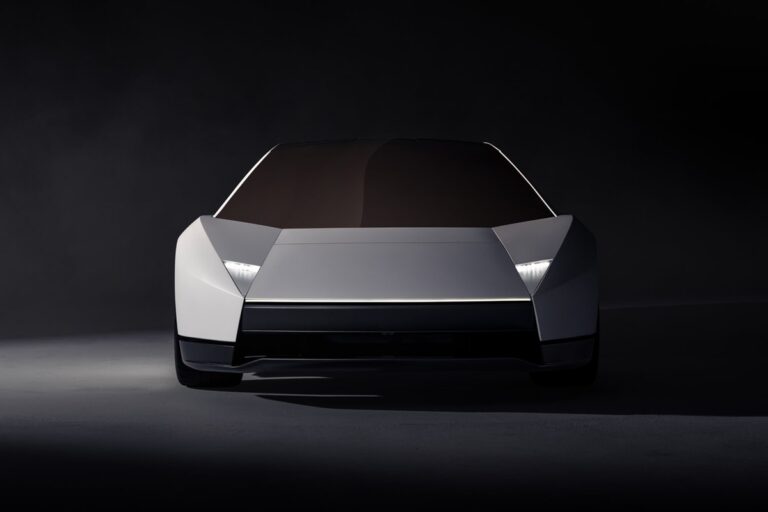
Tesla unveiled a redesigned Roadster that can launch into the air using SpaceX-derived cold-gas thrusters, with production targeted for 2028. The October 15 demonstration at SpaceX’s McGregor, Texas, test facility also put Tesla’s robotics work in an unexpected setting: hardware from Optimus is reportedly part of the sports car’s control systems.
The reveal combined an inverted ramp, aerial maneuvers and an acceleration demonstration. Tesla’s launch video captures the presentation, including Elon Musk’s warning that the demonstration was not guaranteed to succeed and his explanation that the car was operating autonomously for safety.
Where Optimus Fits Into the Roadster
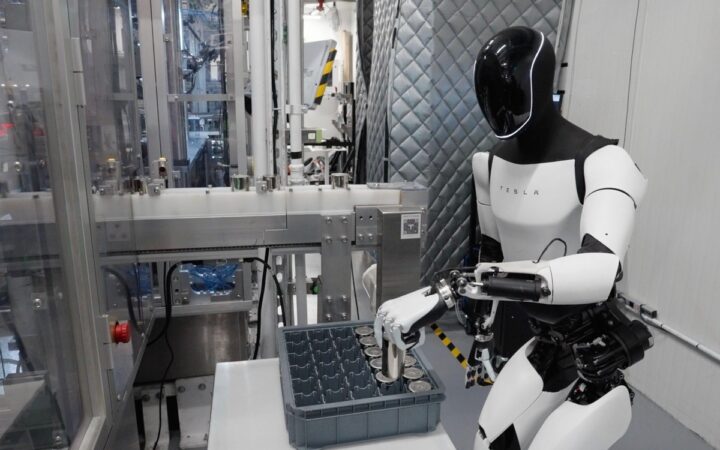
MotorTrend’s early access report says actuators borrowed from Optimus’s ankle mechanism operate the Roadster’s movable rear wing. It also identifies Optimus-derived actuators in the valves controlling the Thrust version’s compressed-gas system.
That is a concrete example of component reuse between a humanoid and a vehicle: electrically controlled mechanisms developed for robot movement can also move aerodynamic surfaces or regulate a burst of thrust. It does not mean the Roadster uses the humanoid’s complete control software, or that Optimus is responsible for driving it.
A widely shared Instagram reel from uncover.robotics highlights Optimus in the driver’s seat during the demonstration. The appearance should be distinguished from evidence of autonomous robot driving: the launch presentation did not establish that the humanoid steered, accelerated or stabilized the vehicle.
Tesla’s transfer of hardware between programs adds context to its broader humanoid ambitions. RobotsBeat previously covered the company’s Optimus sales timeline, which remains a separate manufacturing and commercialization effort.
Three Configurations, Different Capabilities
Tesla’s Roadster page separates the vehicle into Performance, Thrust and Rocket configurations. Performance is described as a two-seat, road-ready car with active aerodynamics and a suction system that increases downforce.
Thrust adds rear cold-gas thrusters and a claimed 0–60 mph time below one second. Rocket is an invitation-only, single-seat configuration with thrusters around the vehicle for forward, upward and rotational movement. Tesla explicitly states that Rocket is not approved for public-road use and is unavailable in some regions.
Those distinctions matter when interpreting the launch footage. The aerial demonstration is not a promise that every Roadster will fly, nor confirmation that owners can perform those maneuvers on ordinary roads.
How the Suction and Thruster Systems Work
Tesla describes a fan-and-ground-sealing system that extracts air beneath the car, producing downforce even when stationary. Active wings and powered fans work together to increase traction, while Track Mode changes ride height and suspension settings.
During the presentation, engineers described the flying configuration as having two pressure vessels with a combined volume of 600 liters and 10 nozzles. Musk said the high-pressure system can replenish its air supply without requiring specialized rocket propellant.
The engineering challenges extend beyond producing a spectacular burst of force. A customer vehicle needs coordinated steering, braking, aerodynamic control and thrust management, as well as clear operating limits. The demonstration showed those systems working in a controlled setting; it did not resolve their durability, service requirements or suitability for everyday use.
The Acceleration Claim and the 2028 Target
Tesla announced a 0–60 mph time of 0.81 seconds after rejecting an initial timing-system reading on stage. That figure is a company demonstration claim, rather than an independently verified result for a production car. Musk said the eventual customer vehicle should improve on it.
MotorTrend describes the current Roadster as a prototype intended for production, with specifications still subject to change. Tesla’s 2028 production target follows the second-generation concept’s 2017 introduction and an earlier 2020 production ambition, making execution an important part of the story.
Our sister publication MarketSpeaker examines the Tesla–SpaceX implications, including the distinction between engineering cooperation and unconfirmed merger discussion. For robotics, the clearest immediate development is narrower: Optimus hardware is finding another application, while the Roadster itself still has to make the transition from demonstration vehicle to customer product.
Disclaimer: RobotsBeat is an independent media brand owned and operated by NuvexMedia LLC, publishing news, research, and insights on artificial intelligence, emerging technologies, automation, and related industries. NuvexMedia LLC invests in and collaborates with companies across the AI, Robotics, technology, software, and digital innovation sectors. These relationships do not influence RobotsBeat's editorial coverage, and the publication maintains full editorial independence to provide accurate, timely, and objective information. © 2026 NuvexMedia LLC. All rights reserved. This content is for informational purposes only and should not be considered legal, tax, investment, financial, or other professional advice.