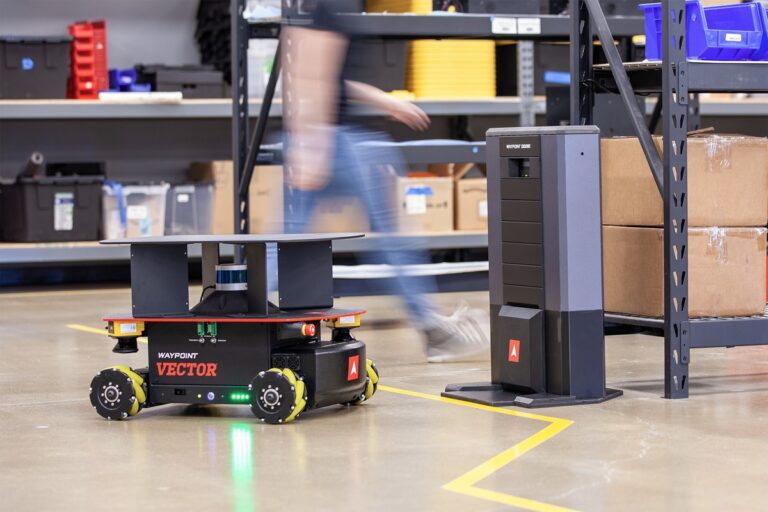
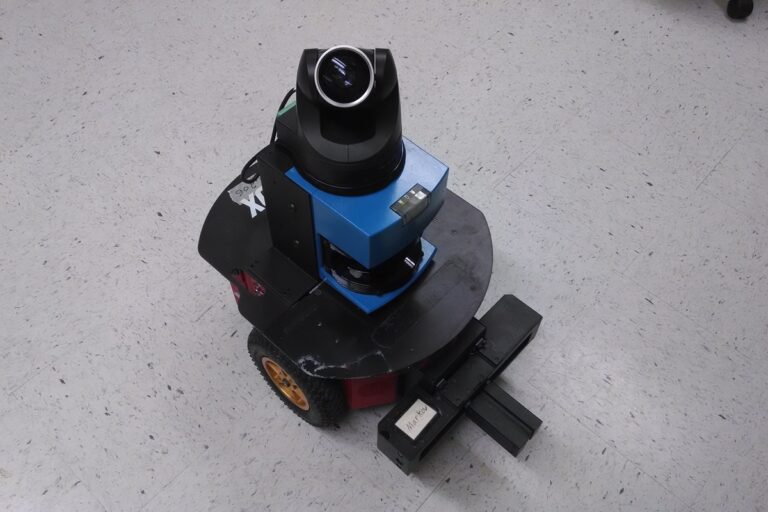
Dependable mobile robot availability requires enough usable energy, accessible charging and a fleet policy validated against real demand. Photo: PattyK33 / Wikimedia Commons
Plan mobile robot batteries and charging using mission energy, usable capacity, dock access and fleet queues, with worked examples and full-shift validation.
Mobile robot batteries and charging determine whether an autonomous fleet can keep moving through a working shift. A robot may navigate perfectly and still miss its service target because it spends too long reaching a charger, waits behind another vehicle or starts a task without enough usable energy.
Battery planning therefore belongs in the deployment design alongside routes, payloads and demand. This guide builds on our AMR guide, explaining how to estimate runtime, select a charging strategy and validate dependable fleet availability.
Key Takeaways
Estimate usable energy and consumption for the complete robot and representative mission, accounting for operating reserves, accessories, temperature and battery aging.
Plan charging as a shared fleet resource, including travel, docking, queueing and recovery, rather than relying on a charger’s rated power or a robot’s headline runtime.
Validate the approved battery-and-charger system under realistic demand, monitor capacity and charging performance, and define service procedures before deteriorating batteries interrupt production.
Start With the Complete Energy System
A mobile robot’s energy system includes its battery pack, management electronics, power distribution, charging equipment and software policies. The installed top module may add conveyors, lifting mechanisms, computers or sensors that draw from the same supply.
For a commercial example, OMRON’s LD datasheet distinguishes the battery, docking station and auxiliary power connections. Its published runtimes also depend on loading conditions; they are product specifications rather than a promise for every customer route.
Confirm the approved combination of robot, pack, charger and software configuration. Similar voltage labels do not establish electrical, communication or safety compatibility.
Write down who supplies and maintains each component. A fleet project can otherwise leave an important gap between the robot vendor, integration contractor and facility team when a charging problem appears.
Understand the Battery Numbers
Quantity
What it describes
What it does not prove
Voltage
Electrical potential, often stated as a nominal value
Compatibility across batteries and chargers
Ampere-hours
Charge capacity under specified conditions
Energy without considering voltage
Watt-hours
Energy capacity under stated conditions
The energy available for every production mission
State of charge
An estimate of the current charge level
How much capacity remains compared with a new pack
State of health
A characterization of aging or performance
One universal measurement method or retirement threshold
For a rough nominal-energy comparison, voltage multiplied by ampere-hours gives watt-hours. A hypothetical 24-volt, 30-ampere-hour pack corresponds to about 720 watt-hours at those nominal values. Actual recoverable energy depends on the pack and operating conditions.
Cadex’s battery primer explains how voltage and capacity relate to cell configurations. Procurement should still use the robot supplier’s approved pack specification rather than infer an interchangeable replacement from this arithmetic.
Also distinguish energy from power. Watt-hours describe stored energy; watts describe a rate of energy use or transfer. A large battery can still have limits on the instantaneous power it can deliver.
Build a Mission Energy Profile
Measure complete missions rather than only steady travel. Include acceleration, loaded movement, waiting, docking, transfers and the return leg. Empty travel can represent a substantial share of the route.
Record the payload and top-module activity alongside energy use. A lift that runs briefly may add a different demand pattern from a continuously powered onboard computer.
Our actuator guide explains why torque, speed and duty cycle belong together. For a mobile installation, floor condition, wheel condition, slopes and repeated starts also affect the complete duty.
Keep idle states separate. Waiting with active sensors, communications and a powered payload is not necessarily equivalent to a low-power parked state. Use consistent measurement boundaries when comparing alternatives.
A Worked Runtime Estimate
Consider a hypothetical robot with 700 watt-hours of nominal battery energy. Suppose the planning model allows 75% of that figure for an operating window after its chosen reserves and assumptions. That leaves 525 watt-hours for the modeled work.
If measured average demand over representative missions is 175 watts, the simple estimate is 525 divided by 175, or three hours. Neither the battery figure nor the 75% window is a recommended specification for a real robot.
The calculation is useful because its assumptions are visible. If a different payload raises average demand to 210 watts, the same modeled energy supports only 2.5 hours. Repeating a brochure runtime would conceal that relationship.
Check the estimate against physical tests. Averages can hide short high-load events, restrictions at low charge and operating changes caused by temperature. The accepted runtime should describe the tested task and environment.
Choose a Charging Strategy
Dedicated charging removes a robot from work for a planned interval. It can fit predictable breaks or a spare-vehicle strategy, but the fleet must still cover demand while vehicles are unavailable.
Opportunity charging uses suitable gaps in work to replenish energy. It depends on the approved charging behavior, available gaps and accessible docks; short idle periods do not automatically provide useful charging time.
Battery swapping may support some systems, but only where the manufacturer provides an approved pack, procedure and operating arrangement. Include handling time, trained staffing, spare inventory and charging of removed packs in the comparison.
A hybrid policy can be practical: routine charging during low demand with a defined response to a long busy period. Select the policy from the workload and equipment limits rather than assume one method suits every fleet.
Charging Power Is Not Recovered Energy
A charger’s rating does not by itself tell you how much energy reaches the battery during an available stop. Conversion losses, onboard consumption, temperature limits and the changing charging profile can all affect the result.
For a deliberately simplified example, replenishing 300 watt-hours at a constant net storage rate of 170 watts would take about 1.76 hours. That assumes the net rate remains constant; it is not a prediction for any named product.
Real charging can slow as the pack approaches its upper charge limit. Measure the interval the operation actually intends to use, including the time required to establish charging and release the robot back to work.
Compare recovered watt-hours per visit with the energy consumed between visits. A robot can appear to charge frequently while gradually falling behind if every brief stop replaces less energy than the preceding work used.
Design the Dock Location and Access
The dock needs a dependable approach, sufficient clearance and an appropriate installation environment. A location that looks convenient on a floor plan may become inaccessible behind pallets or conflict with a busy transfer point.
Account for travel to and from charging, including congestion and any restricted routes. The shortest geometric route is not always the most dependable route during production.
Our SLAM guide explains why localization depends on the operating environment. Charging acceptance should include repeatable arrival and docking under the expected layout and visibility conditions.
Reserve and monitor the charging area as an operating resource. Include access for approved inspection and maintenance, and have the facility team verify the required electrical supply and installation conditions.
Model Fleet Queues and Peak Demand
There is no universal charger-to-robot ratio. The answer depends on energy demand, charging performance, arrival patterns, spare capacity and how much interruption the operation can tolerate.
A useful fleet model represents robots working, traveling to charge, waiting, docking, charging and returning. Include the resources those states occupy, such as an approach lane or a shared loading area.
Test whether several robots will request charging together after similar missions or a synchronized start. A policy that works for one vehicle may create a queue when copied across the fleet.
Our digital twin guide explains how to validate a model against measured behavior. Start with a transparent spreadsheet if that answers the planning question; additional simulation detail is useful only when supported by data.
Set Mission Reserves and Recovery Rules
A mission-acceptance rule should consider the expected task energy, uncertainty and the energy needed to reach a permitted recovery or charging location. A single fixed percentage can be inadequate for routes with very different demands.
Use the supplier’s supported reserve and dispatch controls. Do not interpret a battery management system’s final protective limit as the normal point to finish production.
Define the operational response to a blocked dock, interrupted charging or an unavailable charger. Recovery may involve another approved dock, pausing assignments or trained intervention rather than accepting another mission.
Review these states through the complete application assessment. Our safety guide covers responsibilities and validation; dispatch software does not replace protective functions or approved battery handling.
Track Health Alongside Charge
A displayed full charge does not mean an aging battery stores as much energy as a new one. Cadex’s capacity discussion describes how aging reduces available capacity. Replacement decisions must still reflect the actual pack, manufacturer guidance and application needs.
Track runtime under comparable duties, charging duration, temperature-related interruptions and battery faults. Separate battery deterioration from changes in route length, payload or traffic that also reduce useful service time.
A shorter runtime is evidence to investigate, not proof of one particular fault. Use approved diagnostics and qualified service rather than opening a pack or improvising a charging method.
Our maintenance guide connects repeatable records with fault isolation. Establish replacement stock and service lead times before declining energy capacity becomes an operational emergency.
Validate Availability Through a Full Shift
Define acceptance in service terms: completed missions, delivery delay, charging occupancy, successful docking and required interventions. Run a representative demand profile long enough to reveal whether the fleet’s energy balance is sustainable.
Include approved tests of peak demand, a charger being unavailable and recovery after an interruption. Never create electrical faults or deliberately abuse a battery to simulate a failure.
Record starting conditions and end-of-test charge levels. A fleet that completes one shift by consuming most of its initial stored energy has not necessarily demonstrated repeatable continuous operation.
Reliable charging is a measured operating capability. Match energy capacity, workload and charging access, then maintain those assumptions as the fleet, facility and batteries change.
Frequently Asked Questions
How long can an autonomous mobile robot run on one charge? It depends on the approved battery, usable energy, payload, accessories, route and operating conditions. Use the supplier’s specification as a starting point and verify the actual duty.
What is opportunity charging? It means replenishing energy during suitable gaps in work using the robot’s approved charging system. Useful energy recovered matters more than the number of charging visits.
How many chargers does a fleet need? Model energy demand, charging duration, queues, travel and backup arrangements. There is no reliable ratio that applies to every installation.
Does 100% charge mean the battery is healthy? No. State of charge describes the current charge estimate, while aging can reduce the capacity available even when the display indicates full.
Can any battery with matching voltage replace the original? No. The pack must meet the robot manufacturer’s requirements for electrical behavior, management electronics, interfaces, mounting and approved use.
What should a charging pilot demonstrate? It should prove repeated service under representative demand, including dependable docking, sufficient energy recovery and an approved response to charging interruptions.